
Rhipsalis teres f. prismatica (Lem.) Barthlott & N. P. Taylor
Images | Description | Publications | Reduced Synonyms
W. Barthlott, Lotus-Salvinia.de

Botanical illustrations and historical images
Description
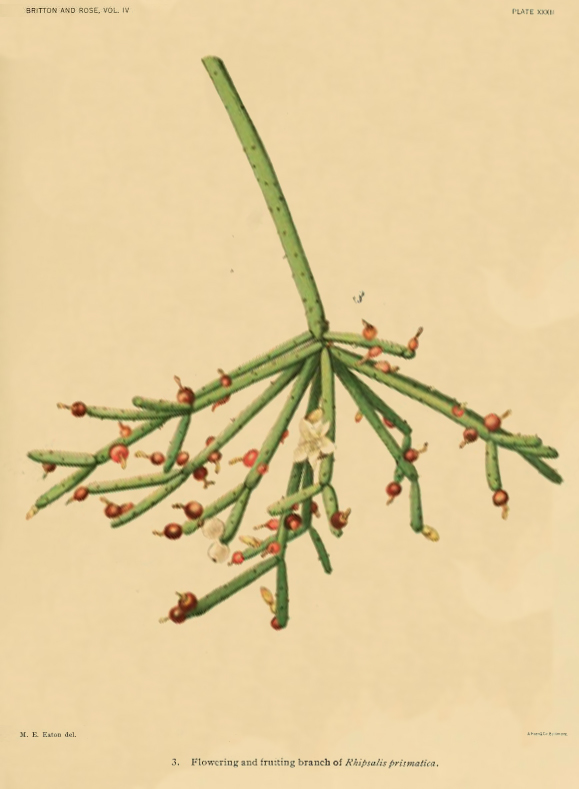
| The accepted name Rhipsalis teres f. prismatica (Lem.) Barthlott & N. P. Taylor was published in Bradleya 13: 65. 1995. The geographic range is Brazil (Minas Gerais, Rio de Janeiro, Sao Paulo, Parana, Santa Catarina, Espírito Santo) found at elevations of 1000 meters with an endangered status of least concern. Rhipsalis teres f. prismatica is classified in the subgenus Rhipsalis. Observed growing as an epiphyte or lithophyte. Overall habit is pendant, branches are dimorphic (more than one stem shape) and acrotonic or subacrotonic (stems form from the tips and just below tips of previous stems). Stems are round and 4 angled and slightly clavate, bristles are absent to sparse. Basal stems are indeterminate (seasonal growth is various lengths), 5cm-100cm x 0.3cm-0.6cm. Main stems are determinate (seasonal growth is about the same length), 0.7cm-18cm x 0.15cm-0.5cm. Flowers are rotate: sub-patent, patent or reflexed (wheel shaped: partial to wide open to reflexed), unreported x unreported. Petals 5, sepal count is unreported. Inner petals are white, cream or light-yellow, outer petals are yellow, pink, brown or red. Stamen are white, from 23 to 29. Stigma lobes from 3 to 5. Flower ovary is subglobose or globose, unreported x unreported. Flowering position on the stem is lateral to apical and the flower orientation in relation to the stem is perpendicular. Does not repeat flowering per areole. A maximum of 1 flowers were reported at a single areole. Areole position in the stems is superficial (flower ovary is visible on the surface of the stems during bud development). Trichomes or wool is absent at the areoles after flowering. Unripe fruit is green, cream, pink, brown or red. Ripe fruit is globose or subglobose; white, pink or magenta, 0.11cm-0.2cm x 0.11cm-0.21cm. Other notable features: Closely related to1 and commonly confused with subspecies of R. baccifera, all R. teres forms can be distinguished by having a flower ovary that is typically of equal length or shorter than the petal parts of the flower during most of the bud of development, flowers are a bright yellow as they die, and do not remain attached to the flower ovary. R. teres f. prismatica typically has 4-angled bristly stems. Some specimen maintain a short bushy semi-upright appearance as they age, others grow long round basal stems that continue to branch losing the 4-angled appearance except near the base. 1Phylogeny and evolution of the epiphytic Rhipsalideae (Cactaceae), Nadja Korotkova, Ph.D. Thesis, 2012 Comments: Forms are often recognized at the extreme morphological characterization found in nature, however this species presents a high level of plasticity and varying intermediate morphologies are reported between the various forms. Taxonomic treatment and description were derived from:
|
Rhipsalis teres f. prismatica referenced publications
| Title | Authors | Type | Journal | Year | Volume | Issue | Pages | Publisher |
|---|---|---|---|---|---|---|---|---|
| Epifytische cactussen, rhipsalis.eu. Accessed on: 15 Jan. 2025 | Aat van Uijen | Website | 2025 | |||||
| IPCN Chromosome Reports. Missouri Botanical Garden. Accessed on: 18 Jan. 2025 | Website | 2025 | ||||||
| The Caryophyllales Network 2015+ [continuously updated]: A global synthesis of species diversity in the angiosperm order Caryophyllales. Accessed on: 15 Jan. 2025 | Website | 2025 | ||||||
| WFO The World Flora Online. Accessed on: 15 Jan. 2025 | Website | 2025 | ||||||
| Cactaceae at Caryophyllales.org – a dynamic online species-level taxonomic backbone for the family | Nadja Korotkova, David Aquino, Salvador Arias, Urs Eggli, Alan Franck, Carlos Gómez-Hinostrosa, Pablo C. Guerrero, Héctor M. Hernández, Andreas Kohlbecker, Matias Köhler, Katja Luther, Lucas C. Majure, Andreas Müller, Detlev Metzing, Reto Nyffeler, Daniel Sánchez, Boris Schlumpberger, Walter G. Berendsohn | Journal Article | Willdenowia | 2021 | 51 | 2 | 251 – 270 | Botanic Garden and Botanical Museum Berlin (BGBM) |
| Rhipsalis, cactussen uit het tropische woud 2 | Aat van Uijen | Journal Article | Succulenta | 2018 | 97 | 1 | 39-44 | |
| Rhipsalis (Cactaceae): loss and gain of floral rewards is mirrored in range sizes and distribution patterns of species | Bernadette Grosse-Veldmann, Stefan Abrahamczyk, Jens Mutke, Wilhelm Barthlott, Maximilian Weigend | Journal Article | Botanical Journal of the Linnean Society | 2016 | 180 | 491-503 | ||
| A macro- and micromorphological survey of floral and extrafloral nectaries in the epiphytic cactus Rhipsalis teres (Cactoideae: Rhipsalideae) | Odair José Garcia de Almeidaa, Adelita A. Sartori Paoli, J. Hugo Cota-Sánchez | Journal Article | Flora | 2012 | 207 | 119-125 | ||
| Phylogeny and evolution of the epiphytic Rhipsalideae (Cactaceae) | Nadja Korotkova | Ph.D. Thesis | 2012 | Rheinische Friedrich-Wilhelms-Universität Bonn | ||||
| What does it take to resolve relationship and to identify species with molecular markers? An example from the epiphytic Rhipsalideae (Cactaceae) | Nadja Korotkova, Borsch T, Dietmar Quandt, Nigel P. Taylor, Müller K, Wilhelm Barthlott | Journal Article | American Journal of Botany | 2011 | 98 | 1549-1572 | ||
| The New Cactus Lexicon: Atlas of illustrations | David Hunt, Nigel P. Taylor, Graham Charles | Book | 2006 | 104-120 | DH Books | |||
| Die Namen der Gattungen und Arten epiphytischer Kakteen. Teil 1. Rhipsalideae | Ralf Bauer | Journal Article | EPIG | 1996 | 8 | 2 | 47-51 | |
| Notes towards a Monograph of Rhipsalideae (Cactaceae) | Wilhelm Barthlott, Nigel P. Taylor | Journal Article | Bradleya | 1995 | 13 | 43-79 | British Cactus and Succulent Society | |
| Bericht über zwei Vorträge von Myron Kimnach und Prof. Dr. Wilhelm Barthlott über ihre Ansichten zur Gattungsgliederung innerhalb der epiphytischen Kakteen | Ralf Bauer | Journal Article | EPIG | 1991 | 3 | 4 | 64-71 | |
| The genus Rhipsalis Gärtner (Cactaceae) in the State of São Paulo-I: species with cylindrical or subcilindrical joints | Julio Antonio Lombardi | Journal Article | Acta Botanica Brasilica | 1991 | 5 | 2 | 53-76 | |
| Cactussen die het hogerop zoeken | Erik Wevers | Journal Article | Succulenta | 1984 | 63 | 8 | 194 | |
| Chromosome numbers in the tribe Rhipsalinae (Cactaceae) | T. W. J. Gadella, E. Kliphuis, J. Naber | Journal Article | Botaniska notiser | 1979 | 3 | 294 | ||
| Cactus Lexicon | Curt Backeberg, Walther Haage | Book | 1966 | 205,220-222,440-449, 647, 750 | Blandford Press Ltd. (1966-1973) | |||
| Über Rhipsalis | Erich Schäfer | Journal Article | Kakteen und andere Sukkulenten | 1962 | 13 | 5 | 65-69 | |
| Genera et Species Plantarum Argentinarum | A. Castellanos, H. V. Lelong | Book | 1943 | 1 | 51 | |||
| The Cactaceae : descriptions and illustrations of plants of the cactus family | Nathaniel Lord Britton, Mary E. Eaton, N. J. Rose, Helen Adelaide Wood | Book | 1923 | 4 | 208-247 | Carnegie Institution of Washington | ||
| Archivos do Jardim Botânico do Rio de Janeiro | Jardim Botânico do Rio de Janeiro | Book | 1915 | 1 | 61-105 | Rio de Janeiro, Jardim Botanico | ||
| Are the species discovered in Africa indigenous? | R. Roland-Gosselin | Journal Article | Torreya | 1913 | 13 | 7 | 151-156 | |
| Hortus Mortolensis : enumeratio plantarum in Horto Mortolensi cultarum = Alphabetical catalogue of plants growing in the garden of the late Sir Thomas Hanbury ... at La Mortola, Ventimiglia, Italy | Giardino Botanico Hanbury, Alwin Berger | Book | 1912 | 272-273 | London, West, Newman, 1912 | |||
| Handbuch der Kakteenkultur : kurze Beschreibung der meisten gegenwärtig im Handel befindlichen Kakteen, nebst Angabe zu deren Pflege für Gärtner und Kakteenliebhaber zusammengestellt | Ernst Schelle | Book | 1907 | 226-233 | Stuttgart, E. Ulmer, 1907 | |||
| Gesamtbeschreibung der Kakteen (Monographia cactacearum) | Karl Schumann, Karl Hirscht | Book | 1899 | 618-650 | Neudamm [Dębno, Poland?], J. Neumann, 1899 | |||
| Bulletin de l'Herbier Boissier | Herbier Boissier. | Book | 1893 | 7 | 2 | 136-137 | Genève, Impr. Romet, 1893-1908 | |
| Dictionnaire d'horticulture illustré | D. Bois | Book | 1893 | 1045-1048 | P. Klincksieck | |||
| Monatsschrift für Kakteenkunde | Karl Schumann | Book | 1893 | 3 | 8-12,22-27,33-35,69,91 | Neudamm, J. Neumann | ||
| Revue horticole | Book | 1892 | Anne 1892 | 424-429 | Paris, Librairie agricole de la maison rustique, 1829-1974 | |||
| Carl Friedrich Forster's Handbuch der Cacteenkunde in ihrem ganzen Umfange :nach dem gegenwartigen Stande der Wissenschaft bearbeitet und durch die seit 1846 begrundetet Gattungen und neu eingefuhrten Arten vermehrt | Carl Friedrich Förster, Theodor Rümpler | Book | 1886 | 2 | 878-893 | Leipzig, Wöller, 1886 | ||
| Flora Brasiliensis, enumeratio plantarum in Brasilia hactenus detectarum :quas suis aliorumque botanicorum studiis descriptas et methodo naturali digestas partim icone illustratas | Karl Friedrich Philipp von Martius, August Wilhelm Eichler, Ignaz Urban, Stephan Endlicher, Eduard Fenzl, Benj. Mary, R. Oldenburg | Book | 1869 | 4 | 2 | 266-300 | Monachii et Lipsiae [Munich & Leipzig], R. Oldenbourg, 1840-1906 | |
| Les Cactées: Histoire, Patrie, Organes de Végétation Inflorescence, Culture, Etc | Charles Antoine Lemaire | Book | 1868 | 78-81 | Librairie agricole de la maison rustique |
Reduced Synonyms
| Name | Reduced by | Published Date | Published In |
|---|---|---|---|
| Hariota prismatica Lem. | Barthlott & Taylor (1995) | 1963 | Ill. Hort. 10: misc. 84-85. 1963 |
| Rhipsalis prismatica (Lem.) Rümpler | Barthlott & Taylor (1995) | 1885 | Handb. Cacteenk., ed. 2: 884. 1885 |
| Rhipsalis tetragona F.A.C.Weber | Britton & Rose (1923) | 1892 | Rev. Hort. (Paris) 64: 425. 1892 |
| Rhipsalis maricaensis Scheinvar | Barthlott & Taylor (1995) | 1992 | Arch. Jard. Bot. Rio de Janeiro 31: 72. 1992 |