
Rhipsalis pacheco-leonis subsp. pacheco-leonis Loefgr.
Images | Description | Publications | Reduced Synonyms
Bonn 4497, Dr. Kirberg
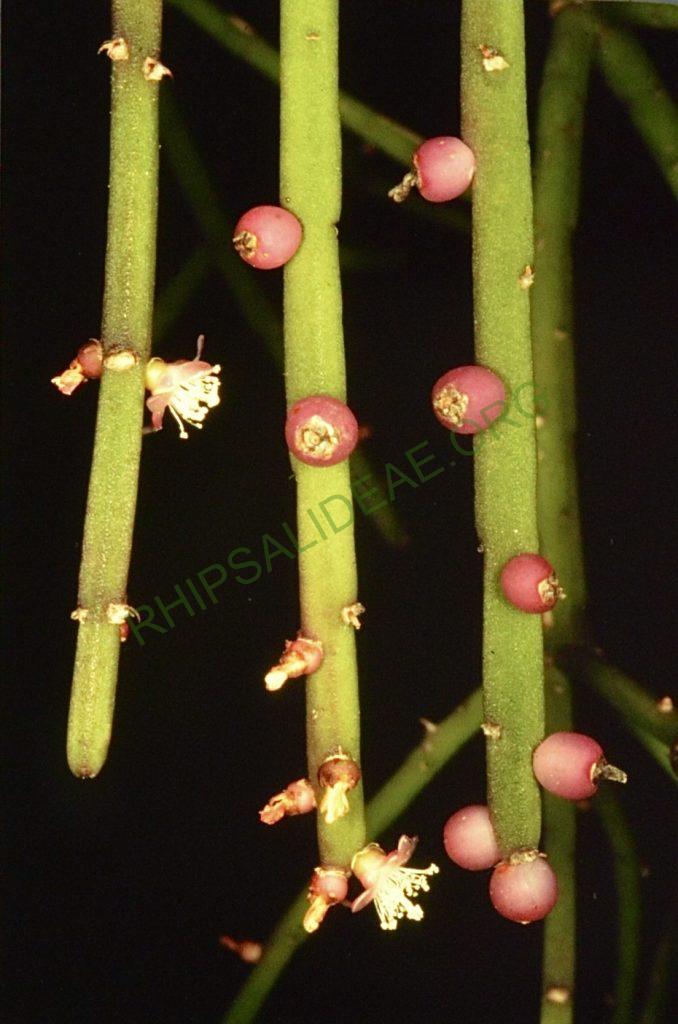
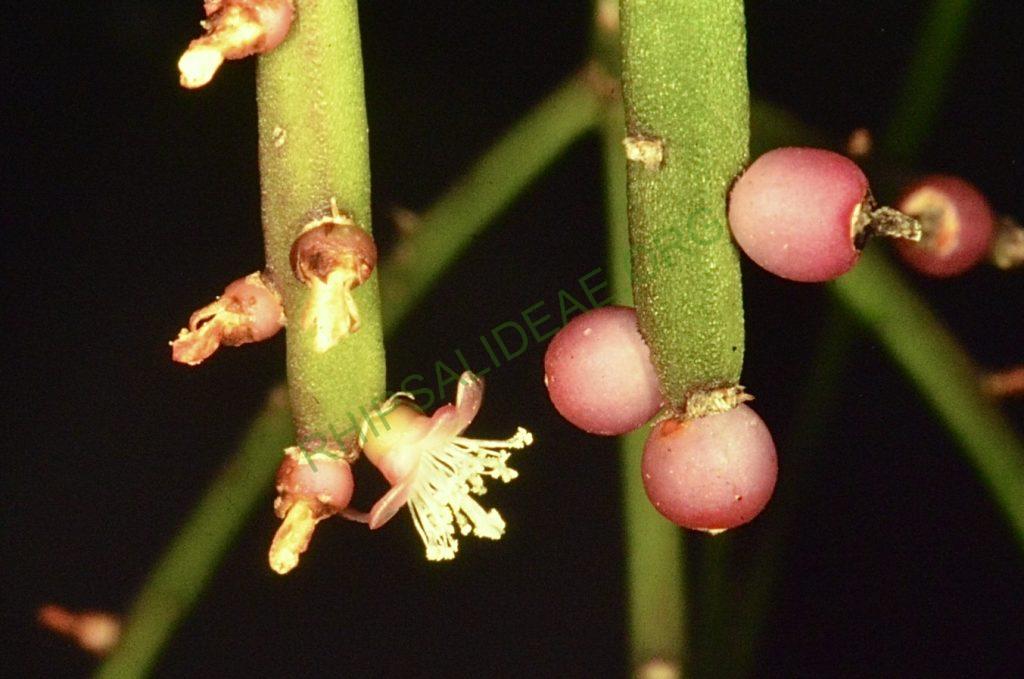
Utrecht University Botanic Gardens
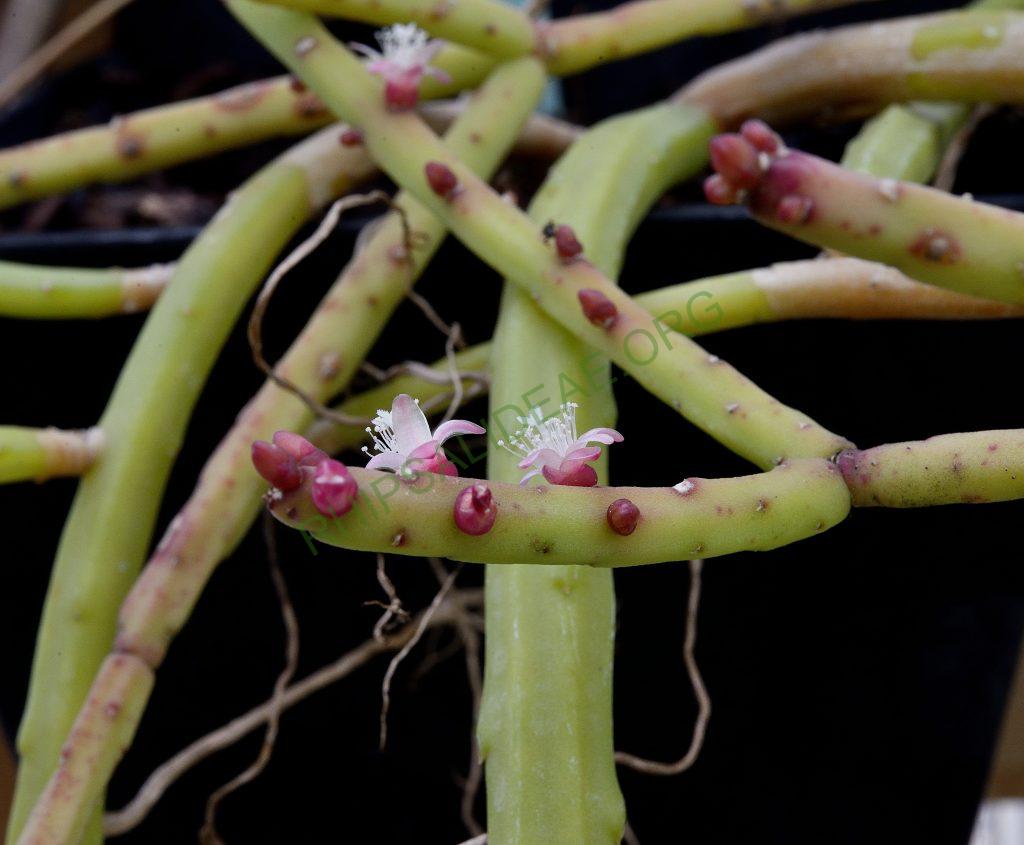
Unknown clone
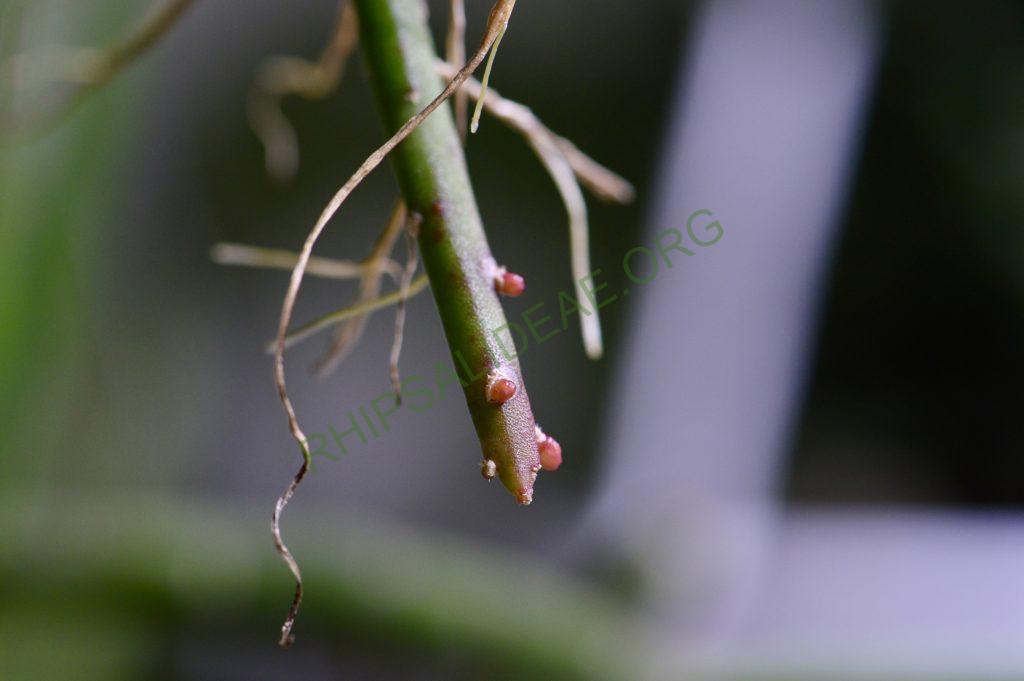
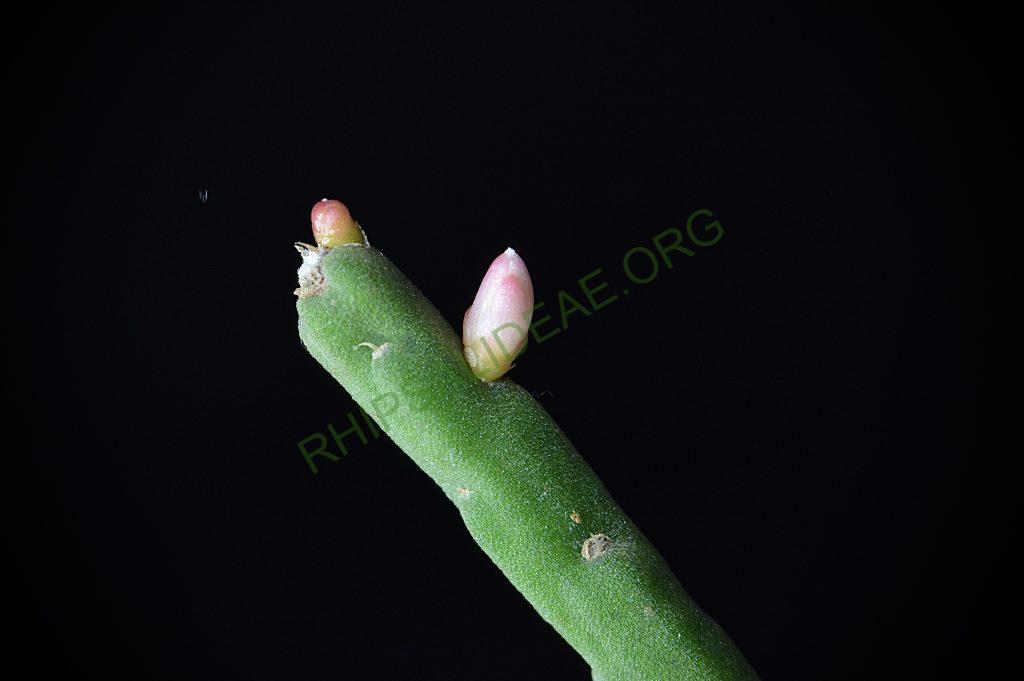
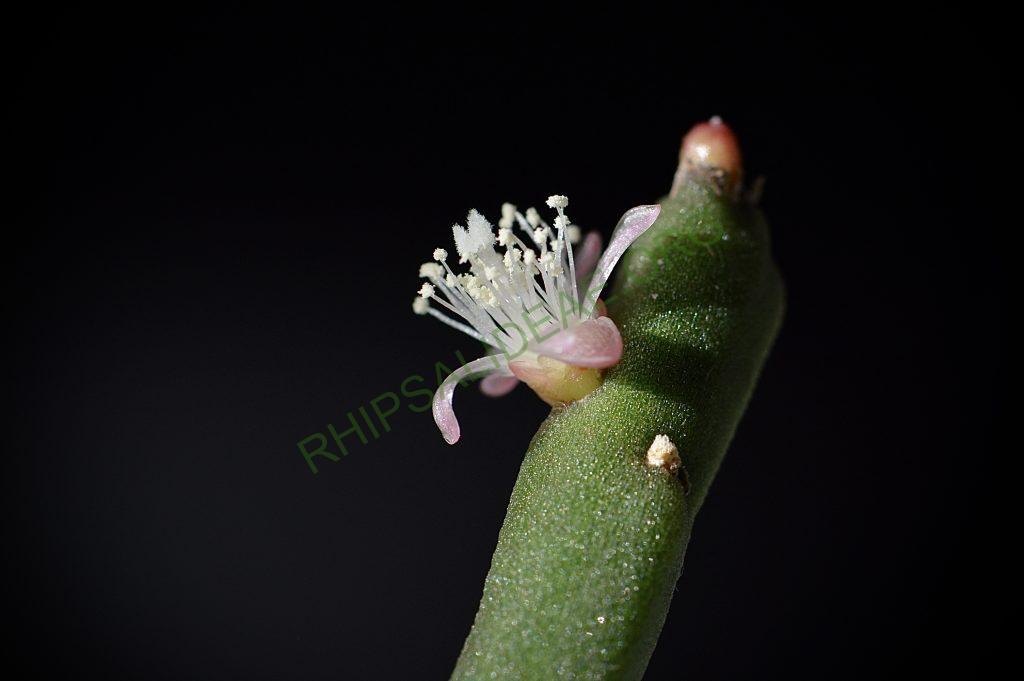
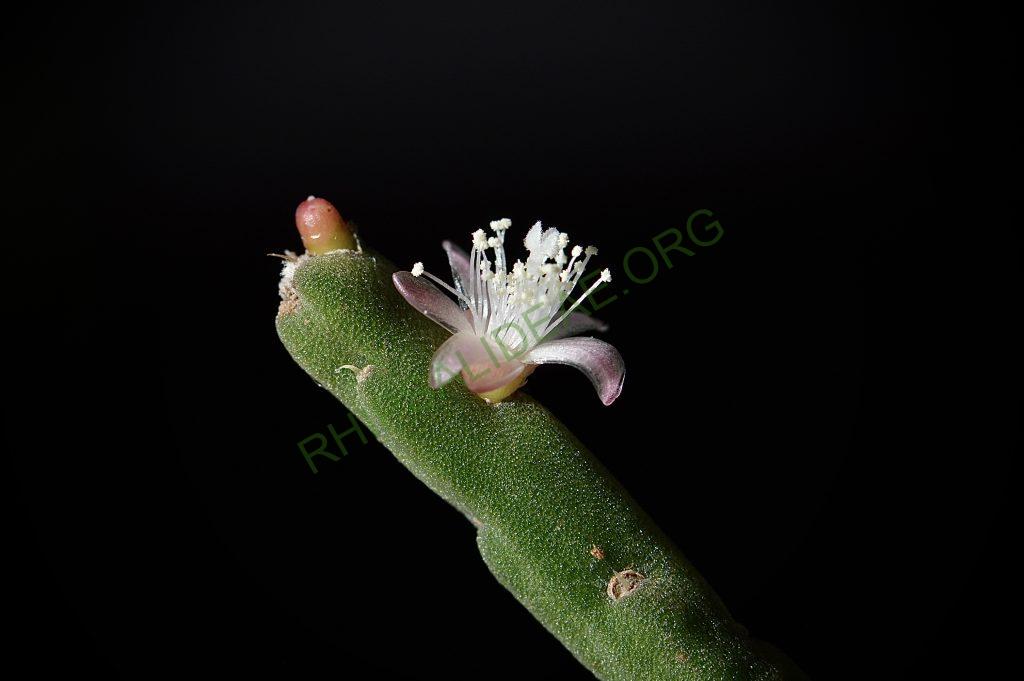
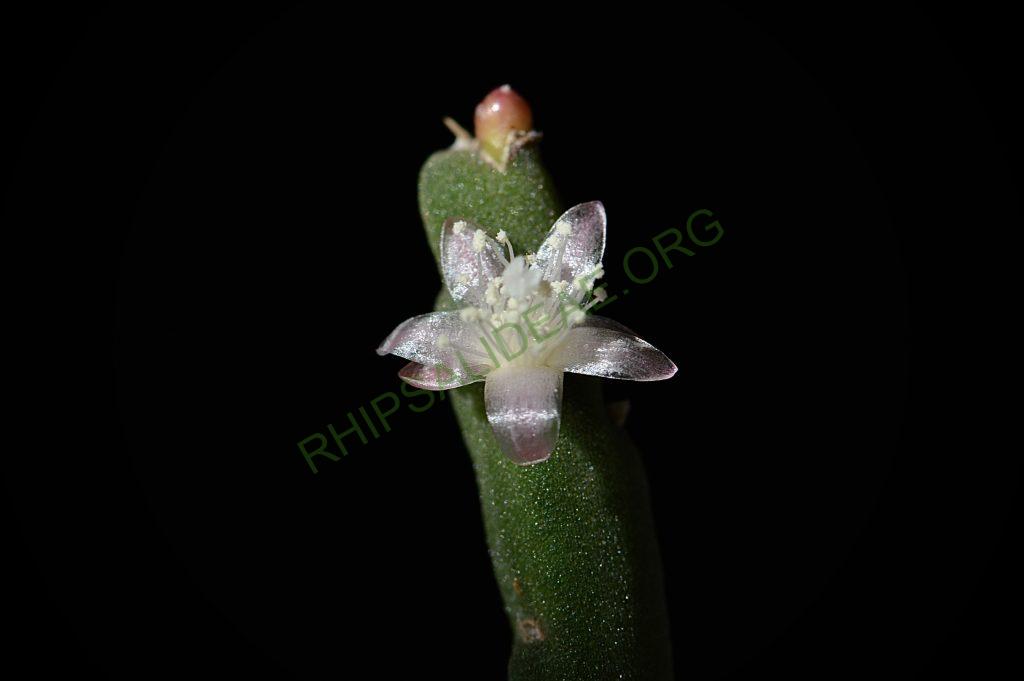
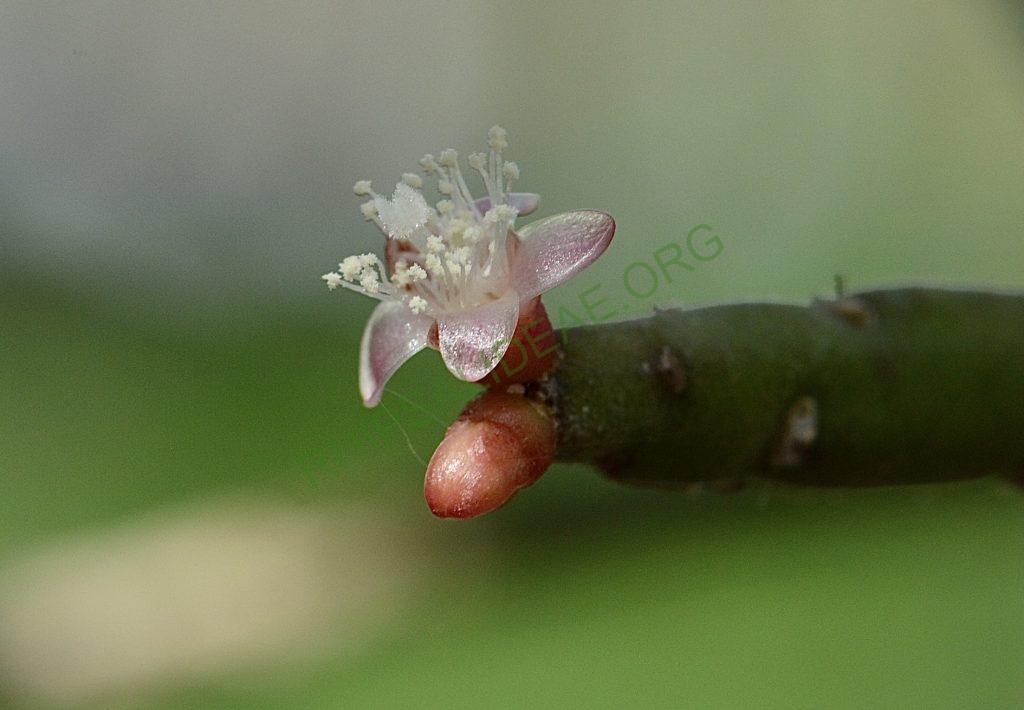
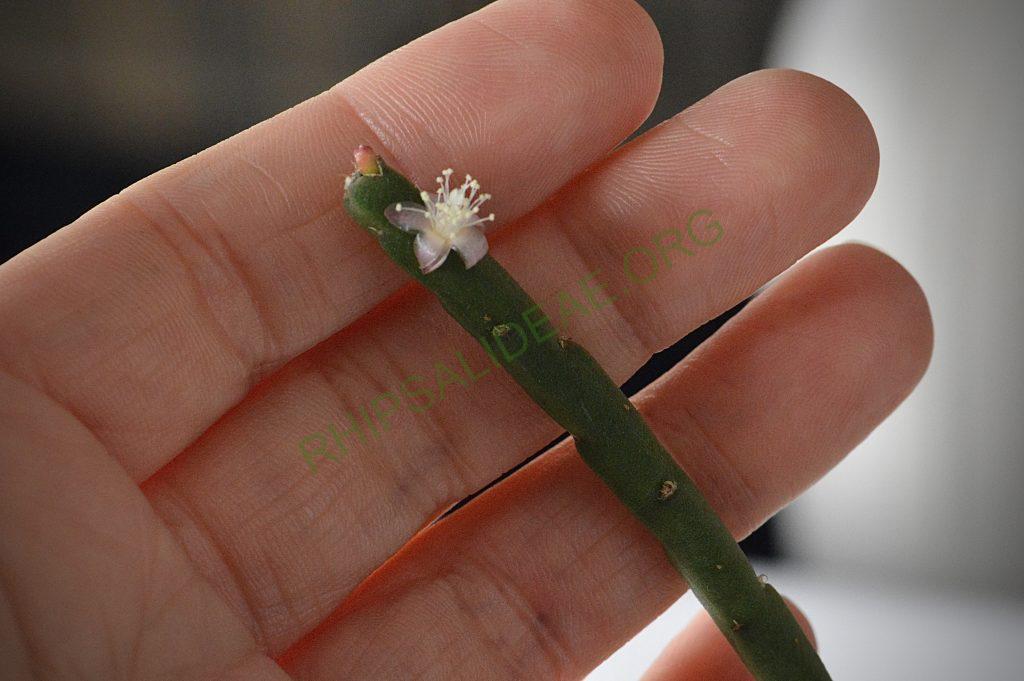
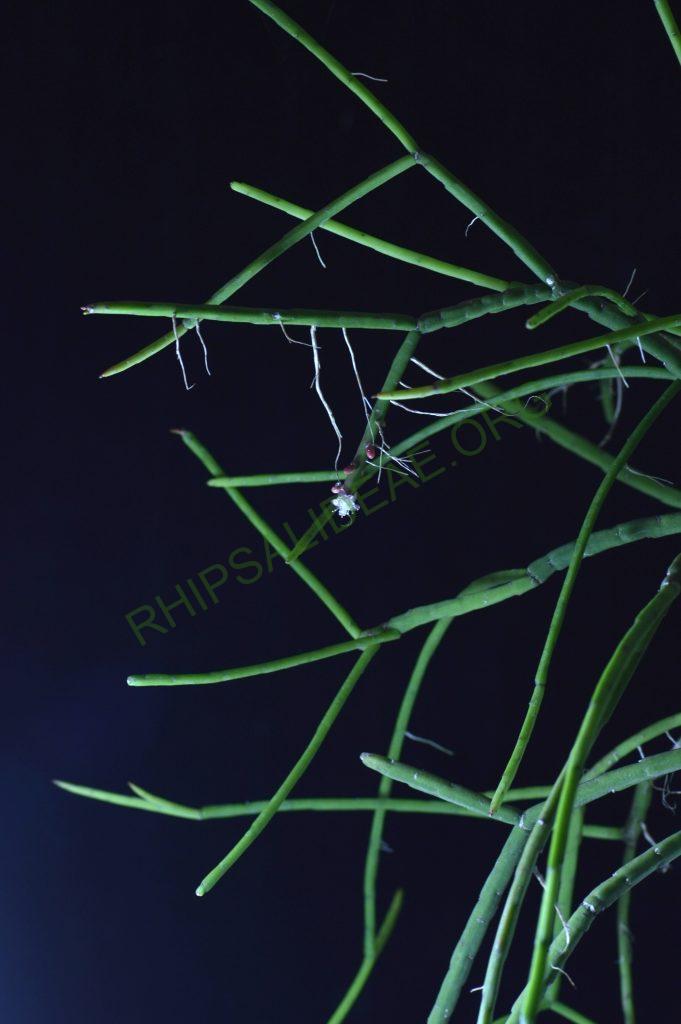
Unknown clone
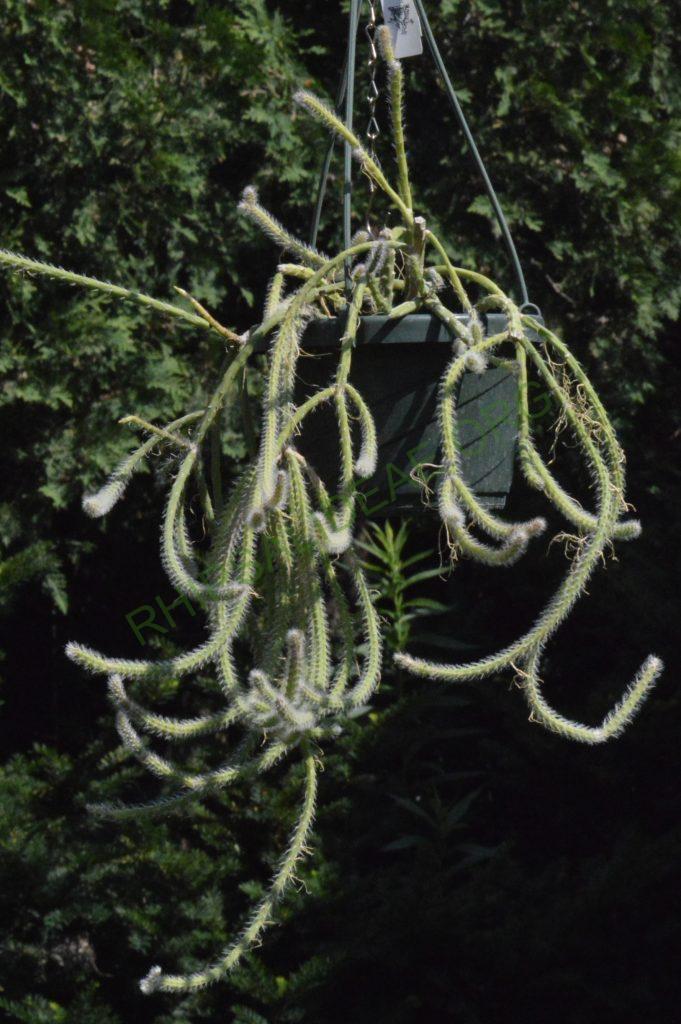
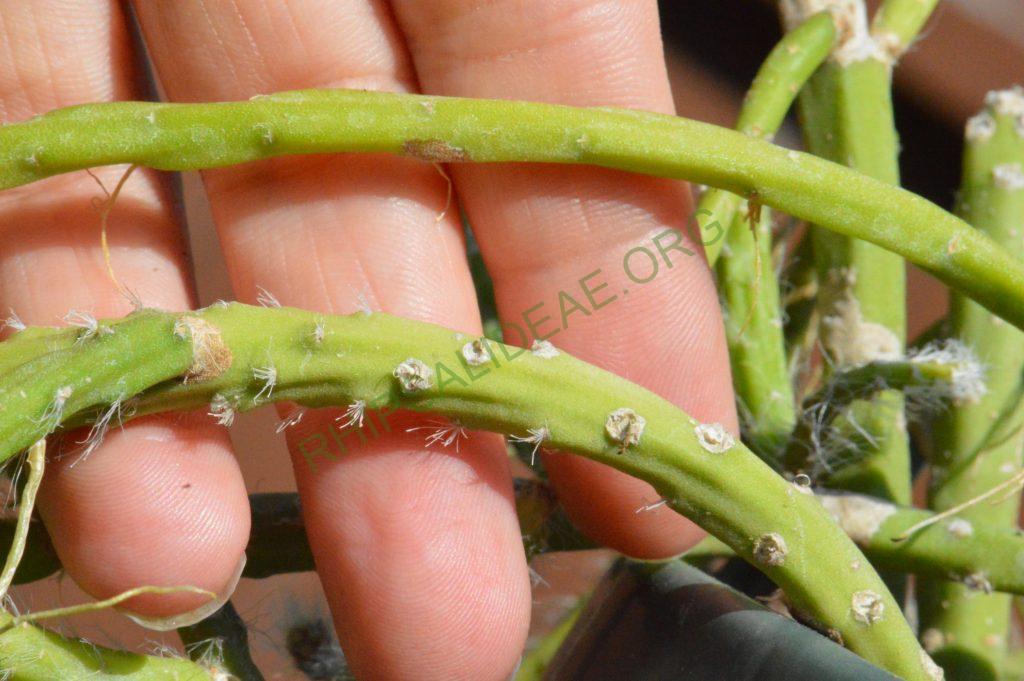
Unknown clone
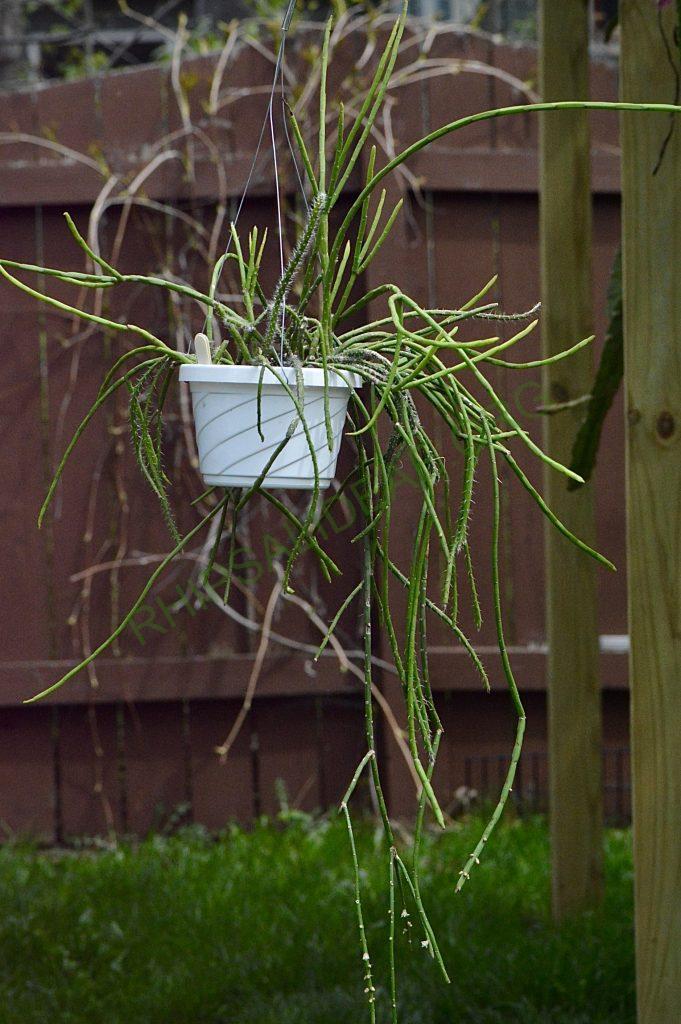
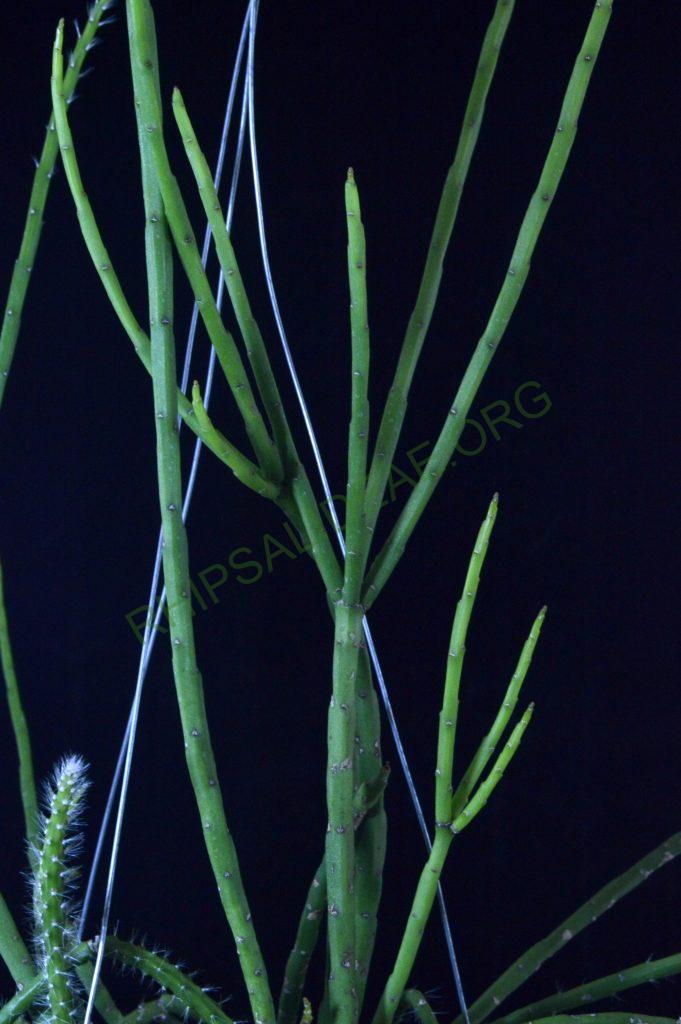
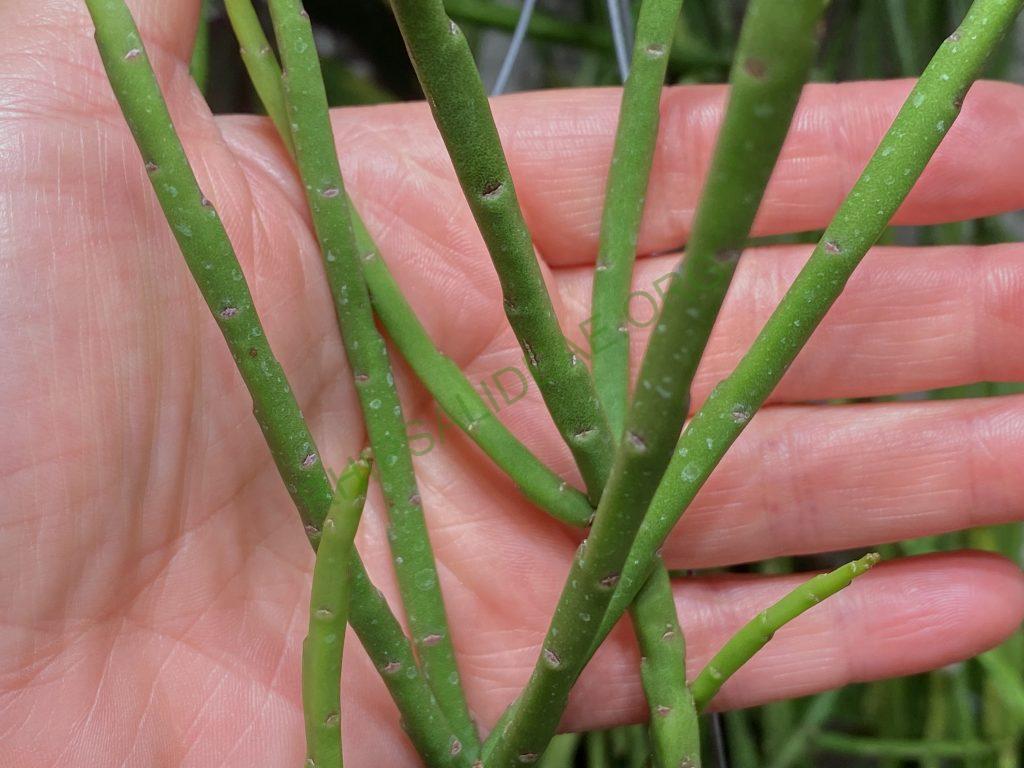
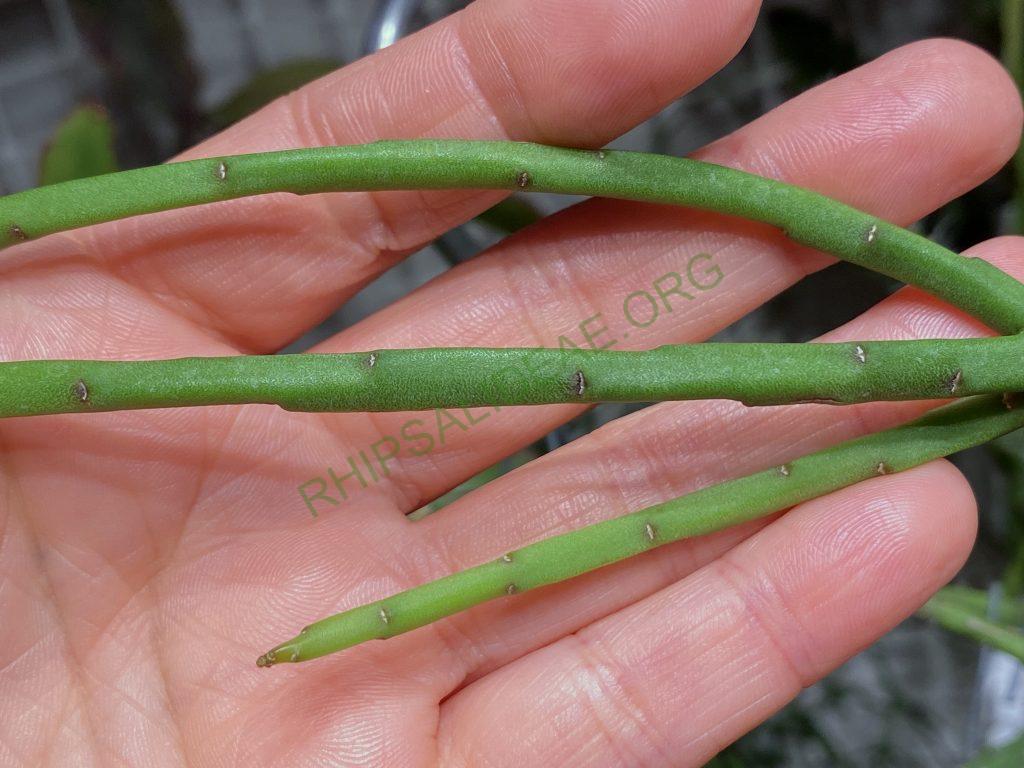
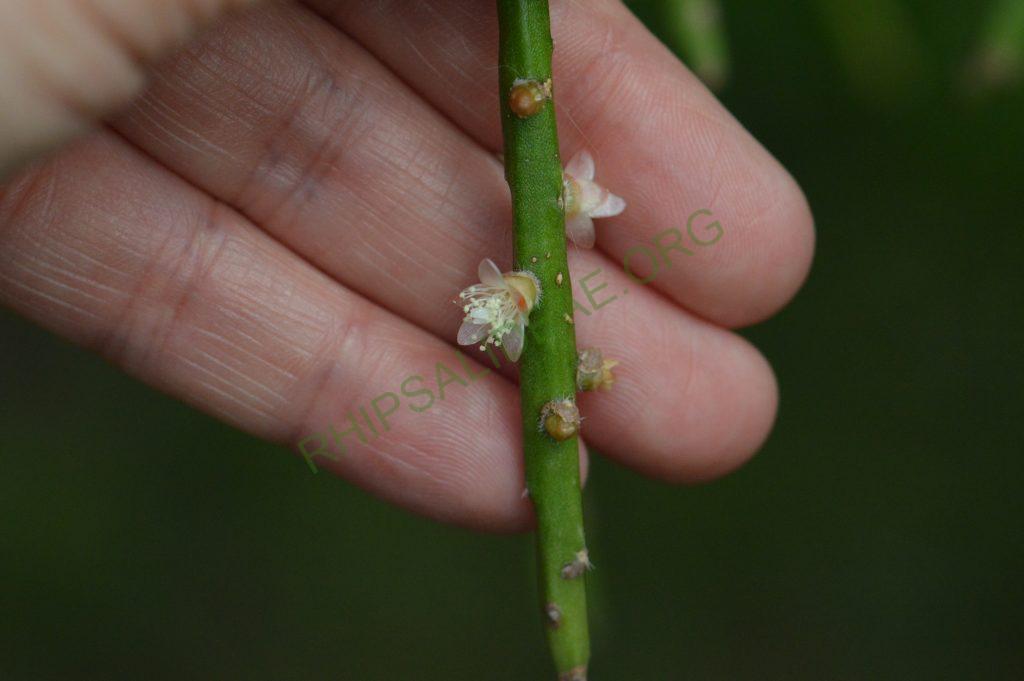
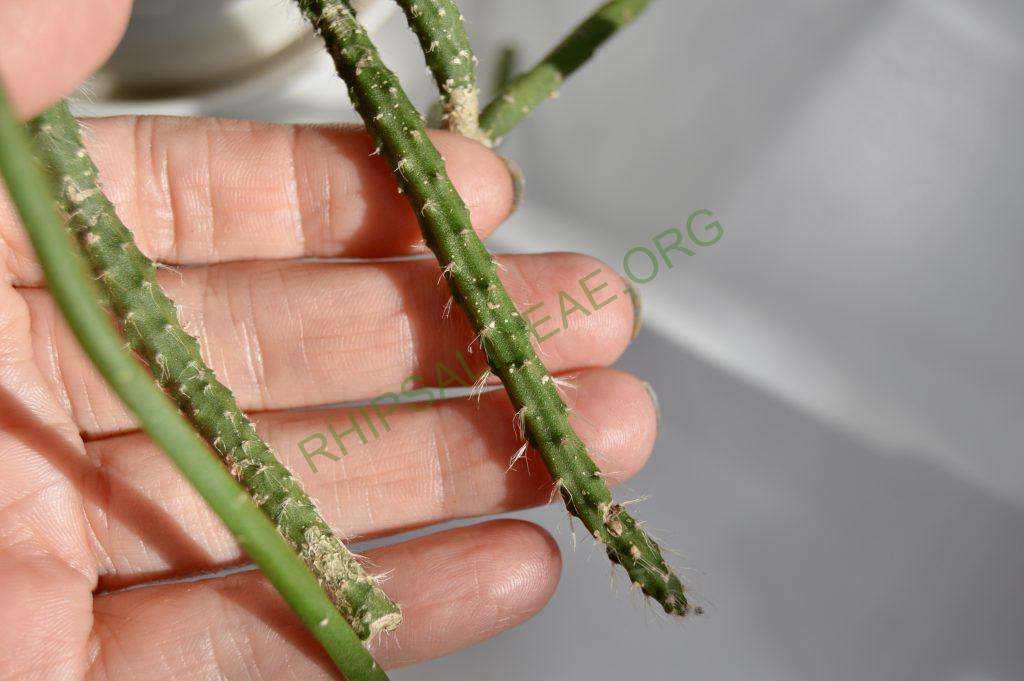

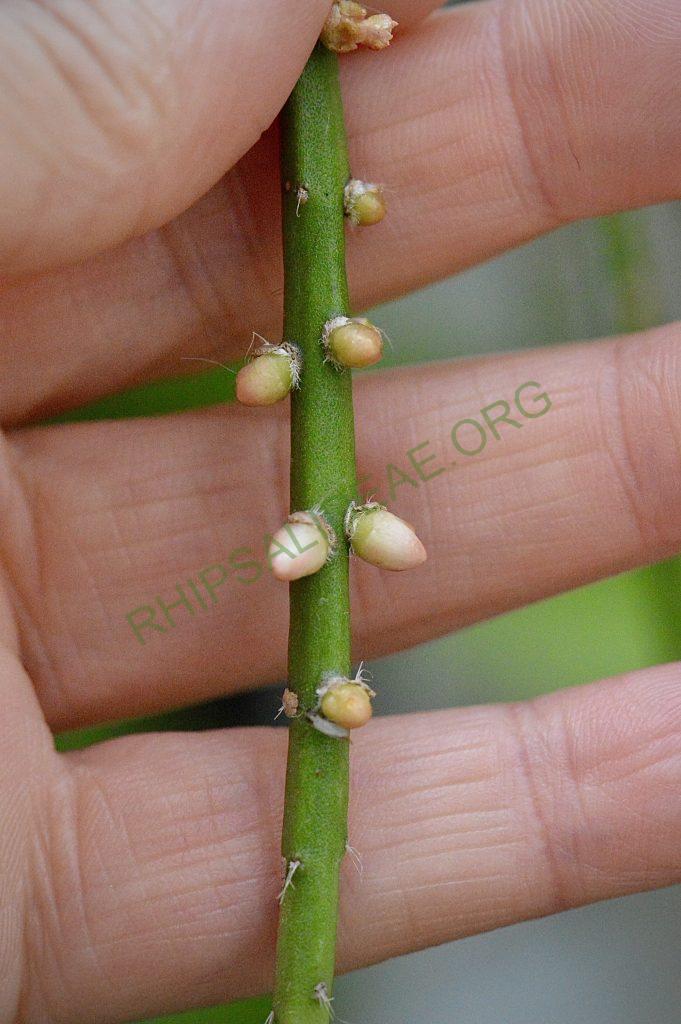
Floral variation
Botanical illustrations and historical images
Description
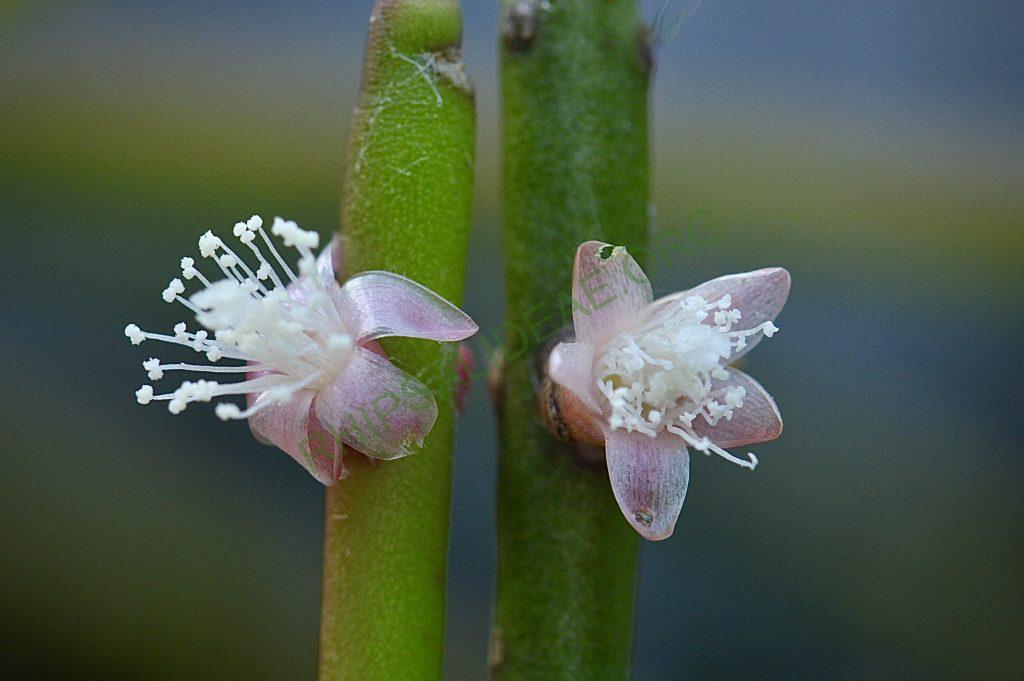
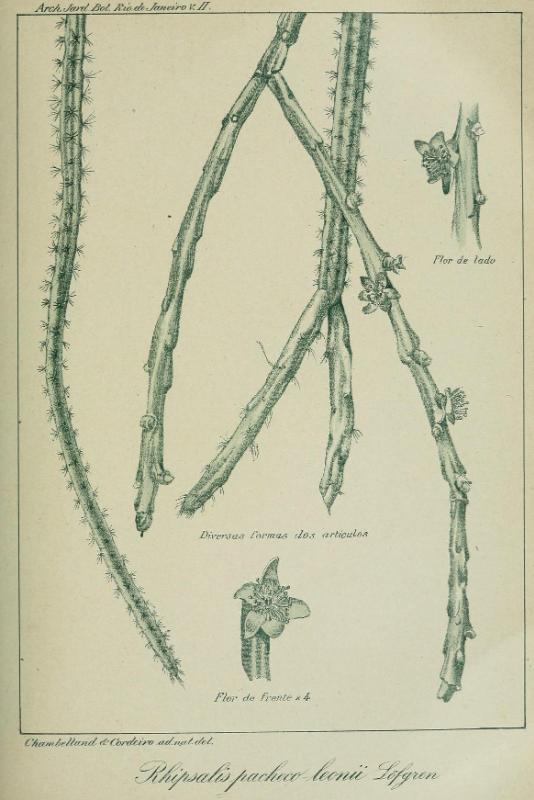
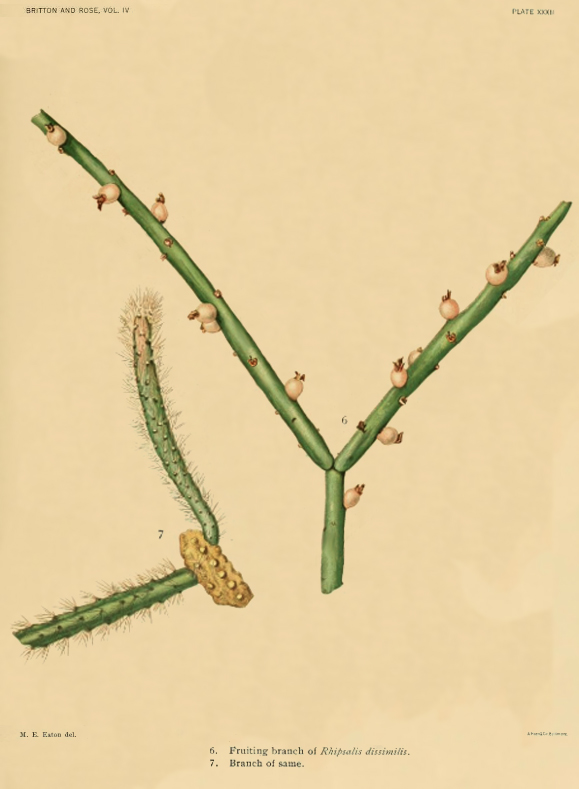
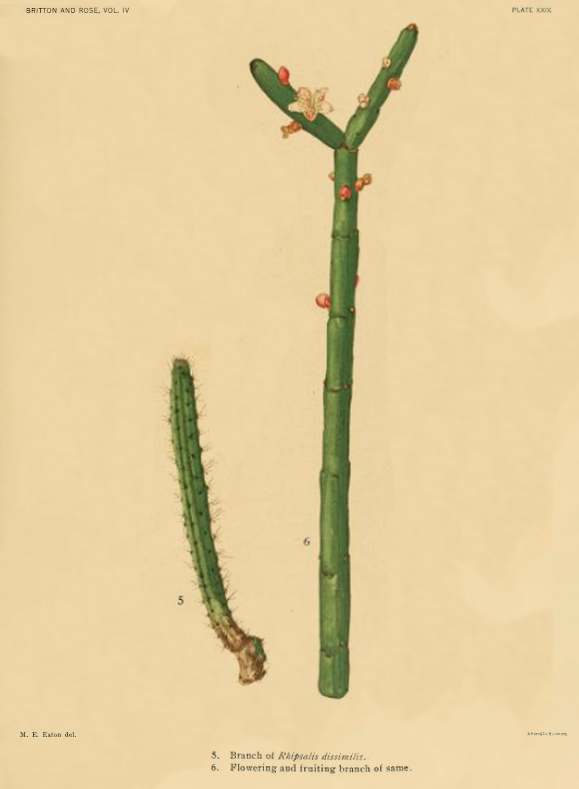
| The accepted name Rhipsalis pacheco-leonis subsp. pacheco-leonis Loefgr. was published in Arch. Jard. Bot. Rio de Janeiro 2: 38. 1918. The geographic range is Brazil (Macaé, Cabo Frio (Iguaba Grande & Búzios) and Pedra da Gávea, Rio de Janeiro) found at elevations of 0-900 meters with an endangered status of endangered. Rhipsalis pacheco-leonis subsp. pacheco-leonis is classified in the subgenus Goniorhipsalis. Observed growing as an epiphyte or lithophyte. Overall habit is pendant, branches are dimorphic (more than one stem shape) and acrotonic or subacrotonic (stems form from the tips and just below tips of previous stems). Stems are round and 6 to 9 angled and 3 to 4 weakly alternating angled, bristles are absent to sparse to dense. Main stems are indeterminate (seasonal growth is various lengths), 12cm-100cm x 0.4cm-0.7cm. Flowers are rotate: sub-patent or patent (wheel shaped: partial to wide open), unreported x 0.85cm-1cm. Petals from 5 to 6, sepals 4. Inner petals are white, pink or magenta, outer petals are white, pink or magenta. Stamen are white, from 28 to 41. Stigma lobes from 3 to 4. Flower ovary is subglobose or obconical, unreported x unreported. Flowering position on the stem is lateral and the flower orientation in relation to the stem is oblique. Does repeat flowering per areole. A maximum of 1 flowers were reported at a single areole. Areole position in the stems is semi-immersed (flower ovary is partially hidden in the stems during bud development). Trichomes or wool is sparse at the areoles after flowering. Unripe fruit is green, brown or red. Ripe fruit is globose; white, pink or red, unreported x 0.6cm-0.7cm. Other notable features: Ripe fruit often with pink or red ring around the top. Commonly confused with R. dissimilis f. dissimilis, but very easily distinguishable by having long indetermintate 3-4 weakly alternating angled stems and much smaller flowers and fruit. R. pacheco-leonis subsp. pachecho-leonis may be more closely related to R. flagelliformis than it is to R. pacheco-leonis subsp. catenulata1. The current taxonomy for this species might change. 1A remarkable new Rhipsalis (Cactaceae) from eastern Brazil, N. P. Taylor, G. Olsthoorn, D. Zappi, G. Khew, D. Quandt, Bradleya:32, 2014 Comments: Subspecies are recognized at the extreme morphological characterization found in nature, however this species presents a high level of plasticity and varying intermediate morphologies are reported between the various subspecies. Taxonomic treatment and description were derived from:
|
Rhipsalis pacheco-leonis subsp. pacheco-leonis referenced publications
| Title | Authors | Type | Journal | Year | Volume | Issue | Pages | Publisher |
|---|---|---|---|---|---|---|---|---|
| Epifytische cactussen, rhipsalis.eu. Accessed on: 15 Jan. 2025 | Aat van Uijen | Website | 2025 | |||||
| Royal Botanic Gardens Kew | Plants of the World Online. Accessed on: 15 Jan. 2025 | Website | 2025 | ||||||
| The Caryophyllales Network 2015+ [continuously updated]: A global synthesis of species diversity in the angiosperm order Caryophyllales. Accessed on: 15 Jan. 2025 | Website | 2025 | ||||||
| WFO The World Flora Online. Accessed on: 15 Jan. 2025 | Website | 2025 | ||||||
| The IUCN Red List of Threatened Species. Version 2024-2. accessed on 2025-01-07 | Website | 2024 | ||||||
| Rio de Janeiro - Cactaceae of the State of Rio de Janeiro (version 1, 8/2022), fieldguides.fieldmuseum.org | Diego Rafael Gonzaga, Maria de Fátima Freitas, Alice Calvente | Website | 2022 | |||||
| Cactaceae at Caryophyllales.org – a dynamic online species-level taxonomic backbone for the family | Nadja Korotkova, David Aquino, Salvador Arias, Urs Eggli, Alan Franck, Carlos Gómez-Hinostrosa, Pablo C. Guerrero, Héctor M. Hernández, Andreas Kohlbecker, Matias Köhler, Katja Luther, Lucas C. Majure, Andreas Müller, Detlev Metzing, Reto Nyffeler, Daniel Sánchez, Boris Schlumpberger, Walter G. Berendsohn | Journal Article | Willdenowia | 2021 | 51 | 2 | 251 – 270 | Botanic Garden and Botanical Museum Berlin (BGBM) |
| Cactaceae in Flora do Brasil 2020. Jardim Botânico do Rio de Janeiro. Accessed on: 15 Jan. 2025 | Daniela C. Zappi, Nigel P. Taylor | Website | 2020 | |||||
| Flora do Rio de Janeiro: Cactaceae | Maria de Fátima Freitas, Alice Calvente, Diego Rafael Gonzaga | Journal Article | Rodriguésia | 2020 | 71 | |||
| Additions and corrections to ‘Cacti of Eastern Brazil’ | Nigel P. Taylor, Daniela C. Zappi | Journal Article | Bradleya | 2018 | 2018 | 36 | 2 – 21 | British Cactus and Succulent Society |
| Rhipsalis, cactussen uit het tropische woud 2 | Aat van Uijen | Journal Article | Succulenta | 2018 | 97 | 1 | 39-44 | |
| Rhipsalis, cactussen uit het tropische woud 3 | Aat van Uijen | Journal Article | Succulenta | 2018 | 97 | 4 | 163-166 | |
| Rhipsalis, cactussen uit het tropische woud 1 | Aat van Uijen | Journal Article | Succulenta | 2017 | 96 | 6 | 270-275 | |
| Rhipsalis (Cactaceae): loss and gain of floral rewards is mirrored in range sizes and distribution patterns of species | Bernadette Grosse-Veldmann, Stefan Abrahamczyk, Jens Mutke, Wilhelm Barthlott, Maximilian Weigend | Journal Article | Botanical Journal of the Linnean Society | 2016 | 180 | 491-503 | ||
| A remarkable new Rhipsalis (Cactaceae) from eastern Brazil | Nigel P. Taylor, Gerardus Olsthoorn, Daniela C. Zappi, Gillian Khew, Dietmar Quandt | Journal Article | Bradleya | 2014 | 32 | 2-12 | ||
| Phylogeny and evolution of the epiphytic Rhipsalideae (Cactaceae) | Nadja Korotkova | Ph.D. Thesis | 2012 | Rheinische Friedrich-Wilhelms-Universität Bonn | ||||
| Der seltsame Binsenkaktus Rhipsalis paradoxa - eine kulturwürdige Art aus Brasilien | Andreas Hofacker | Journal Article | Kakteen und andere Sukkulenten | 2011 | 62 | 8 | 202-206 | |
| Molecular Phylogeny, Evolution, and Biogeography of South American Epiphytic Cacti | Alice Calvente, Daniela C. Zappi, Félix Forest, Lúcia G. Lohmann | Journal Article | International Journal of Plant Sciences | 2011 | 172 | 7 | 902-914 | |
| What does it take to resolve relationship and to identify species with molecular markers? An example from the epiphytic Rhipsalideae (Cactaceae) | Nadja Korotkova, Borsch T, Dietmar Quandt, Nigel P. Taylor, Müller K, Wilhelm Barthlott | Journal Article | American Journal of Botany | 2011 | 98 | 1549-1572 | ||
| The New Cactus Lexicon: Atlas of illustrations | David Hunt, Nigel P. Taylor, Graham Charles | Book | 2006 | 104-120 | DH Books | |||
| The New Cactus Lexicon: Text | David Hunt, Nigel P. Taylor, Graham Charles | Book | 2006 | 138-139,142-143,253-257 | DH Books | |||
| Cacti of Eastern Brazil | Nigel P. Taylor, Daniela C. Zappi | Book | 2004 | The Royal Botanic Gardens, Kew | ||||
| Re-classification of Rhipsalideae, A Polyphyletic Tribe of the Cactaceae Durande | Alexander B. Doweld | Journal Article | Succulents | 2001 | 4 | 1-2 | ||
| Die Namen der Gattungen und Arten epiphytischer Kakteen. Teil 1. Rhipsalideae | Ralf Bauer | Journal Article | EPIG | 1996 | 8 | 2 | 47-51 | |
| Notes towards a Monograph of Rhipsalideae (Cactaceae) | Wilhelm Barthlott, Nigel P. Taylor | Journal Article | Bradleya | 1995 | 13 | 43-79 | British Cactus and Succulent Society | |
| Cactus Lexicon | Curt Backeberg, Walther Haage | Book | 1966 | 205,220-222,440-449, 647, 750 | Blandford Press Ltd. (1966-1973) | |||
| The Cactaceae : descriptions and illustrations of plants of the cactus family | Nathaniel Lord Britton, Mary E. Eaton, N. J. Rose, Helen Adelaide Wood | Book | 1923 | 4 | 208-247 | Carnegie Institution of Washington | ||
| Archivos do Jardim Botânico do Rio de Janeiro | Jardim Botânico do Rio de Janeiro | Book | 1918 | 2 | 34-47 | Rio de Janeiro, Jardim Botanico |
Reduced Synonyms
| Name | Reduced by | Published Date | Published In |
|---|---|---|---|
| Rhipsalis pacheco-leoni Loefgr. | Barthlott & Taylor (1995) | 1918 | Arch. Jard. Bot. Rio de Janeiro 2: 38, pl. 10. 1918 |
| Lepismium pacheco-leonis (Loefgr.) Backeb. | Barthlott & Taylor (1995) | 1936 | Kaktus-ABC: 154. 1936 ["1935"] |
| Hylorhipsalis pacheco-leonis (Loefgr.) Doweld | Korotkova (2021) | 2002 | Sukkulenty 4(1-2): 39. 2002 ["2001"] |