
Rhipsalis ormindoi N. P. Taylor & Zappi
Images | Description | Publications | Reduced Synonyms
Pico da Caledônia, Rio de Janeiro, Brazil

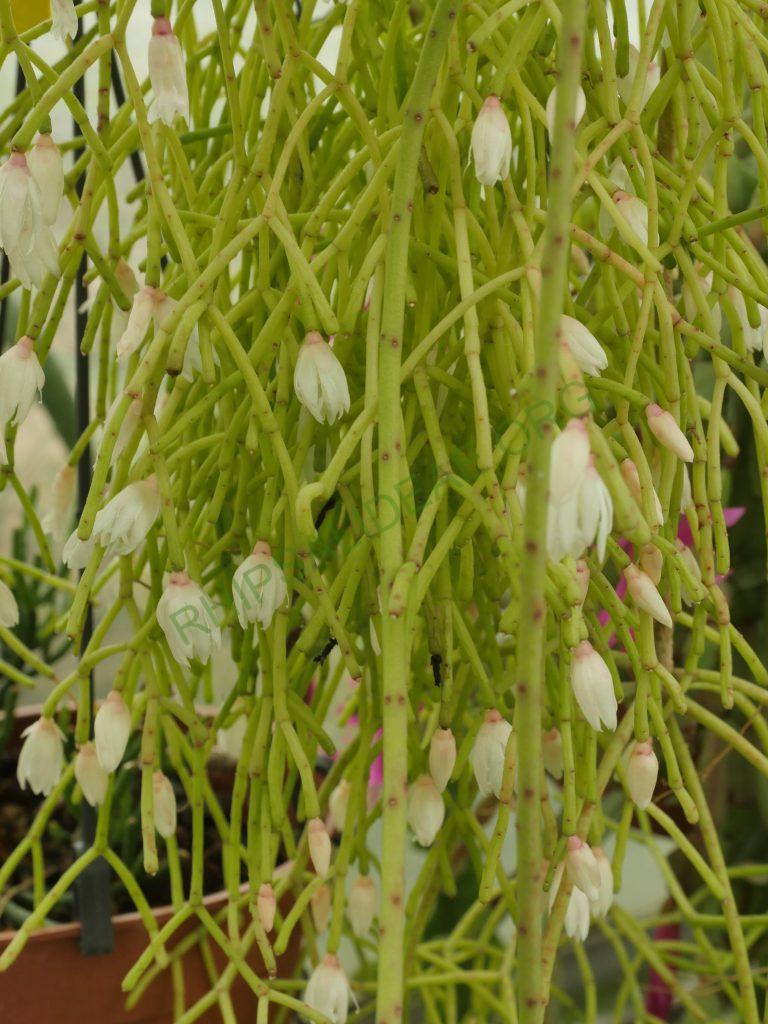

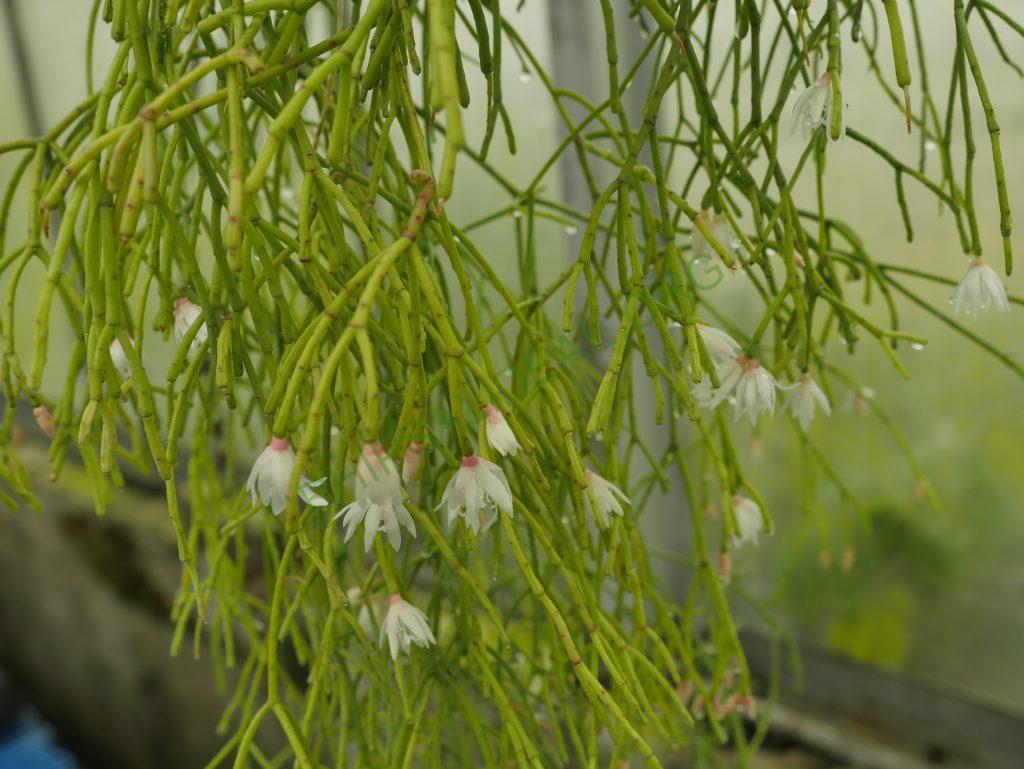


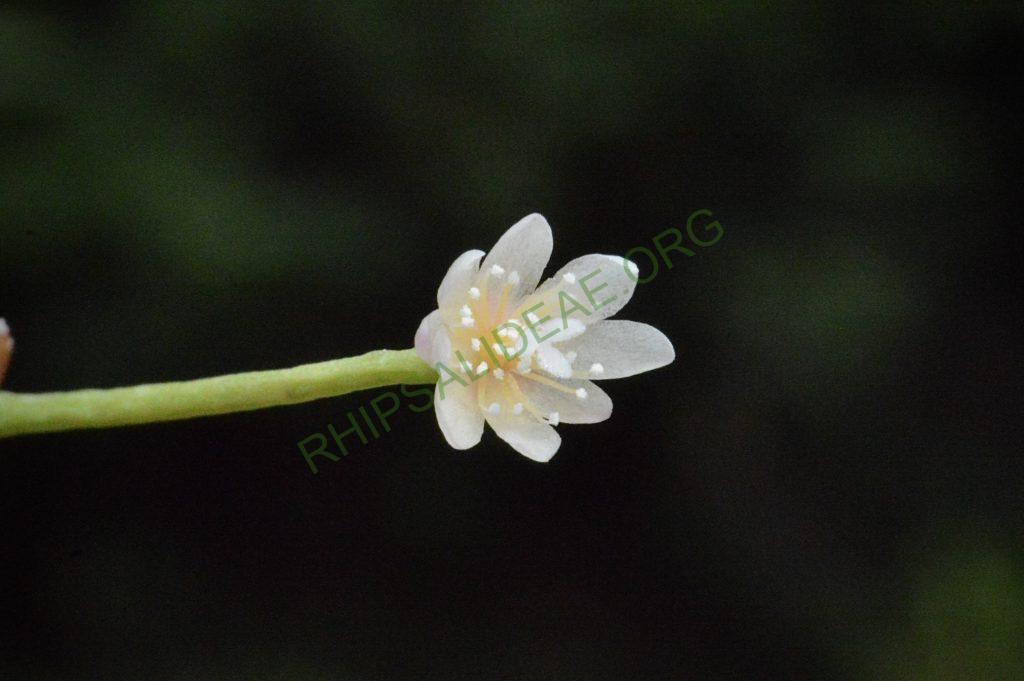


Possibly Rhipsalis ormindoi, Itatiaia, Rio de Janeiro, Brazil


Description
| The accepted name Rhipsalis ormindoi N. P. Taylor & Zappi was published in Cactaceae Consensus Init. 3: 8. 1997. The geographic range is Brazil (Rio de Janeiro) found at elevations of 1500-1600 meters with an endangered status of near threatened. Rhipsalis ormindoi is classified in the subgenus Erythrorhipsalis. Observed growing as an epiphyte. Overall habit is pendant, branches are dimorphic (more than one stem shape) and acrotonic (stems form from the tips of previous stems). Stems are round and slightly clavate, bristles are absent. Basal stems are indeterminate (seasonal growth is various lengths), 10cm-150cm x 0.2cm-1cm. Main stems are determinate (seasonal growth is about the same length), 2cm-8cm x 0.2cm-0.3cm. Flowers are campanulate (bell shaped), 0.8cm-2.5cm x 0.5cm-1.8cm. Petal count is unreported, sepal count is unreported. Inner petals are white, outer petals are white, cream, pink, brown or red. Stamen are yellow, count is unreported. Stigma lobes from 4 to 6. Flower ovary is obconical, 0.2cm x 0.25cm. Flowering position on the stem is apical and the flower orientation in relation to the stem is parallel. Does not repeat flowering per areole. A maximum of 3 flowers were reported at a single areole. Areole position in the stems is superficial (flower ovary is visible on the surface of the stems during bud development). Trichomes or wool is absent at the areoles after flowering. Unripe fruit is green, pink or red. Ripe fruit is globose or subglobose; white, yellow, pink, magenta, purple or red, 0.5cm-0.6cm x 0.4cm-0.7cm. Other notable features: Identifying characteristics that help to differentiate R. ormindoi from other similar closely related1 species R. burchellii, R. campos-portoana, and R. clavata are the yellow colored stamen which are also present in the closely related 1R. juengeri. It is typically distinguishabled from R. juengeri by the ripe yellow fruit. Ripe yellow fruit sometimes has a reddish ring at the top. Fruit has also been reported as white, pink, magenta, purple, or red. Quite often historically described as resembling R. clavata, however R. ormindoi commonly produces long basal stems of indeterminate length, a trait that is reportedly quite rare in R. clavata. In her thesis Alice Calvente writes: "Visual comparison of the “small combined data set” and the MS topology indicated that the varying position of R. ormindoi (sister to R. juengeri in the MS topology and sister to R. clavata in the “small combined” tree) was likely responsible for the incongruence detected. We reduced these clades to polytomies in both topologies and conducted the Templeton test again, which then lead to a non-significant result (rival tree “small combined”, P=0.125; rival tree MS, P=0.5). The exclusion of R. ormindoi in either tree or in both trees also resulted in a non-significant result. We then combined the cpDNA, ITS and MS data sets (here denominated “large combined”) but collapsed the clade formed by R. ormindoi and R. juengeri in the Bayesian consensus tree presented (Fig. 2), representing R. ormindoi, R. clavata and R. juengeri as a polytomy." "The individual topologies resulting from the cpDNA, ITS and MS data sets were generally congruent, except for the position of R. ormindoi, which appeared as sister to R. juengeri in the analysis of the MS (bs=99), rpl32-trnL (bs=64), and trnQ-rps16 (bs=63), but as sister to R. clavata in the analysis of ITS (bs=86), and “small combined” data set (bs = 96). Furthermore, in the psbA-trnH tree, R. ormindoi appeared in a polytomy within the Erythrorhipsalis clade together with R. clavata while R. juengeri appeared as closely related to the remaining Erythrorhipsalis species (low support; data not shown). This data suggests a hybrid origin of R. ormindoi, which is also supported by morphological evidence. In particular, the vegetative morphology of R. ormindoi is intermediate between R. clavata and R. jungeri as the branching pattern of stems resembles R. jungeri, while the final stem segments are clavate like those of R. clavata." 1Molecular phylogeny, evolution and systematics of Rhipsalis (Cactaceae), Alice Calvente, Ph.D. Thesis, 2010 Taxonomic treatment and description were derived from:
|
Rhipsalis ormindoi referenced publications
| Title | Authors | Type | Journal | Year | Volume | Issue | Pages | Publisher |
|---|---|---|---|---|---|---|---|---|
| Epifytische cactussen, rhipsalis.eu. Accessed on: 15 Jan. 2025 | Aat van Uijen | Website | 2025 | |||||
| Royal Botanic Gardens Kew | Plants of the World Online. Accessed on: 15 Jan. 2025 | Website | 2025 | ||||||
| The Caryophyllales Network 2015+ [continuously updated]: A global synthesis of species diversity in the angiosperm order Caryophyllales. Accessed on: 15 Jan. 2025 | Website | 2025 | ||||||
| WFO The World Flora Online. Accessed on: 15 Jan. 2025 | Website | 2025 | ||||||
| The IUCN Red List of Threatened Species. Version 2024-2. accessed on 2025-01-07 | Website | 2024 | ||||||
| Rio de Janeiro - Cactaceae of the State of Rio de Janeiro (version 1, 8/2022), fieldguides.fieldmuseum.org | Diego Rafael Gonzaga, Maria de Fátima Freitas, Alice Calvente | Website | 2022 | |||||
| Cactaceae at Caryophyllales.org – a dynamic online species-level taxonomic backbone for the family | Nadja Korotkova, David Aquino, Salvador Arias, Urs Eggli, Alan Franck, Carlos Gómez-Hinostrosa, Pablo C. Guerrero, Héctor M. Hernández, Andreas Kohlbecker, Matias Köhler, Katja Luther, Lucas C. Majure, Andreas Müller, Detlev Metzing, Reto Nyffeler, Daniel Sánchez, Boris Schlumpberger, Walter G. Berendsohn | Journal Article | Willdenowia | 2021 | 51 | 2 | 251 – 270 | Botanic Garden and Botanical Museum Berlin (BGBM) |
| Rhipsalis, cactussen uit het tropische woud 6 | Aat van Uijen | Journal Article | Succulenta | 2020 | 99 | 2 | 62-67 | |
| Cactaceae in Flora do Brasil 2020. Jardim Botânico do Rio de Janeiro. Accessed on: 15 Jan. 2025 | Daniela C. Zappi, Nigel P. Taylor | Website | 2020 | |||||
| Flora do Rio de Janeiro: Cactaceae | Maria de Fátima Freitas, Alice Calvente, Diego Rafael Gonzaga | Journal Article | Rodriguésia | 2020 | 71 | |||
| Rhipsalis, cactussen uit het tropische woud 1 | Aat van Uijen | Journal Article | Succulenta | 2017 | 96 | 6 | 270-275 | |
| Succulentennieuwtjes | Wolter ten Hoeve | Journal Article | Succulenta | 2014 | 93 | 3 | 139 | |
| Rhipsalis ormindoi, eine noch wenig bekannte Rhipsalis aus der brasilianischen Mata Atlântica | Andreas Hofacker | Journal Article | Kakteen und andere Sukkulenten | 2013 | 61 | 11 | 295-300 | |
| A New Subgeneric Classification of Rhipsalis (Cactoideae, Cactaceae) | Alice Calvente | Journal Article | Systematic Botany | 2012 | 37 | 4 | 983 – 988 | The American Society of Plant Taxonomists |
| Molecular Phylogeny, Evolution, and Biogeography of South American Epiphytic Cacti | Alice Calvente, Daniela C. Zappi, Félix Forest, Lúcia G. Lohmann | Journal Article | International Journal of Plant Sciences | 2011 | 172 | 7 | 902-914 | |
| Rhipsalis aurea M. F. Freitas & J. M. A. Braga - eine bemerkenswerte neue Art aus Brasilien | Andreas Hofacker | Journal Article | EPIG | 2011 | 68 | 21-25 | ||
| What does it take to resolve relationship and to identify species with molecular markers? An example from the epiphytic Rhipsalideae (Cactaceae) | Nadja Korotkova, Borsch T, Dietmar Quandt, Nigel P. Taylor, Müller K, Wilhelm Barthlott | Journal Article | American Journal of Botany | 2011 | 98 | 1549-1572 | ||
| Molecular phylogeny, evolution and systematics of Rhipsalis (Cactaceae) | Alice Calvente | Ph.D. Thesis | 2010 | Instituto de Biociências da Universidade de São Paulo | ||||
| A New Species of Rhipsalis (Cactaceae) from Brazil | Maria de Fátima Freitas, Alice Calvente, João Marcelo Alvarenga Braga | Journal Article | Systematic Botany | 2009 | 34 | 3 | 505-509 | |
| The New Cactus Lexicon: Atlas of illustrations | David Hunt, Nigel P. Taylor, Graham Charles | Book | 2006 | 104-120 | DH Books | |||
| The New Cactus Lexicon: Text | David Hunt, Nigel P. Taylor, Graham Charles | Book | 2006 | 138-139,142-143,253-257 | DH Books |
Reduced Synonyms
| Name | Reduced by | Published Date | Published In |
|---|---|---|---|
| Erythrorhipsalis ormindoi (N.P.Taylor & Zappi) Doweld | Taylor & Zappi (1997) | 2002 | Sukkulenty 4(1-2): 31. 2002 ["2001"] |