
Hatiora herminiae (Porto & A.Cast.) Backeb. ex Barthlott
Images | Description | Publications | Reduced Synonyms
AH 721, Campos do Jordão, Brazil


Bonn 4691
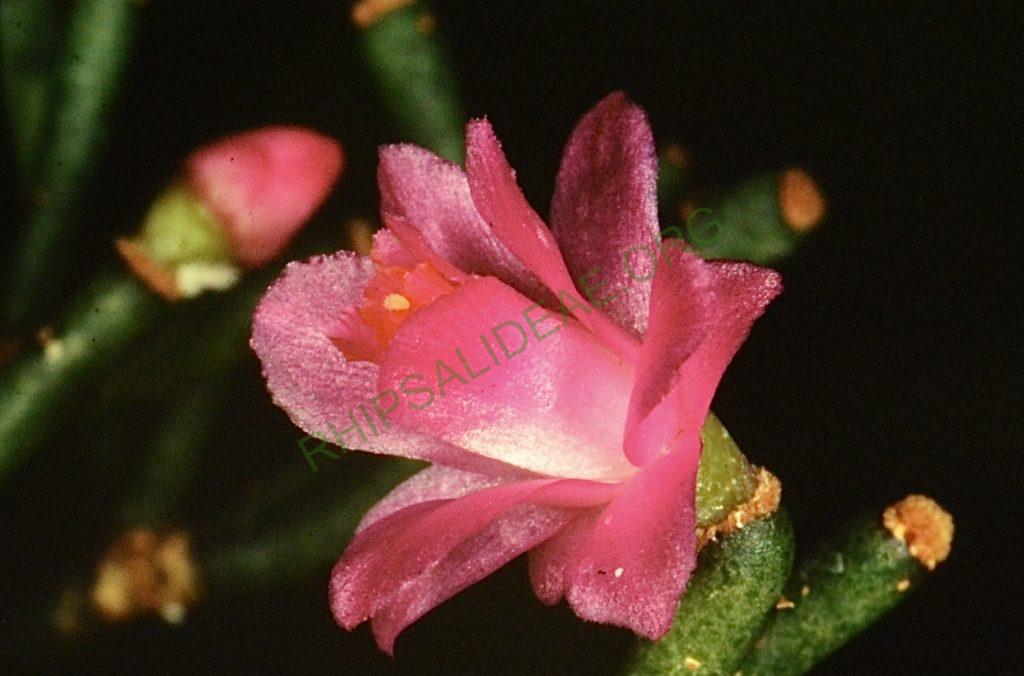

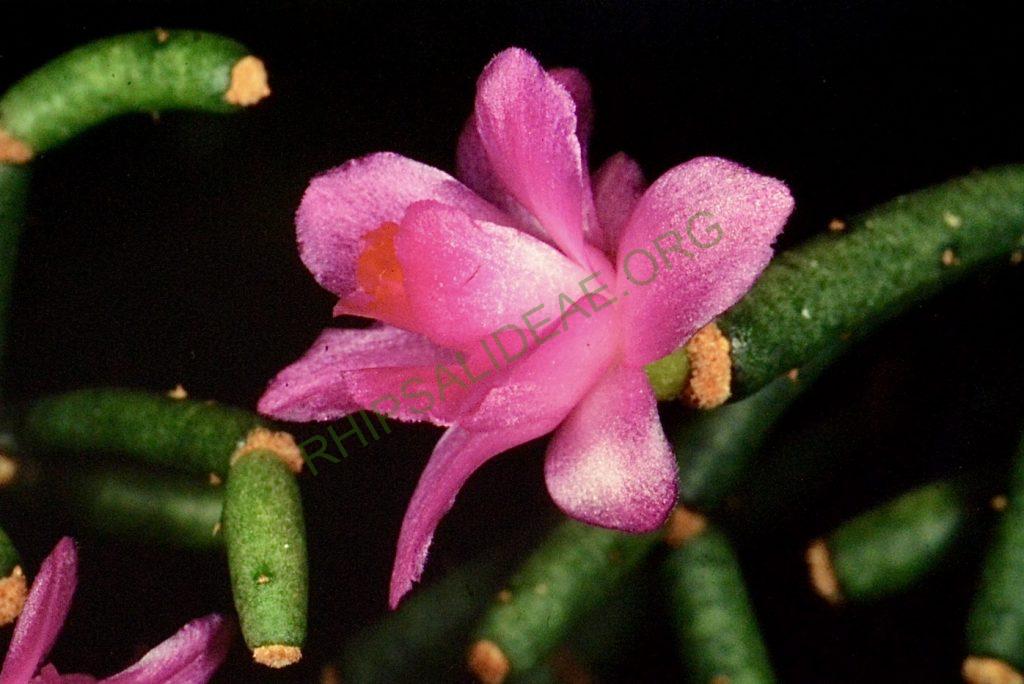
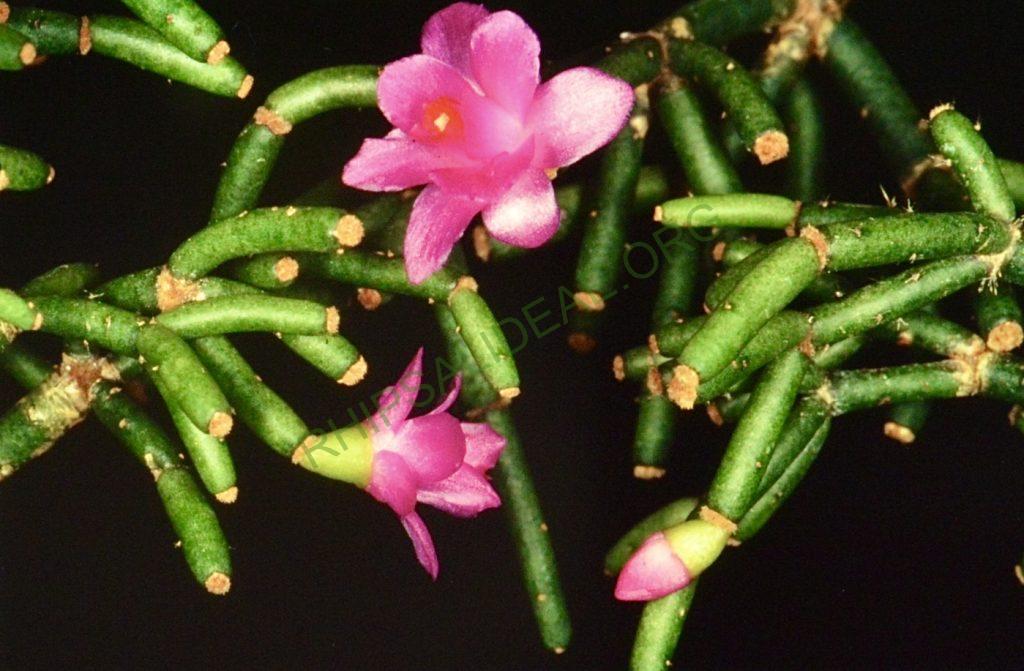

Heidelberg Botanical Garden, Neotenic (juvenile) form

Unknown clone


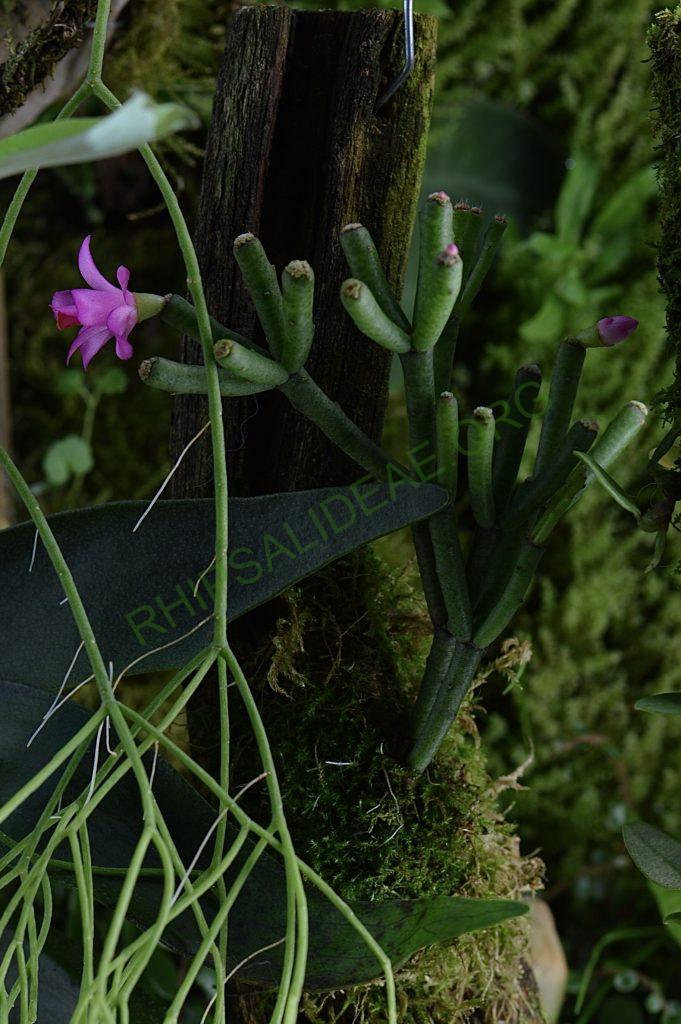
Unknown clone

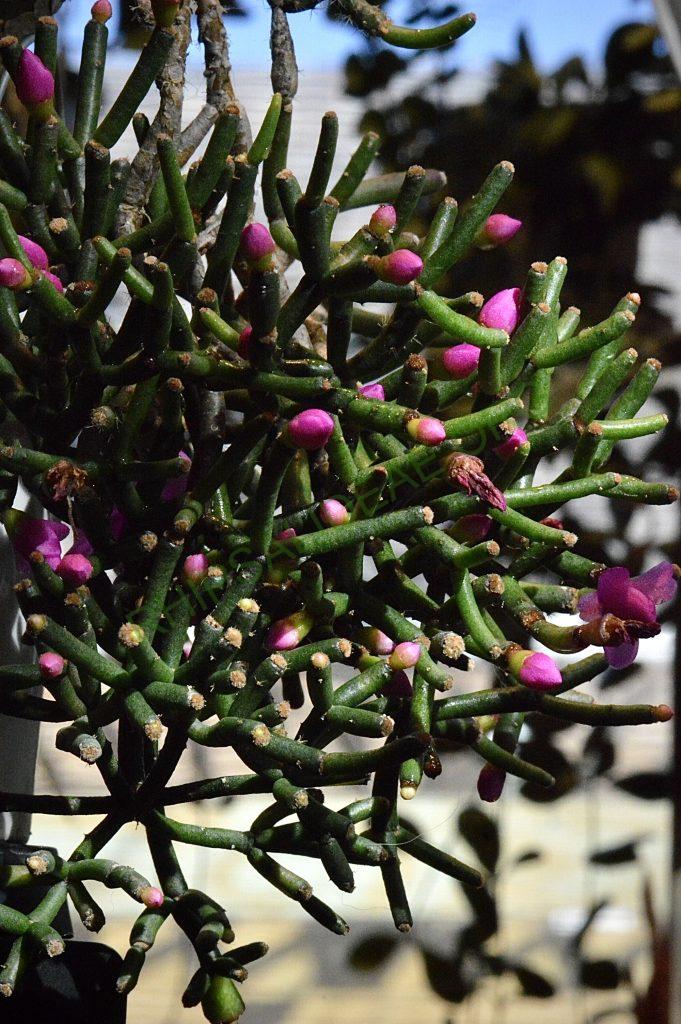


Unknown clone

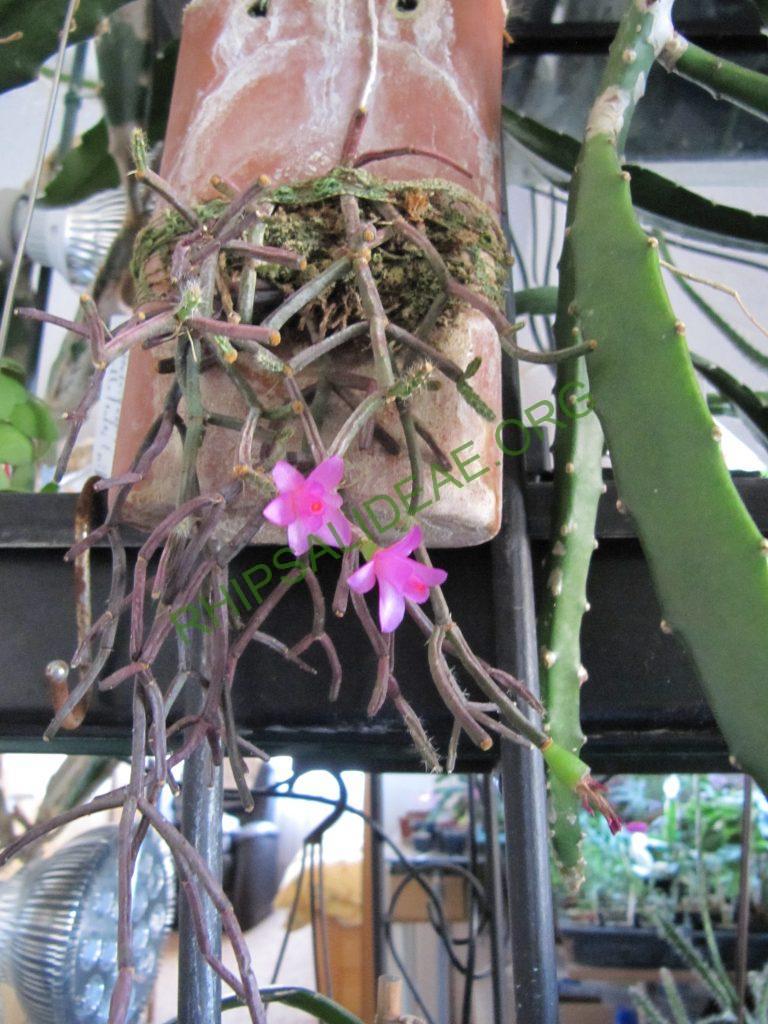
Description
| The accepted name Hatiora herminiae (Porto & A.Cast.) Backeb. ex Barthlott was published in Bradleya 5: 100. 1987. The geographic range is Brazil (São Paulo, Minas Gerais) found at elevations of 1500-2000 meters with an endangered status of endangered. Hatiora herminiae is classified in the subgenus Hatiora. Observed growing as an epiphyte or lithophyte. Overall habit is pendant, semi-erect or erect, branches are monomorphic (single stem shape) and acrotonic (stems form from the tips of previous stems). Stems are round and slightly clavate, bristles are absent to sparse. Main stems are determinate (seasonal growth is about the same length), 1.5cm-4cm x 0.2cm-0.8cm. Flowers are campanulate or infundibuliform (bell or funnel shaped), 0.8cm-2cm x 0.6cm-2cm. Petals 17, sepal count is unreported. Inner petals are pink, magenta or red, outer petals are green. Stamen are yellow, 37. Stigma lobes from 3 to 4. Flower ovary is obconic, 0.4cm-0.6cm x 0.3cm-0.6cm. Flowering position on the stem is apical and the flower orientation in relation to the stem is parallel. It is unreported whether flowering repeats per areole. A maximum of 1 flowers were reported at a single areole. Areole position in the stems is superficial (flower ovary is visible on the surface of the stems during bud development). Trichomes or wool is sparse at the areoles after flowering. Unripe fruit is green. Ripe fruit is turbinate; white, grey, yellow-green or pink, 0.6cm-0.9cm x 0.6cm-0.65cm. Taxonomic treatment and description were derived from:
|
Hatiora herminiae referenced publications
| Title | Authors | Type | Journal | Year | Volume | Issue | Pages | Publisher |
|---|---|---|---|---|---|---|---|---|
| Epifytische cactussen, rhipsalis.eu. Accessed on: 15 Jan. 2025 | Aat van Uijen | Website | 2025 | |||||
| Royal Botanic Gardens Kew | Plants of the World Online. Accessed on: 15 Jan. 2025 | Website | 2025 | ||||||
| The Caryophyllales Network 2015+ [continuously updated]: A global synthesis of species diversity in the angiosperm order Caryophyllales. Accessed on: 15 Jan. 2025 | Website | 2025 | ||||||
| WFO The World Flora Online. Accessed on: 15 Jan. 2025 | Website | 2025 | ||||||
| The IUCN Red List of Threatened Species. Version 2024-2. accessed on 2025-01-07 | Website | 2024 | ||||||
| Cactaceae at Caryophyllales.org – a dynamic online species-level taxonomic backbone for the family | Nadja Korotkova, David Aquino, Salvador Arias, Urs Eggli, Alan Franck, Carlos Gómez-Hinostrosa, Pablo C. Guerrero, Héctor M. Hernández, Andreas Kohlbecker, Matias Köhler, Katja Luther, Lucas C. Majure, Andreas Müller, Detlev Metzing, Reto Nyffeler, Daniel Sánchez, Boris Schlumpberger, Walter G. Berendsohn | Journal Article | Willdenowia | 2021 | 51 | 2 | 251 – 270 | Botanic Garden and Botanical Museum Berlin (BGBM) |
| Cactaceae na Serra da Mantiqueira, Brasil | Diego Rafael Gonzaga, Luiz Menini Neto, Ariane Luna Peixoto | Journal Article | Rodriguésia | 2020 | 71 | |||
| Cactaceae in the state of Paraná, Brasil | André Soller, Patricia Soffiatti, Alice Calvente, Renato Goldenberg | Journal Article | Rodriguésia | 2014 | 65 | 201-219 | ||
| Ein Juwel der epiphytischen Kakteen: Hatiora herminiae | Andreas Hofacker | Journal Article | Kakteen und andere Sukkulenten | 2013 | 64 | 2 | 39-42 | |
| Phylogeny and evolution of the epiphytic Rhipsalideae (Cactaceae) | Nadja Korotkova | Ph.D. Thesis | 2012 | Rheinische Friedrich-Wilhelms-Universität Bonn | ||||
| Molecular phylogeny of tribe Rhipsalideae (Cactaceae) and taxonomic implications for Schlumbergera and Hatiora | Alice Calvente, Daniela C. Zappi, Félix Forest, Lúcia G. Lohmann | Journal Article | Molecular Phylogenetics and Evolution | 2011 | 58 | 3 | 456-468 | |
| What does it take to resolve relationship and to identify species with molecular markers? An example from the epiphytic Rhipsalideae (Cactaceae) | Nadja Korotkova, Borsch T, Dietmar Quandt, Nigel P. Taylor, Müller K, Wilhelm Barthlott | Journal Article | American Journal of Botany | 2011 | 98 | 1549-1572 | ||
| Molecular phylogeny, evolution and systematics of Rhipsalis (Cactaceae) | Alice Calvente | Ph.D. Thesis | 2010 | Instituto de Biociências da Universidade de São Paulo | ||||
| Cactaceae | Daniela C. Zappi, Lidyanne Yuriko Saleme Aona, Nigel P. Taylor | Journal Article | Flora Fanerogâmica do Estado de São Paulo | 2007 | 5 | 180-193 | ||
| The New Cactus Lexicon: Atlas of illustrations | David Hunt, Nigel P. Taylor, Graham Charles | Book | 2006 | 104-120 | DH Books | |||
| Cacti of Eastern Brazil | Nigel P. Taylor, Daniela C. Zappi | Book | 2004 | The Royal Botanic Gardens, Kew | ||||
| Die Namen der Gattungen und Arten epiphytischer Kakteen. Teil 1. Rhipsalideae | Ralf Bauer | Journal Article | EPIG | 1996 | 8 | 2 | 47-51 | |
| Hatiora - die Osterkakteen und ihre Verwandten | Wilhelm Barthlott, Nigel P. Taylor | Journal Article | Kakteen und andere Sukkulenten | 1996 | 47 | 4 | 73-77 | |
| Notes towards a Monograph of Rhipsalideae (Cactaceae) | Wilhelm Barthlott, Nigel P. Taylor | Journal Article | Bradleya | 1995 | 13 | 43-79 | British Cactus and Succulent Society | |
| Probleme mit Rhipsalis herminiae und Rhipsalis clavata | Kurt Petersen | Journal Article | EPIG | 1993 | 5 | 2 | 25 | |
| Bericht über zwei Vorträge von Myron Kimnach und Prof. Dr. Wilhelm Barthlott über ihre Ansichten zur Gattungsgliederung innerhalb der epiphytischen Kakteen | Ralf Bauer | Journal Article | EPIG | 1991 | 3 | 4 | 64-71 | |
| New names in Rhipsalidinae (Cactaceae) | Wilhelm Barthlott | Journal Article | Bradleya | 1987 | 5 | 97-100 | ||
| Cactus Lexicon | Curt Backeberg, Walther Haage | Book | 1966 | 205,220-222,440-449, 647, 750 | Blandford Press Ltd. (1966-1973) | |||
| Rodriguésia: Revista do Jardim Botânico do Rio de Janeiro | Jardim Botânico do Rio de Janeiro | Book | 1941 | 5 | 14 | 353 | Rio de Janeiro, Instituto de Pesquisas Jardim Botânico do Rio de Janeiro, 1935 |
Reduced Synonyms
| Name | Reduced by | Published Date | Published In |
|---|---|---|---|
| Hariota herminiae Porto & A.Cast. | Barthlott & Taylor (1995) | 1941 | Rodriguésia 5: 353. 1941 |
| Rhipsalis herminiae (Porto & A.Cast.) Kimnach | IPNI | 1996 | Cact. Succ. J. (Los Angeles) 68(3): 156. 1996 |
| Hatiora herminiae (Porto & A.Cast.) Backeb. | 1959 | Cactaceae 2: 710. 1959 |