
Hatiora salicornioides f. cylindrica (Britton & Rose) Süpplie
Images | Description | Publications | Reduced Synonyms
AJ 125, Morro do Pai Inácio, Chapada Diamantina, Bahia, Brazil


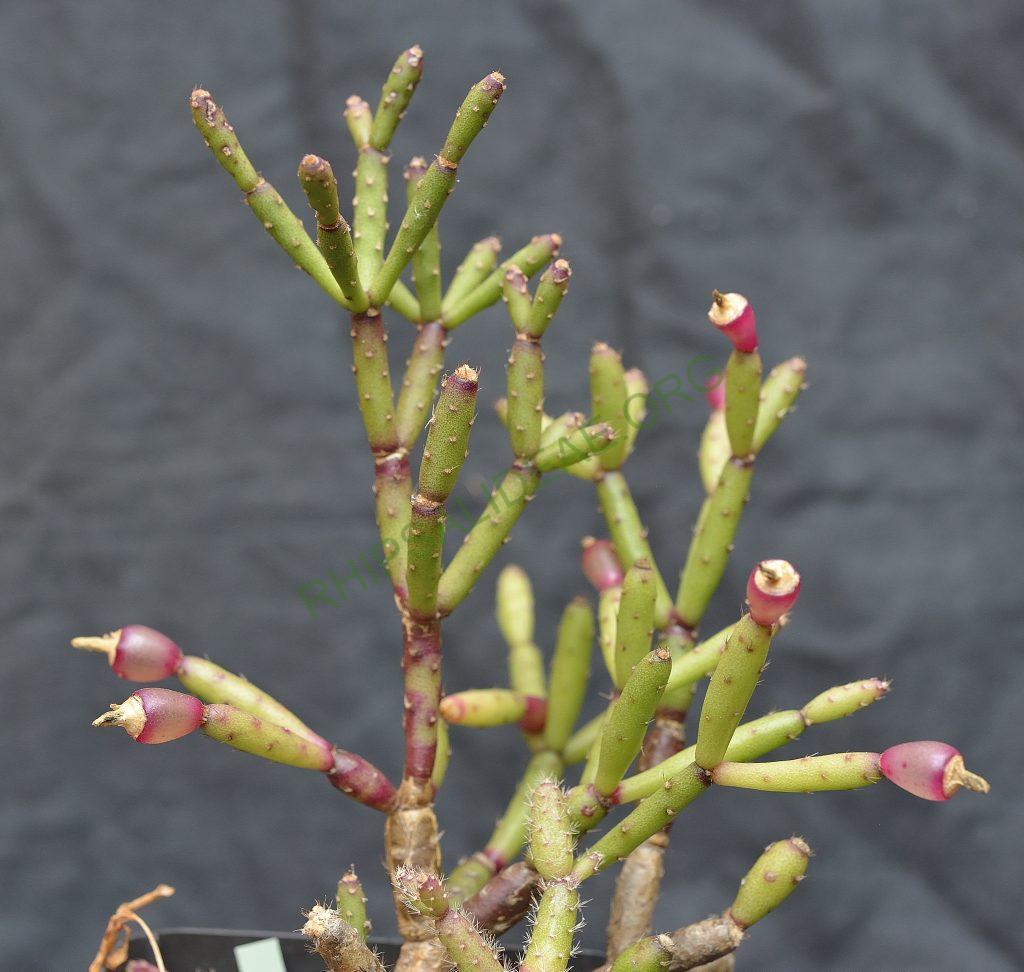


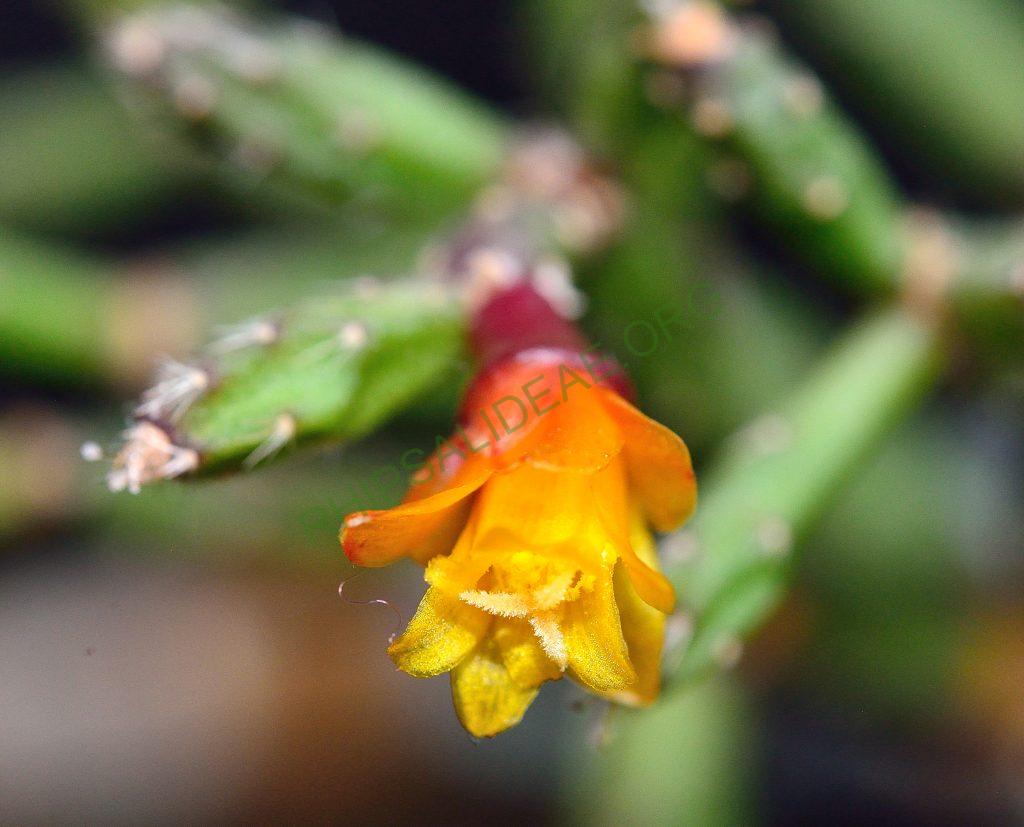


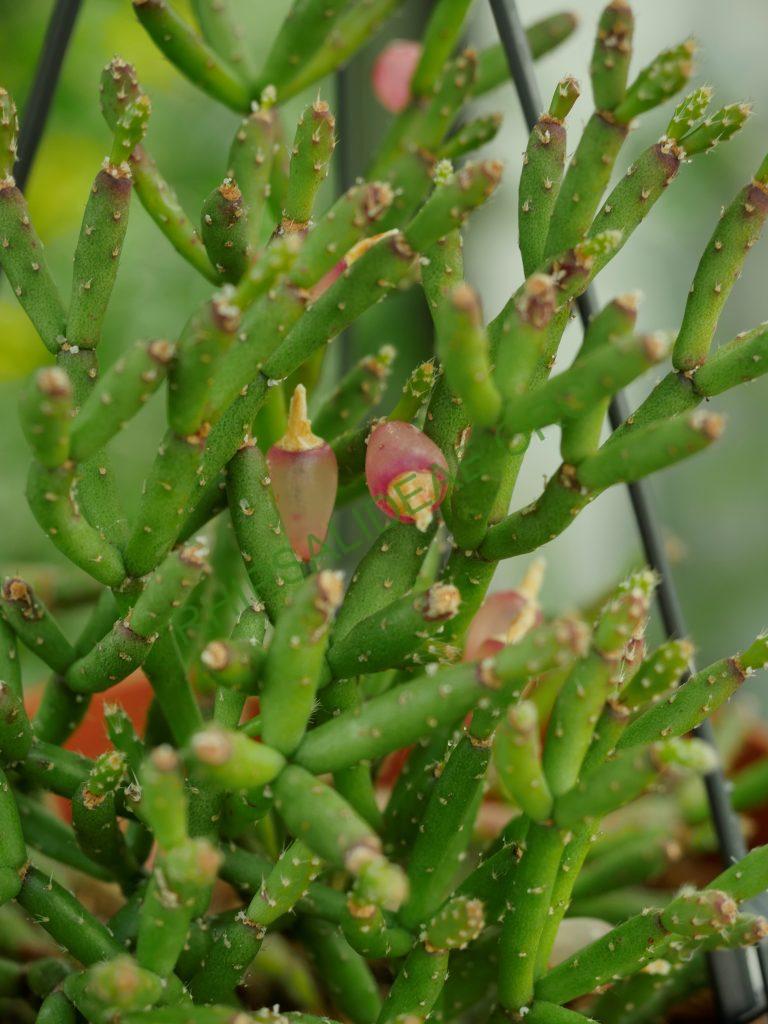
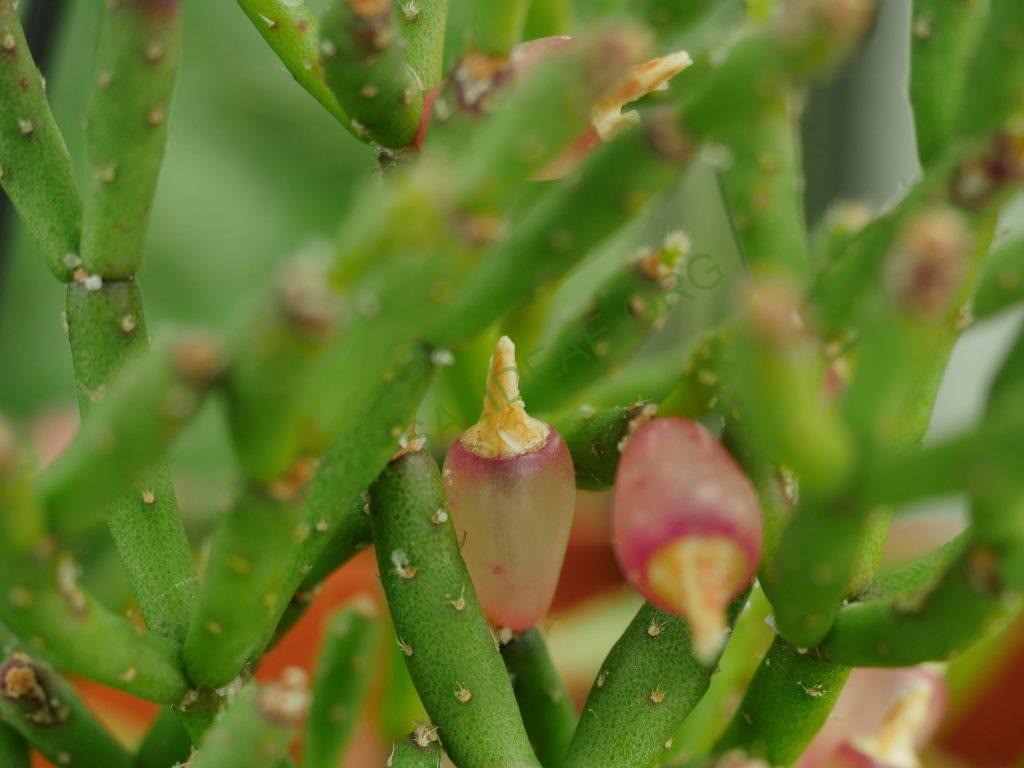

Bonn 12190

Reduced synonym H. bambusoides, Barthlott & Taylor (1995)
(multiple specimen of H. salicornioides f. cylindrica carried the name ‘bambusoides’)



Reduced synonym H. salicornioides f. bambusoides, HBG 122705, from Chad Husby MBC ex. Leland Miyano from Roberto Burle Marx
(multiple specimen of H. salicornioides f. cylindrica carried the name ‘bambusoides’)

No. 41388, reduced synonym H. salicornioides f. bambusoides, Barthlott & Taylor (1995)
(multiple specimen of H. salicornioides f. cylindrica carried the name ‘bambusoides’)

© W. Barthlott, Lotus-Salvinia.de
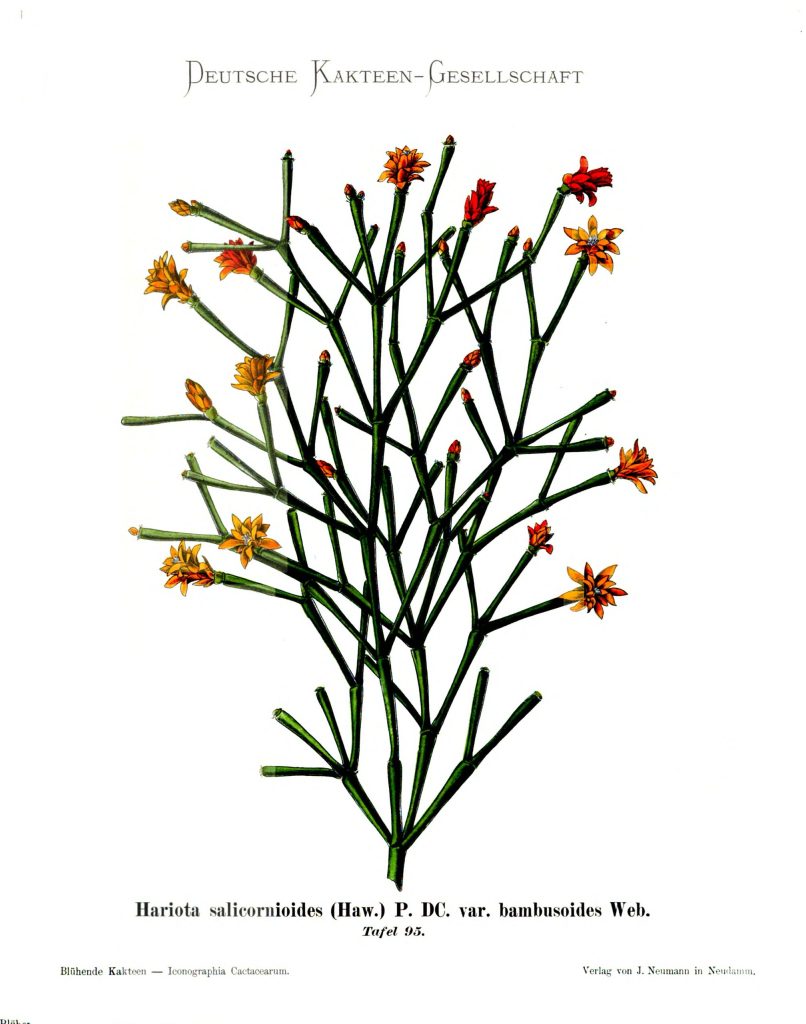
Photograph below of a specimen that matches well to the original description of R. salicornioides var. bambusoides by Dr. Weber in Revue horticole, 1892 and later botanical sketch in Blühende Kakteen – Iconographia Cactacearum, 1907, Tafel 95.
A translated excerpt from Dr. Weber’s description:
“Large specimens, introduced from Brazil to the Jardin-des-Plantes in Paris, offer a very different form. Their stem is very rigid, erect, straight; it rises to nearly 2 meters in height, and forms internodes 3 to 4 centimeters long, so as to absolutely resemble a bamboo stem. Their articles are much more elongated, less attenuated at the base, and the flowers are generally orange-yellow, sometimes almost red.”
Following the original description more specimen found growing upright with less smooth knobby stems were included under R. salicornioides var. bambusoides.
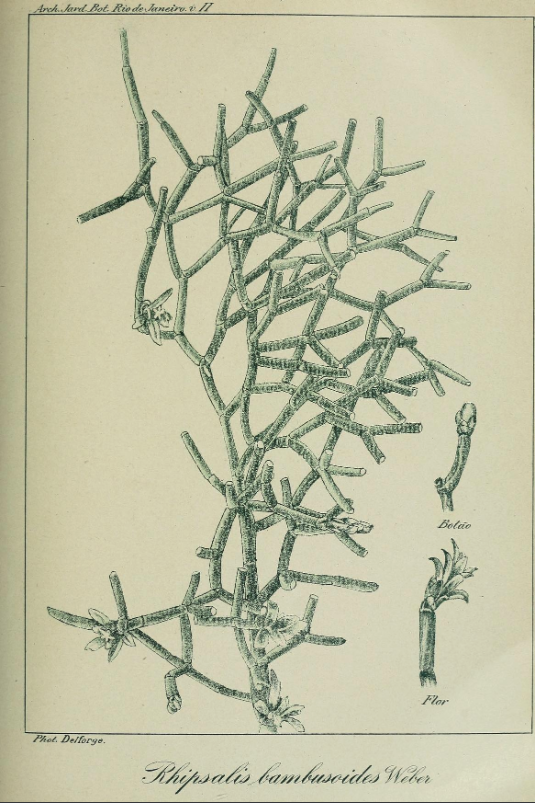
In Archivos do Jardim Botânico do Rio de Janeiro, 1917 we see an illustration of R. bambusoides similar to the HBG 122705 specimen, or what today we would typically consider H. salicornioides f. cylindrica due to large scale commercialization of similar specimen.
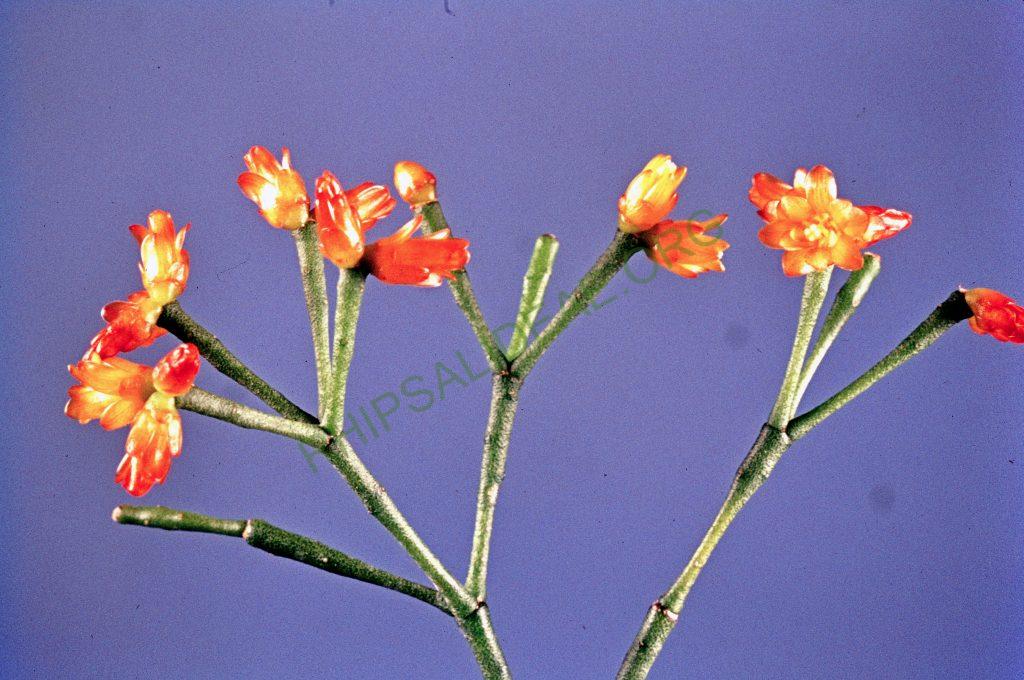
BGGO 9608


ISI 95-10
A clone released from the International Succulent Introductions in 1995, the released material is from Huntington Botanical Gardens: “HBG 52257, a plant received as Pierre Braun 459 and collected by him in 1984 from Sao Joao del Rei, Minas Gerais, Brazil at 1500m.”


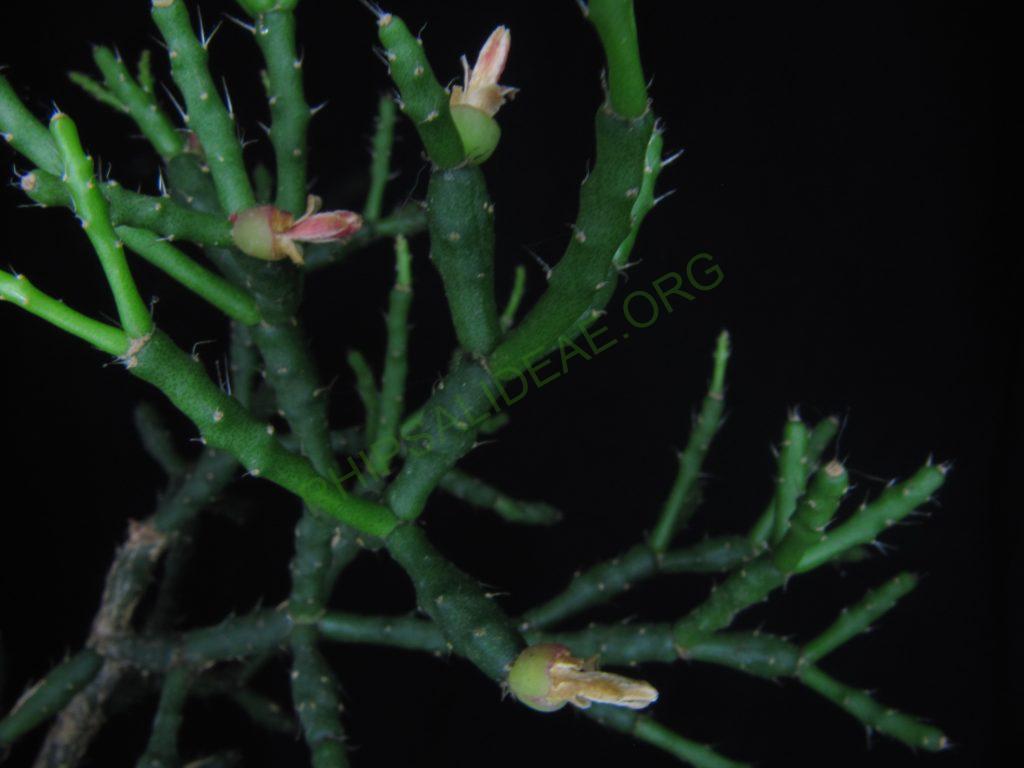

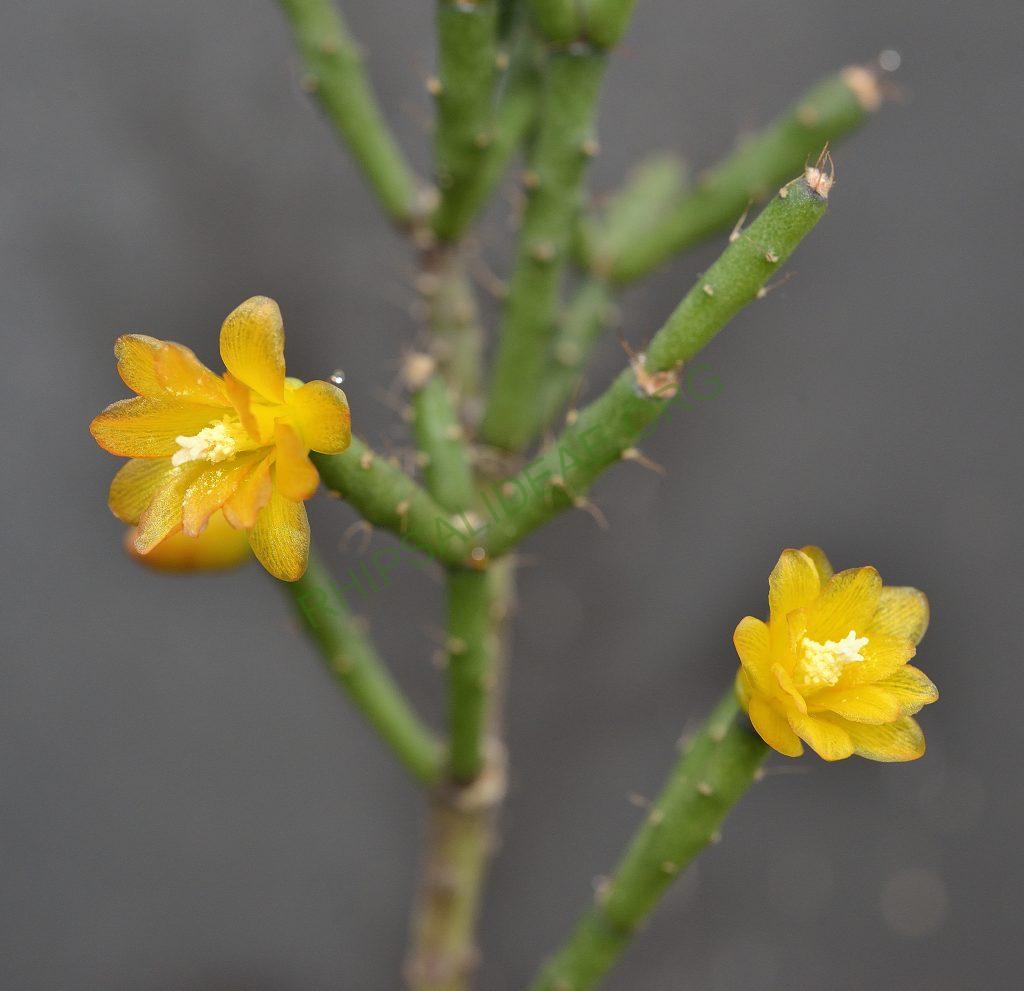
New Clone ISI 95-10, ex Rainbow Gardens
It is unknown why New Clone was prepended onto the name of this clone, ISI 95-10 was a clone released from the International Succulent Introductions in 1995, the released material is from Huntington Botanical Gardens: “HBG52257, a plant received as Pierre Braun459 and collected by him in 1984 from Sao Joao del Rei, Minas Gerais, Brazil at 1500m.”


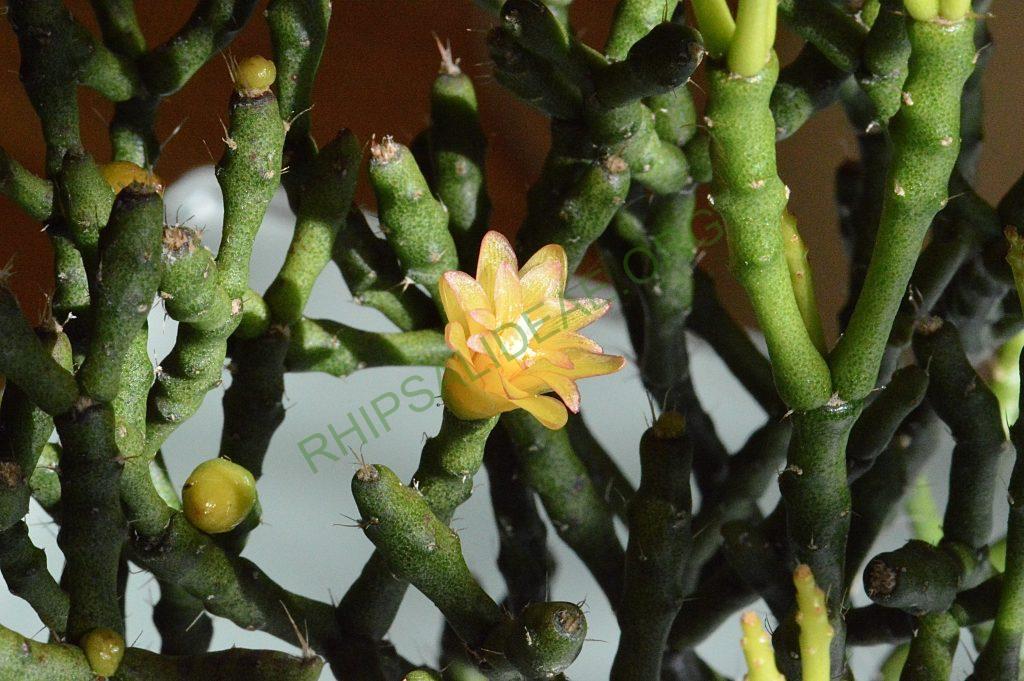


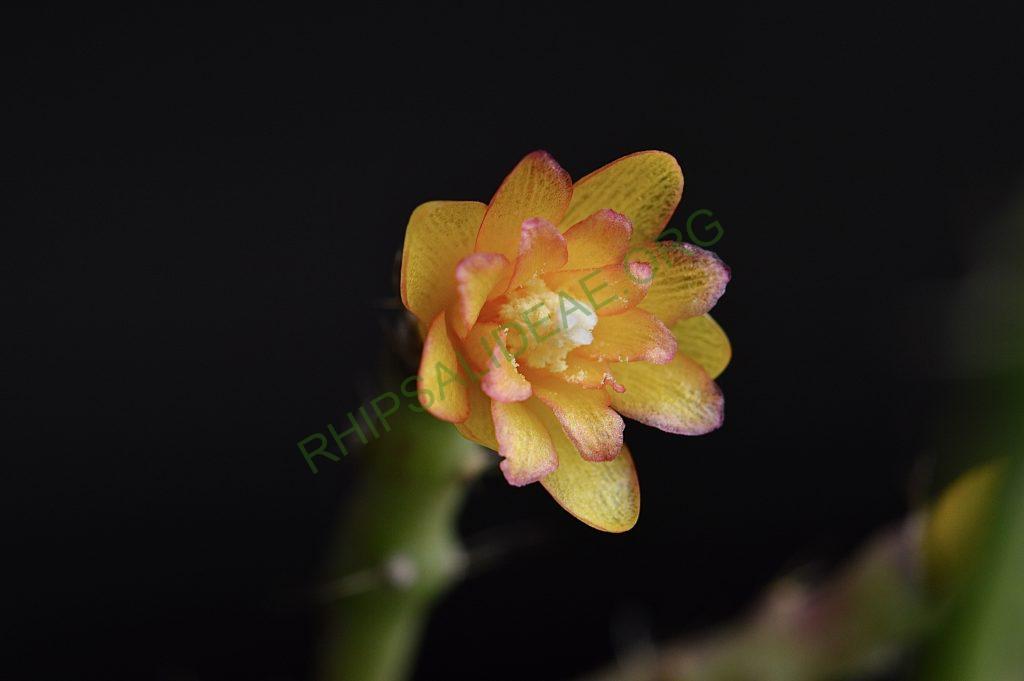


AH 747, Forno Grande, Espírito Santo, Brazil

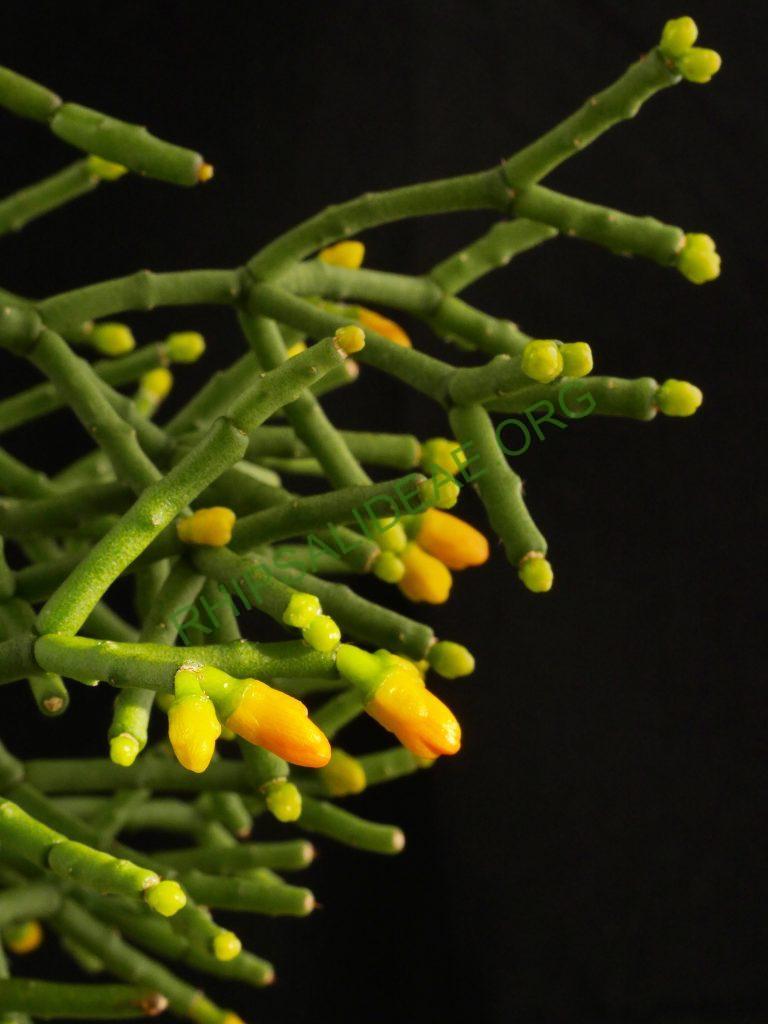

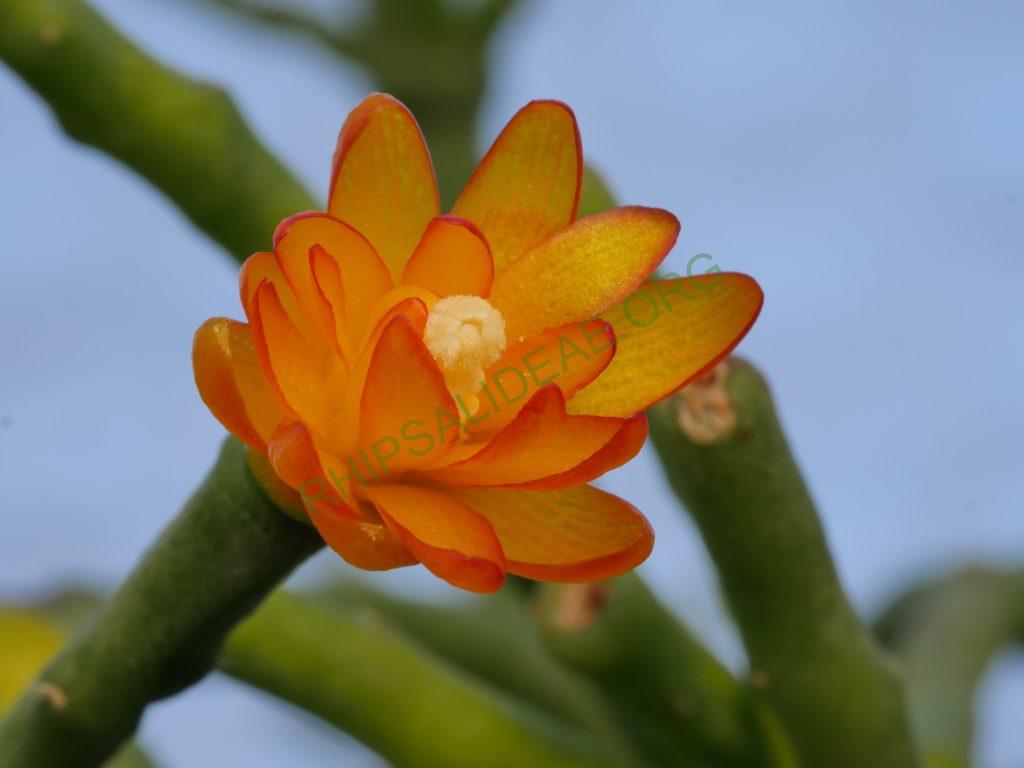

Kew


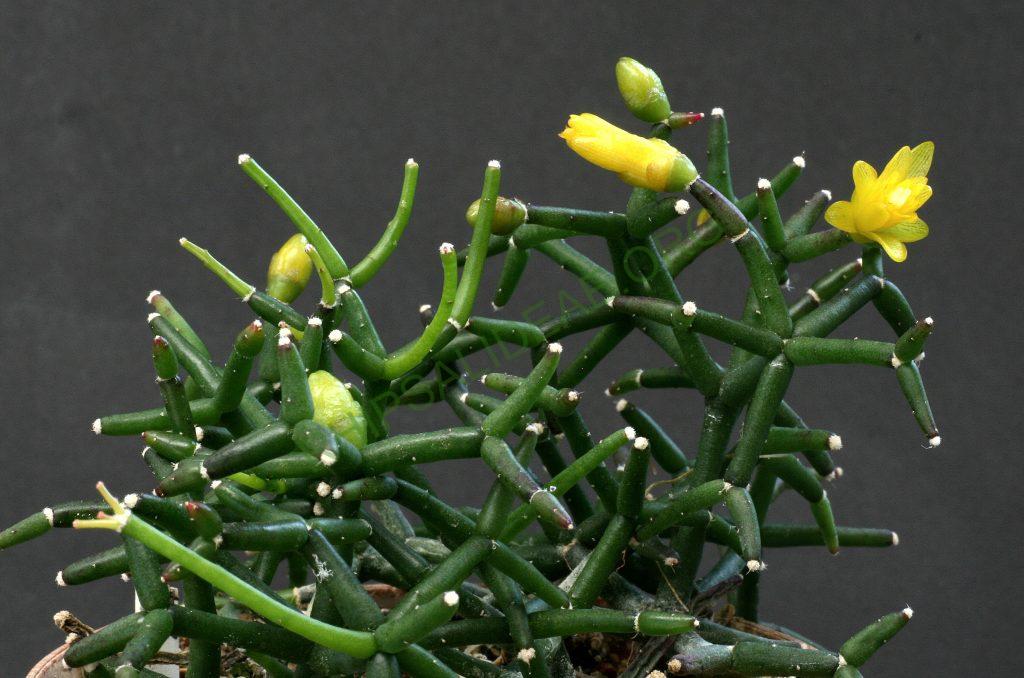
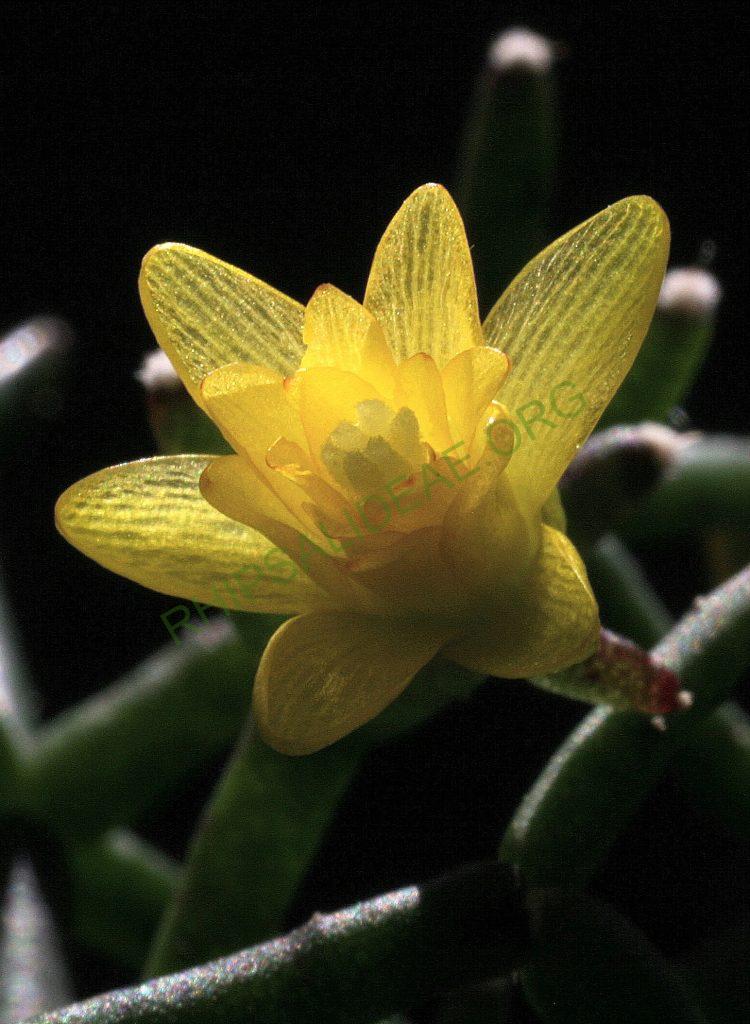
© W. Barthlott, Lotus-Salvinia.de


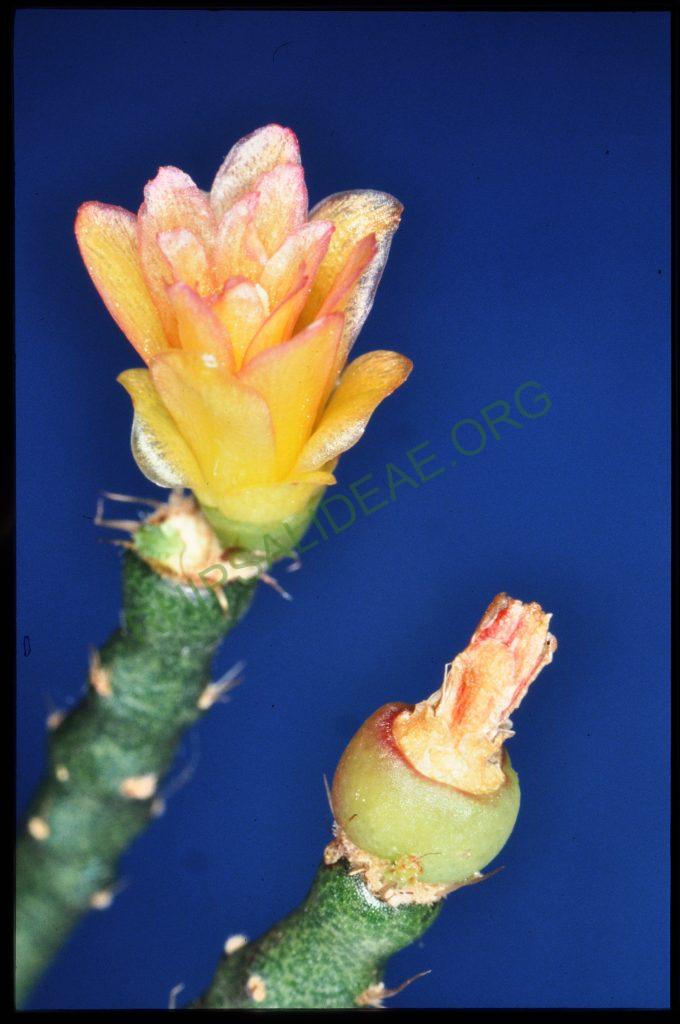
Neotenic (juvenile) forms, © W. Barthlott, Lotus-Salvinia.de


Unknown clone


Unknown clone


Unknown clone

Unknown clone


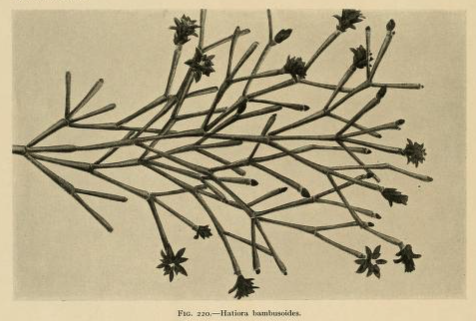
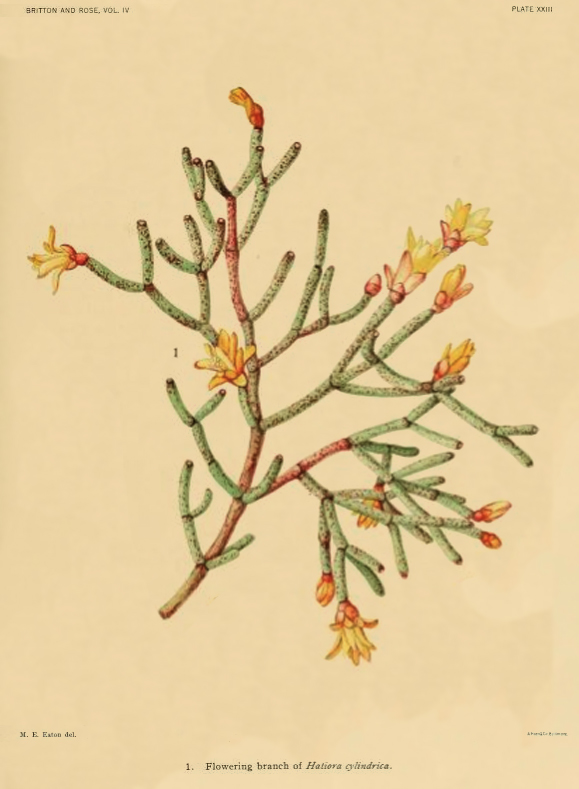
Botanical illustrations and historical images
Description
| The accepted name Hatiora salicornioides f. cylindrica (Britton & Rose) Süpplie was published in Rhipsalidinae: 65. 1990. The geographic range is Brazil (Rio de Janeiro, Bahia, Minas Gerais) found at elevations of 0-1200 meters with an endangered status of endangered. Hatiora salicornioides f. cylindrica is classified in the subgenus Hatiora. Observed growing as an epiphyte or lithophyte. Overall habit is pendant, semi-erect or erect, branches are monomorphic (single stem shape) and acrotonic (stems form from the tips of previous stems). Stems are round and slightly clavate, bristles are absent to sparse. Main stems are determinate (seasonal growth is about the same length), 3cm-5cm x 0.2cm-0.7cm. Flowers are campanulate or infundibuliform (bell or funnel shaped), unreported x 0.4cm-1.2cm. Petals 18, sepal count is unreported. Inner petals are yellow, orange or red, outer petals are yellow, green, orange or red. Stamen are white, count is unreported. Stigma lobes count is unreported. Flower ovary is obconic, 0.2cm-0.4cm x 0.2cm-0.3cm. Flowering position on the stem is apical and the flower orientation in relation to the stem is parallel. It is unreported whether flowering repeats per areole. A maximum of 1 flowers were reported at a single areole. Areole position in the stems is superficial (flower ovary is visible on the surface of the stems during bud development). Trichomes or wool is sparse at the areoles after flowering. Unripe fruit is yellow, green, red or purple. Ripe fruit is turbinate; red, purple, white or sometimes with; purple spots, unreported x unreported. Other notable features: The distinguishing characteristics between H. salicornioides f. cylindra and H. salicornioides f. salicornoides are minimal, H. salicornioides f. cylindrica was characterized by having more wide spread open flowers and cylindrical stems. There is a considerable level of variability in the stem shapes and lengths, and there appear to be intermediate specimen between the two forms. Some botanical texts note the distinction as H. salicornioides f. salicornioides having only white fruit while H. salicornioides f. cylindrica only has red fruit, unfortunately the many reductions and botanical descriptions over the years are not clear in that distinction. Comments: Taxanomic treatment is debated as to whether or not H. salicornioides f. cylindrica is a distinct species from H. salicornioides f. salicornioides. Nadja Korotkova writes: "Our data indicate that H. cylindrica might either not be a “good” species but a form or variety of H. salicornioides. But it is also possible that what is known as H. salicornioides is more than one species. This is even likely because very distinct races and ecotypes exist in the wild (N. Taylor, pers. obs). Some H. salicornioides forms have been described as separate taxa, but species-limits are hard to define because of intergrading characters and further differences possibly attributable to cultivated plants, so the additional species names are currently treated as synonyms."1 1Phylogeny and evolution of the epiphytic Rhipsalideae (Cactaceae), Nadja Korotkova, Ph.D. Thesis, 2012 Taxonomic treatment and description were derived from:
|
Hatiora salicornioides f. cylindrica referenced publications
| Title | Authors | Type | Journal | Year | Volume | Issue | Pages | Publisher |
|---|---|---|---|---|---|---|---|---|
| Epifytische cactussen, rhipsalis.eu. Accessed on: 15 Jan. 2025 | Aat van Uijen | Website | 2025 | |||||
| Royal Botanic Gardens Kew | Plants of the World Online. Accessed on: 15 Jan. 2025 | Website | 2025 | ||||||
| The Caryophyllales Network 2015+ [continuously updated]: A global synthesis of species diversity in the angiosperm order Caryophyllales. Accessed on: 15 Jan. 2025 | Website | 2025 | ||||||
| WFO The World Flora Online. Accessed on: 15 Jan. 2025 | Website | 2025 | ||||||
| The IUCN Red List of Threatened Species. Version 2024-2. accessed on 2025-01-07 | Website | 2024 | ||||||
| Cactaceae in a priority area for conservation in Espírito Santo state | Weverson Cardoso, Alice Calvente, Valquíria Dutra, Cassia Sakuragui | Journal Article | Rodriguésia | 2022 | 73 | |||
| Cactaceae at Caryophyllales.org – a dynamic online species-level taxonomic backbone for the family | Nadja Korotkova, David Aquino, Salvador Arias, Urs Eggli, Alan Franck, Carlos Gómez-Hinostrosa, Pablo C. Guerrero, Héctor M. Hernández, Andreas Kohlbecker, Matias Köhler, Katja Luther, Lucas C. Majure, Andreas Müller, Detlev Metzing, Reto Nyffeler, Daniel Sánchez, Boris Schlumpberger, Walter G. Berendsohn | Journal Article | Willdenowia | 2021 | 51 | 2 | 251 – 270 | Botanic Garden and Botanical Museum Berlin (BGBM) |
| Flora do Rio de Janeiro: Cactaceae | Maria de Fátima Freitas, Alice Calvente, Diego Rafael Gonzaga | Journal Article | Rodriguésia | 2020 | 71 | |||
| Ein Juwel der epiphytischen Kakteen: Hatiora herminiae | Andreas Hofacker | Journal Article | Kakteen und andere Sukkulenten | 2013 | 64 | 2 | 39-42 | |
| Phylogeny and evolution of the epiphytic Rhipsalideae (Cactaceae) | Nadja Korotkova | Ph.D. Thesis | 2012 | Rheinische Friedrich-Wilhelms-Universität Bonn | ||||
| Molecular phylogeny of tribe Rhipsalideae (Cactaceae) and taxonomic implications for Schlumbergera and Hatiora | Alice Calvente, Daniela C. Zappi, Félix Forest, Lúcia G. Lohmann | Journal Article | Molecular Phylogenetics and Evolution | 2011 | 58 | 3 | 456-468 | |
| What does it take to resolve relationship and to identify species with molecular markers? An example from the epiphytic Rhipsalideae (Cactaceae) | Nadja Korotkova, Borsch T, Dietmar Quandt, Nigel P. Taylor, Müller K, Wilhelm Barthlott | Journal Article | American Journal of Botany | 2011 | 98 | 1549-1572 | ||
| Molecular phylogeny, evolution and systematics of Rhipsalis (Cactaceae) | Alice Calvente | Ph.D. Thesis | 2010 | Instituto de Biociências da Universidade de São Paulo | ||||
| Cactaceae | Daniela C. Zappi, Lidyanne Yuriko Saleme Aona, Nigel P. Taylor | Journal Article | Flora Fanerogâmica do Estado de São Paulo | 2007 | 5 | 180-193 | ||
| The New Cactus Lexicon: Atlas of illustrations | David Hunt, Nigel P. Taylor, Graham Charles | Book | 2006 | 104-120 | DH Books | |||
| Cacti of Eastern Brazil | Nigel P. Taylor, Daniela C. Zappi | Book | 2004 | The Royal Botanic Gardens, Kew | ||||
| Die Namen der Gattungen und Arten epiphytischer Kakteen. Teil 1. Rhipsalideae | Ralf Bauer | Journal Article | EPIG | 1996 | 8 | 2 | 47-51 | |
| Hatiora - die Osterkakteen und ihre Verwandten | Wilhelm Barthlott, Nigel P. Taylor | Journal Article | Kakteen und andere Sukkulenten | 1996 | 47 | 4 | 73-77 | |
| Notes towards a Monograph of Rhipsalideae (Cactaceae) | Wilhelm Barthlott, Nigel P. Taylor | Journal Article | Bradleya | 1995 | 13 | 43-79 | British Cactus and Succulent Society | |
| Cactus Lexicon | Curt Backeberg, Walther Haage | Book | 1966 | 205,220-222,440-449, 647, 750 | Blandford Press Ltd. (1966-1973) | |||
| The Cactaceae : descriptions and illustrations of plants of the cactus family | Nathaniel Lord Britton, Mary E. Eaton, N. J. Rose, Helen Adelaide Wood | Book | 1923 | 4 | 208-247 | Carnegie Institution of Washington | ||
| Monatsschrift für Kakteenkunde | Book | 1921 | 31-32 (1921-1922) | 144 | Neudamm, J. Neumann | |||
| Monatsschrift für Kakteenkunde | Book | 1918 | 28 | 133-136 | Neudamm, J. Neumann | |||
| Blühende Kakteen (Iconographia Cactacearum): Im auftrage der Deutschen Kakteen-Gesellschaft | Karl Schumann, Toni Gürke | Book | 1907 | 24 | 95 | |||
| Dictionnaire d'horticulture illustré | D. Bois | Book | 1893 | 1045-1048 | P. Klincksieck | |||
| Revisio generum plantarum vascularium omnium atque cellularium multarum secundum leges nomenclaturae internationales cum enumeratione plantarum exoticarum in itinere mundi collectarum, mit erläuterungen | Otto Kuntze | Book | 1891 | 1 | 261 | A. Felix | ||
| Die Gartenwelt | Max Hesdörffer | Book | 1897 | 13 | 117 | G. Schmidt |
Reduced Synonyms
| Name | Reduced by | Published Date | Published In |
|---|---|---|---|
| Hatiora cylindrica Britton & Rose | Barthlott & Taylor (1995) | 1923 | Cactaceae 4: 219. 1923 |
| Rhipsalis cylindrica (Britton & Rose) Vaupel | Barthlott & Taylor (1995) | 1925 | Kakteen 1: 39. 1925 |
| Hariota cylindrica (Britton & Rose) A.Berger | Barthlott & Taylor (1995) | 1929 | Kakteen: 96. 1929 |
| Rhipsalis salicornioides var. cylindrica (Britton & Rose) Kimnach | Korotkova (2021) | 1996 | Cact. Succ. J. (Los Angeles) 68: 156. 1996 |
| Rhipsalis salicornioides var. bambusoides F.A.C.Weber | IPNI | 1892 | Rev. Hort. (Paris) 64: 429. 1892 |
| Hariota bambusoides (F.A.C.Weber) F.A.C.Weber | Barthlott & Taylor (1995) | 1898 | Bois, Dict. Hort.: 1048. 1898 |
| Rhipsalis bambusoides F.A.C.Weber | Barthlott & Taylor (1995) | 1898 | Bois Dict. Hort.: 1048. 1898 |
| Hatiora bambusoides (F.A.C.Weber) Britton & Rose | Barthlott & Taylor (1995) | 1923 | Cactaceae 4: 218. 1923 |
| Hatiora salicornioides f. bambusoides (F.A.C.Weber) Supplie | IPNI | 1990 | Repert. Pl. Succ. 41: 8. 1990 |
| Rhipsalis bambusoides Loefgr. | Barthlott & Taylor (1995) | 1918 | Arch. Jard. Bot. Rio de Janeiro 2: 41. 1918 |