
Rhipsalis cuneata subsp. cuneata Britton & Rose
Images | Description | Publications | Reduced Synonyms
Bonn 12957, Villa Tunari, Cochambamba, Bolivia, 1450m, Ibisch & Ibisch – material sampled, Phylogeny and evolution of the epiphytic Rhipsalideae (Cactaceae), Nadja Korotkova, Ph.D. Thesis, 2012 and Molecular Phylogeny, Evolution, and Biogeography of South American Epiphytic Cacti, Alice Calvente, Daniela C. Zappi, Félix Forest, Lúcia G. Lohmann, International Journal of Plant Sciences, 172:7, 2011
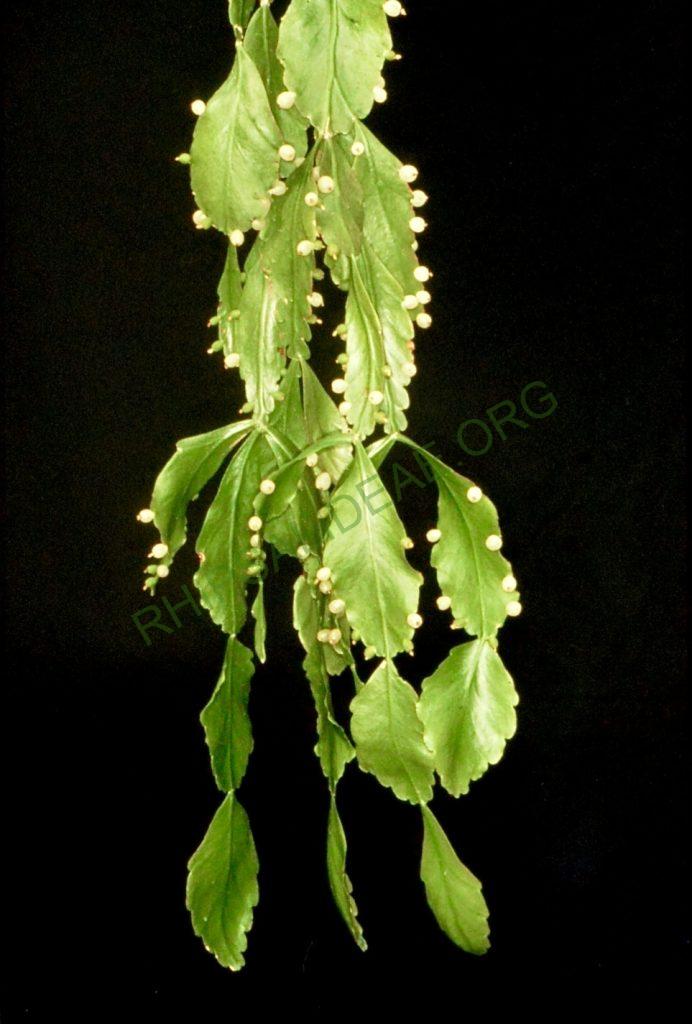
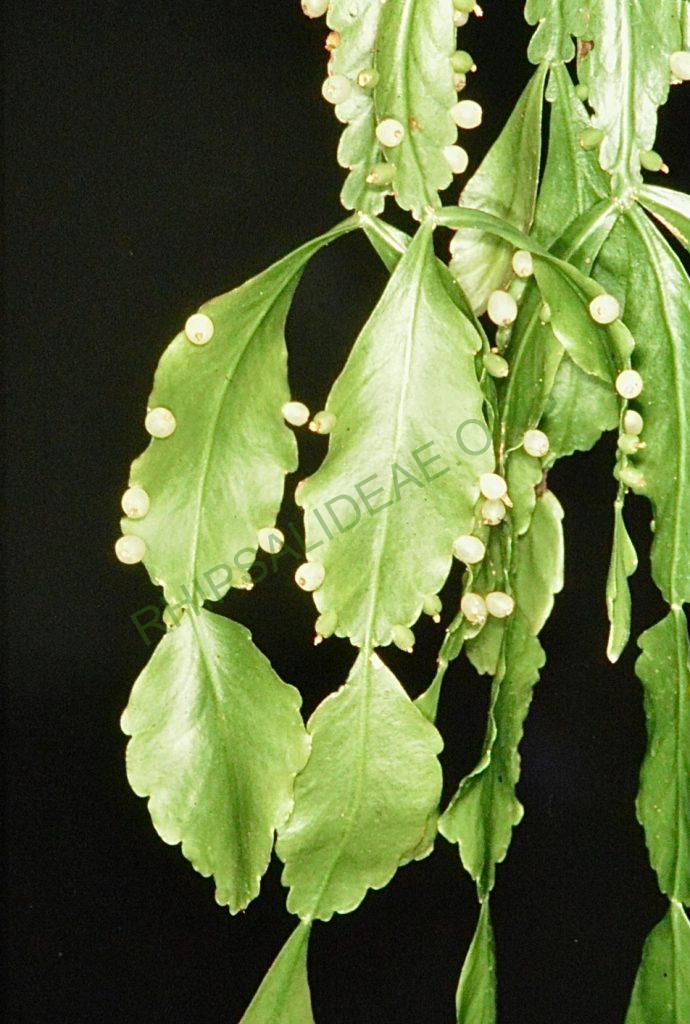

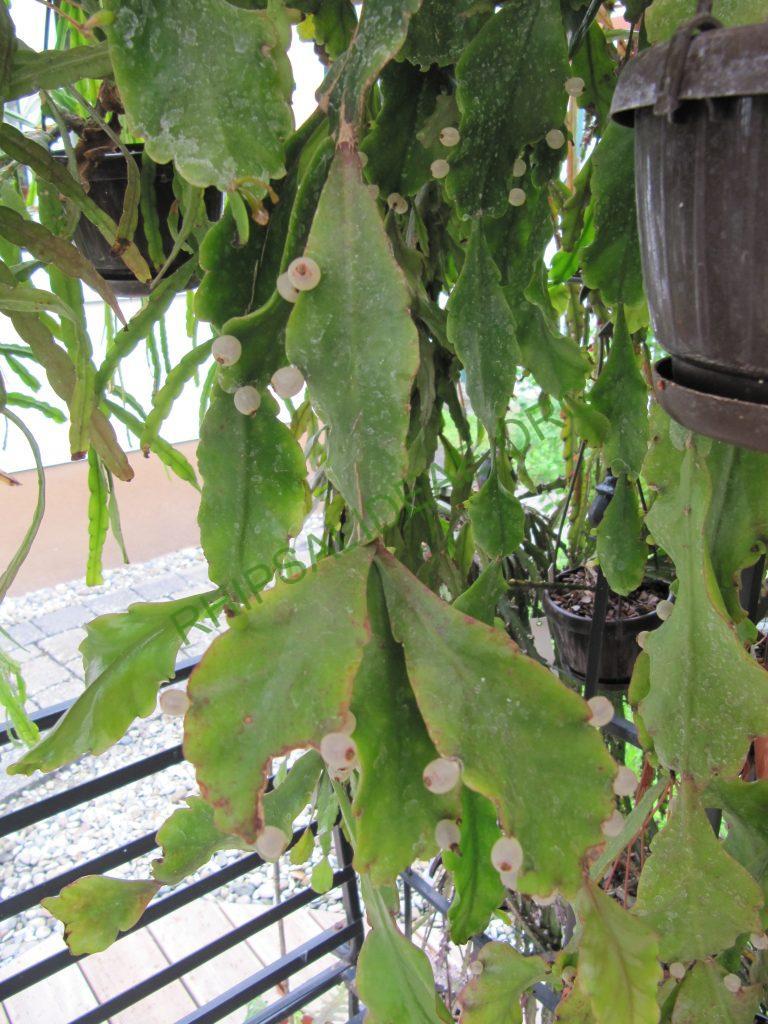
Unknown clone
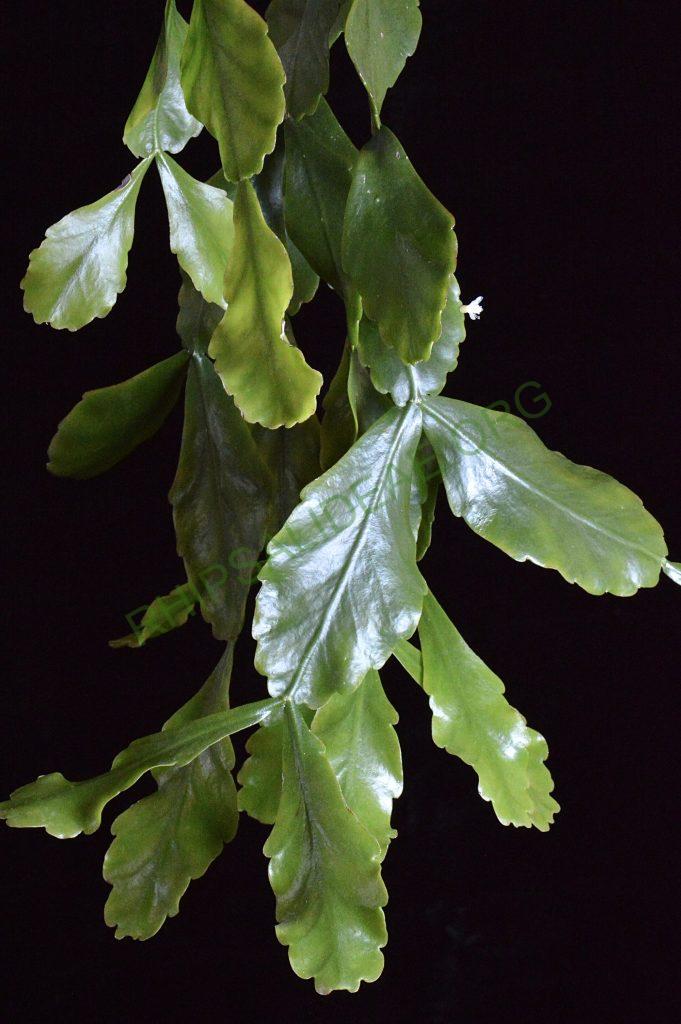
Botanical illustrations and historical images
Description
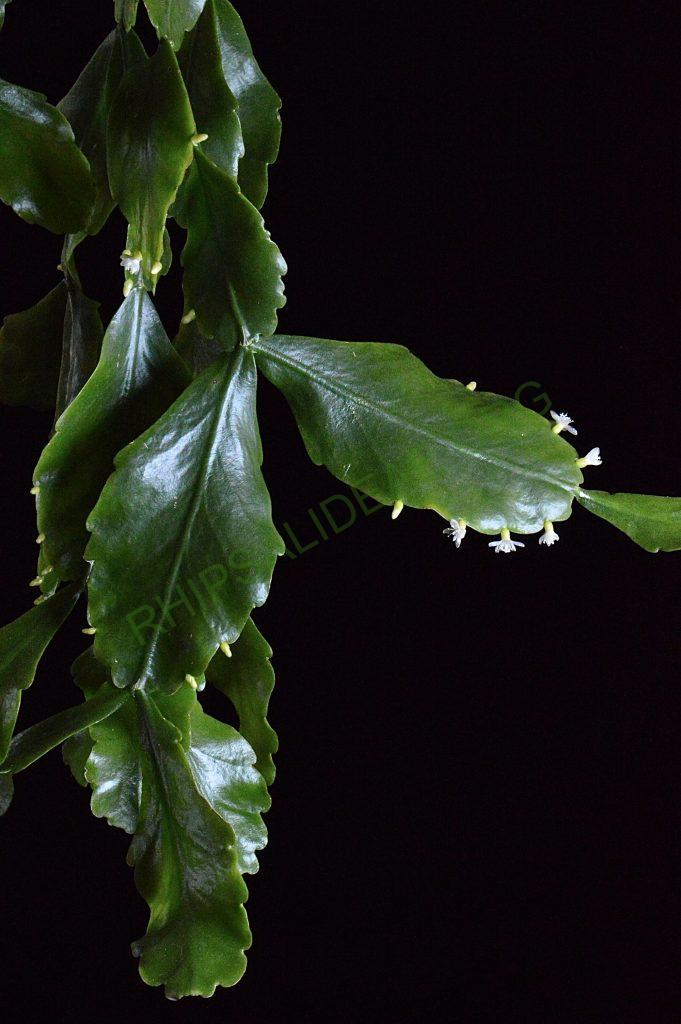
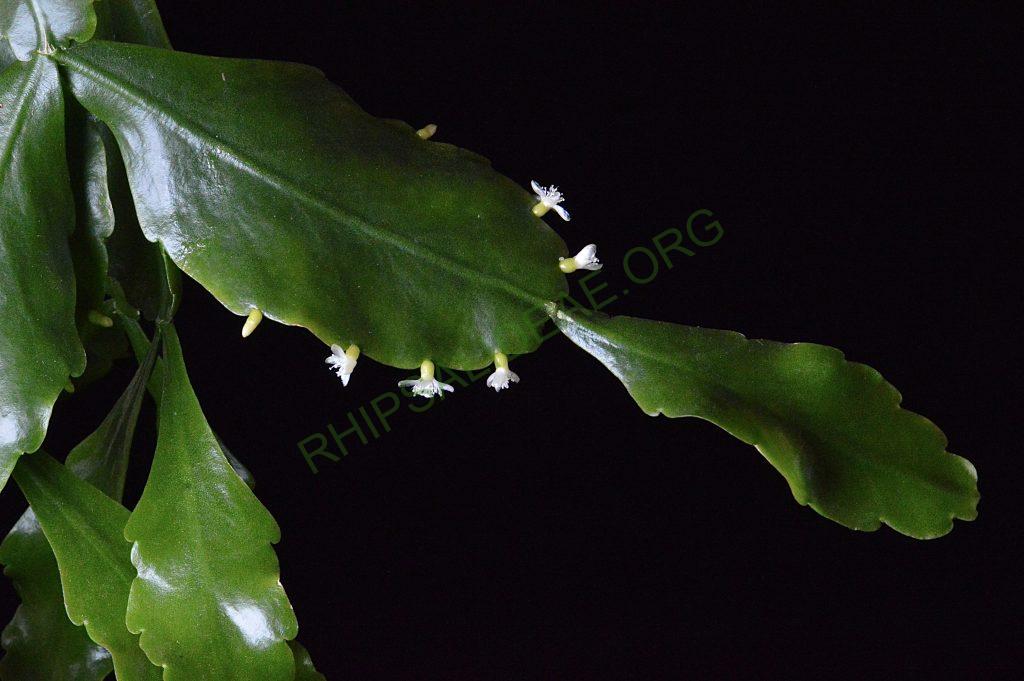
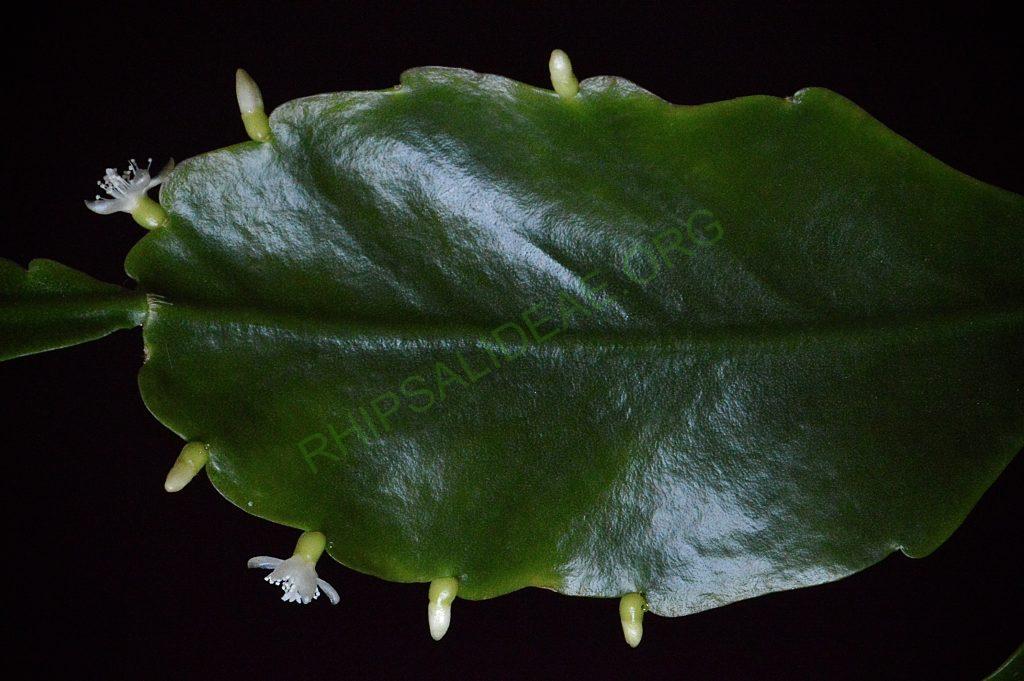
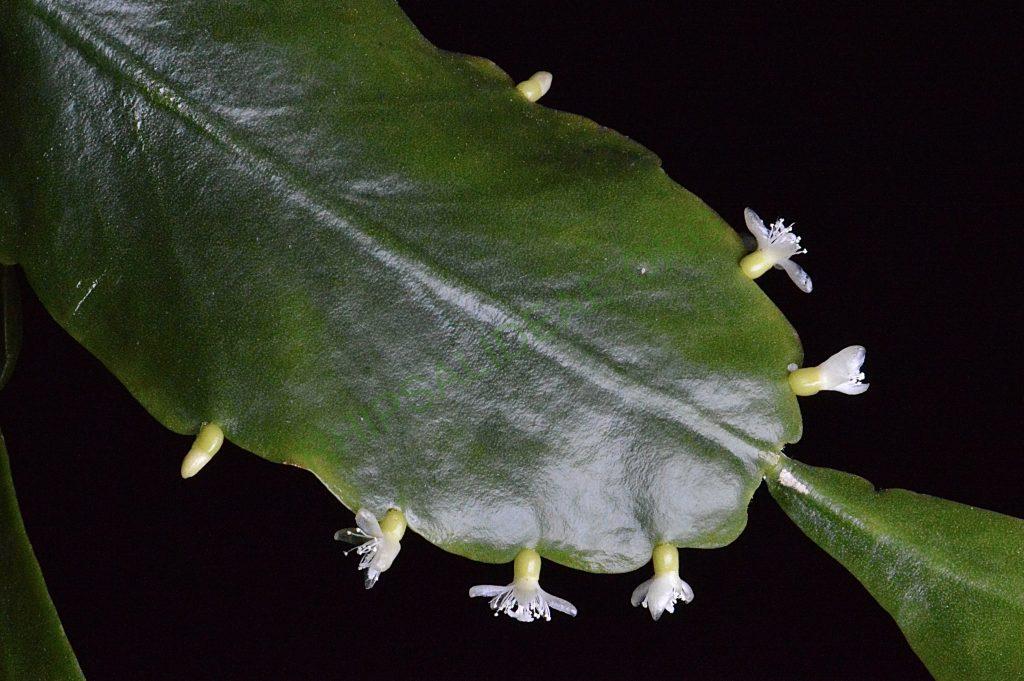
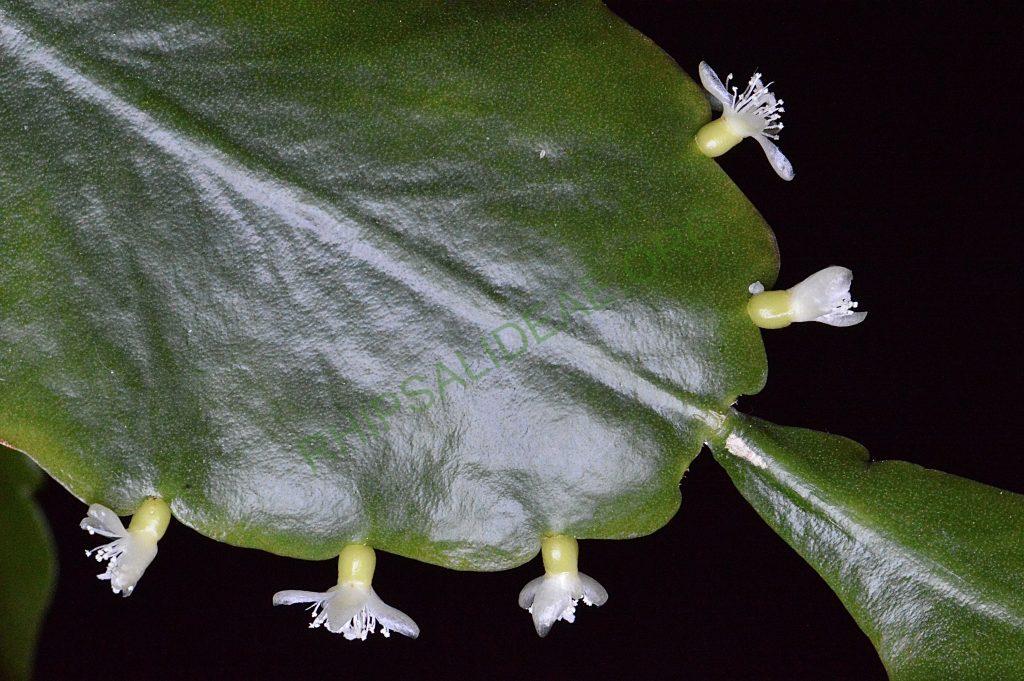
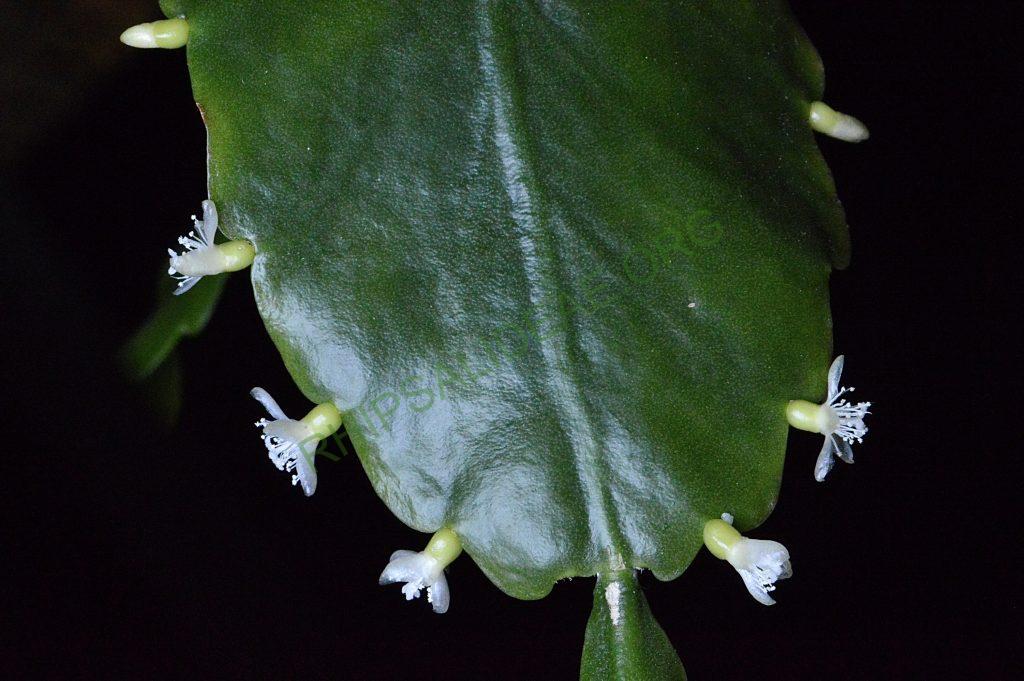
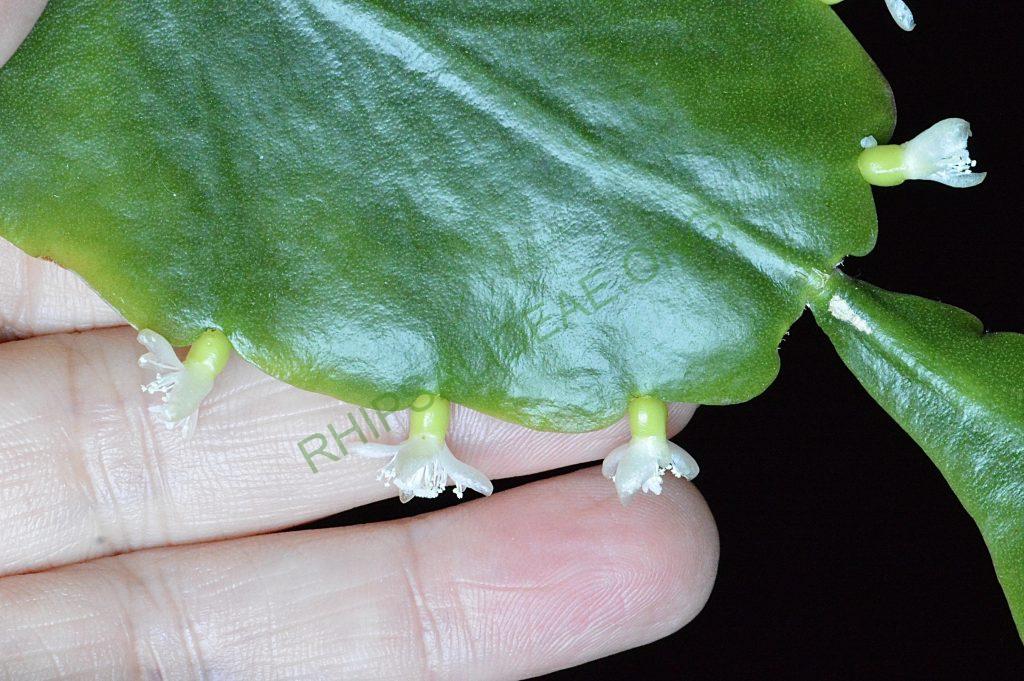
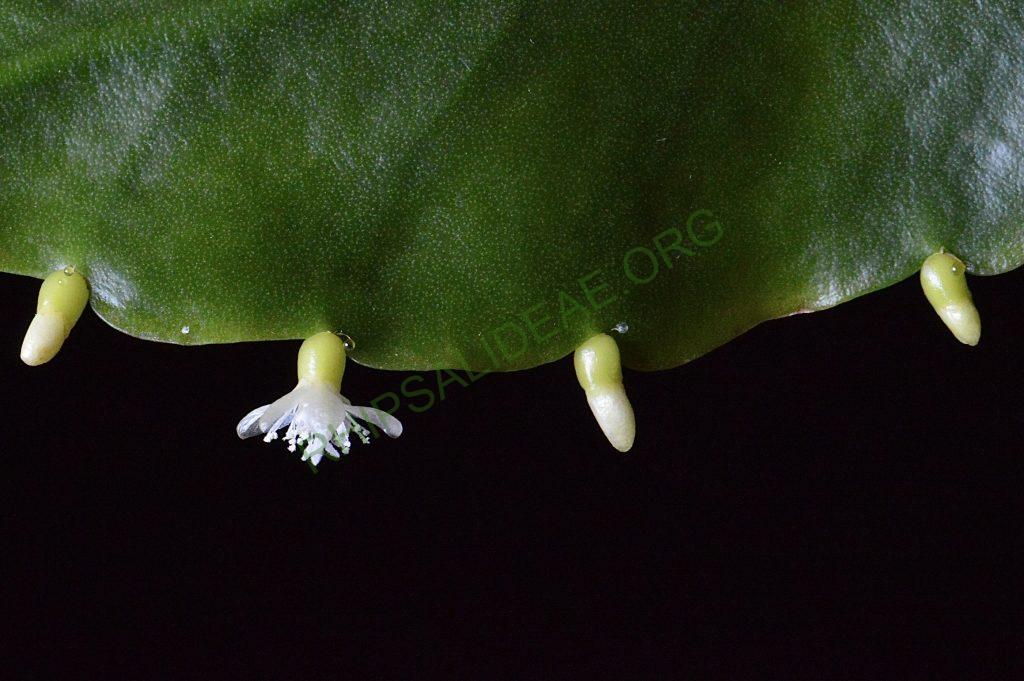
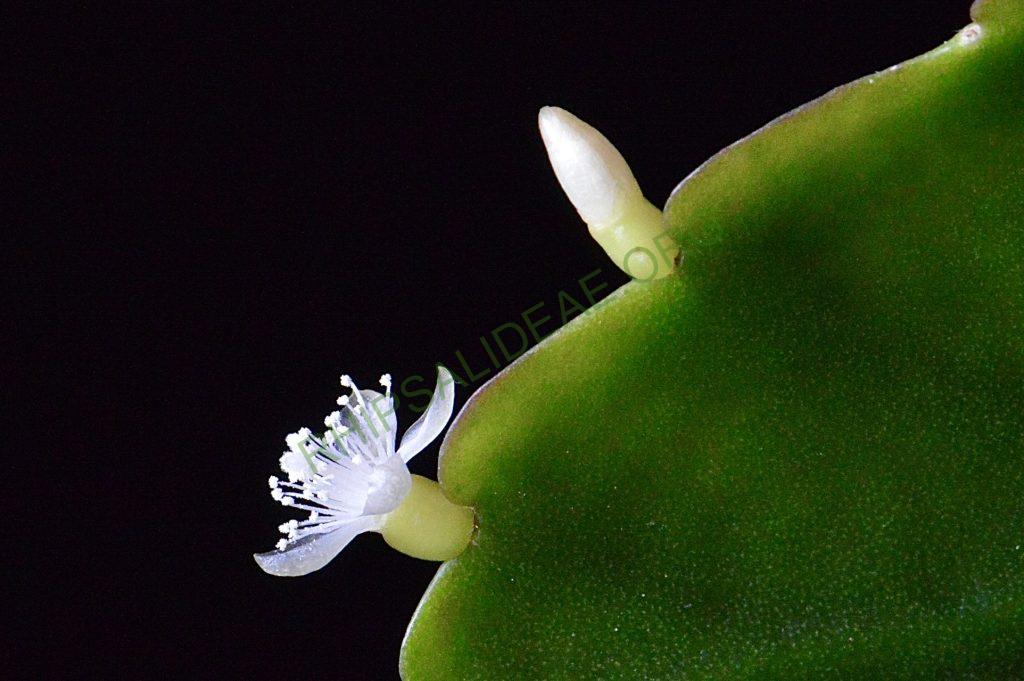
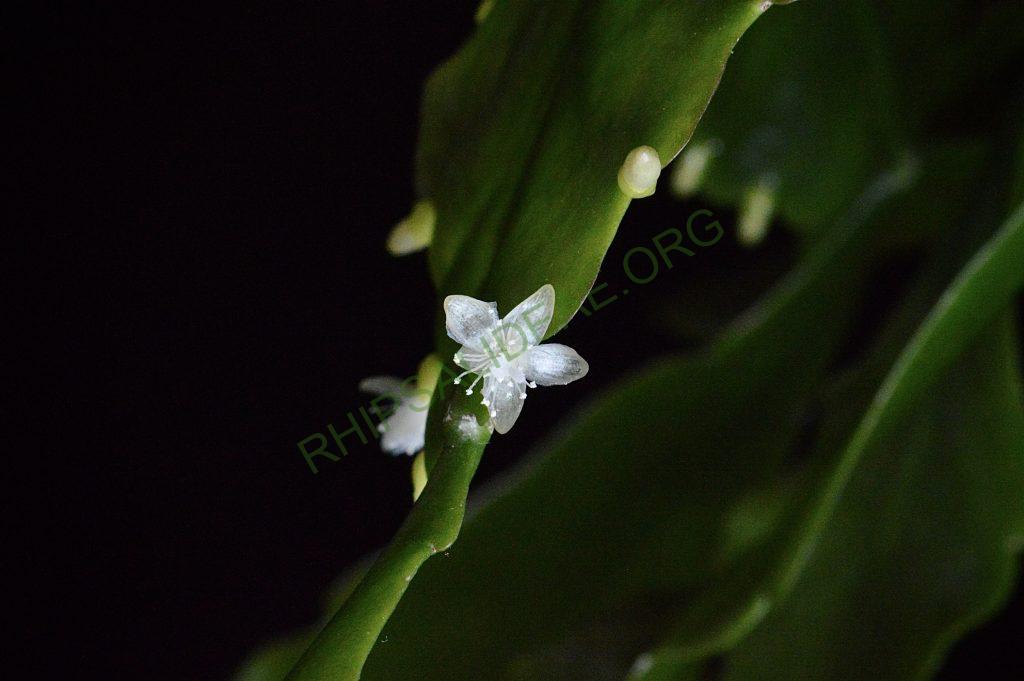
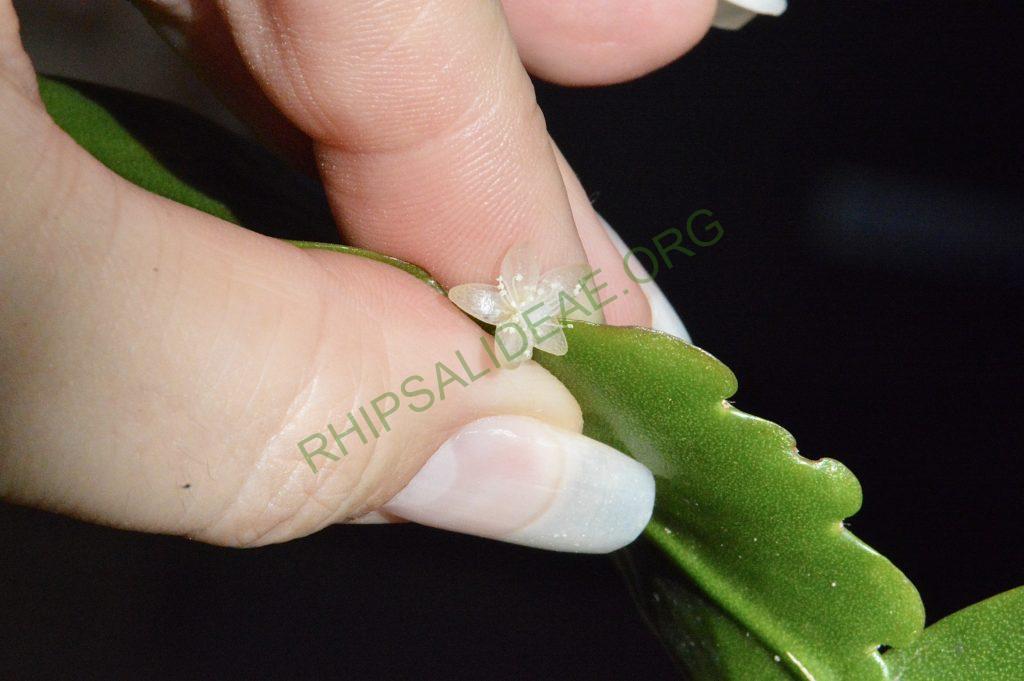
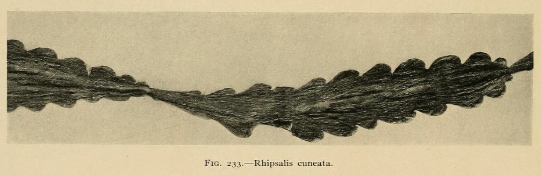
| The accepted name Rhipsalis cuneata subsp. cuneata Britton & Rose was published in Cactaceae 4: 246. 1923. The geographic range is Bolivia (Yungas) found at elevations of 700-1500 meters with an endangered status of least concern. Rhipsalis cuneata subsp. cuneata is classified in the subgenus Phyllarthrorhipsalis. Observed growing as an epiphyte. Overall habit is pendant, branches are dimorphic (more than one stem shape) and acrotonic or mesotonic (stems form from the tips to middle of previous stems). Stems are 2 to 3 angled, margins have low to deep crenations, at times undulating or frilled (slightly to deeply scalloped), bristles are absent. Basal stems are indeterminate (seasonal growth is various lengths), 25cm x unreported. Main stems are determinate (seasonal growth is about the same length), 5.5cm-17cm x 1cm-6cm. Flowers are rotate: reflexed (wheel shaped: reflexed), unreported x 0.8cm. Petals from 5 to 7, sepals from 1 to 3. Inner petals are translucent-white, outer petals are white, cream, green or pink. Stamen are white, from 25 to 60. Stigma lobes from 3 to 5. Flower ovary is globose, obovoid or cylindrical, 0.2cm-0.4cm x 0.2cm. Flowering position on the stem is lateral and the flower orientation in relation to the stem is perpendicular. Does repeat flowering per areole. A maximum of 2 flowers were reported at a single areole. Areole position in the stems is superficial (flower ovary is visible on the surface of the stems during bud development). Trichomes or wool is absent at the areoles after flowering. Unripe fruit is green. Ripe fruit is globose; white, 0.5cm-0.9cm x 0.4cm-0.8cm. Other notable features: Stems are consistently wedge shaped at the base. R. cuneata is closely related to1,2 and can be difficult to distinguish from some specimen of R. barthlottii, R. crispata, R. occidentalis, and R. oblonga. The truest identifiable characteristics are the white fruit color and shape, inner stamen being shorter than outer stamen, consistent wedge shape at the base of the stems, and smaller translucent predominantly white flowers. It is very closely related to R. occidentalis1,2 and is possibly a synonym3 of it. thinner stemmed specimen can present with undulating or frilly stem margins, but that is not a good identifying characteristic for this species as R. barthlottii, R. crispata, R. oblonga, R. occidentalis, R. goebeliana, and R. rhombea at least can also present the same characteristic. Comments: P.L. Ibisch, M. Kessler, C. Nowicki and W. Barthlott, indicated specimen found growing at higher elevations in Bolivia were R. goebeliana4, they have since however been treated as a R. cuneata subsp. cuneata by Ralf Bauer3. R. goebeliana specimen growing at lower elevations were also treated as R. cuneata subsp. australis3. R. goebeliana has not been found in the wild, any attribution of R. goebeliana found in Bolivia should be treated as R. cuneata subsp. cuneata or R. cuneata subsp. australis3. R. cuneata subsp. cuneata (Photo 8: R. cuneata subsp. cuneata) and R. cuneata subsp. australis (Photo 10: R. goebeliana) can be seen pictured on page 29 of Bradley 18. EPIG 62 contains several more photographs of R. cuneata subsp. cuneata (images from Ecuador and Peru should be regarded as R. occidentalis), R. cuneata subsp. australis, and R. goebeliana (only known from cultivated material). R. occidentalis (Ecuador and Peru) was synonymized with R. cuneata subsp. cuneata (Bolivia) by Bauer3, however later molecular phylogenetic studies kept the species separate1,2, no reason was provided for the separate treatment. Pictures of R. occidentalis from (Ecuador and Peru) can found in Rhipsalis occidentalis Barthlott et Rauh. Eine neue Art mit blattartig abgeflachten Sprossen aus Ecuador und Peru, Wilhelm Barthlott, Werner Rauh, Kakteen und andere Sukkulenten 38:1 16-19, 1987. 1Phylogeny and evolution of the epiphytic Rhipsalideae (Cactaceae), Nadja Korotkova, Ph.D. Thesis, 2012 2Molecular phylogeny, evolution and systematics of Rhipsalis (Cactaceae), Alice Calvente, Ph.D. Thesis, 2010 3Rhipsalis cuneata Britton & Rose, eine variable Art mit flachen Trieben von den Ostabhängen der Anden Boliviens, Perus and Ecuadors - mit Beschreibung der neuen Unterart R. cuneata subsp. australis Ralf Bauer subsp. nov., Ralf Bauer, EPIG, 62:5-28, 2008 4Ecology, biogeography and diversity of the Bolivian epiphytic cacti — with the description of two new taxa, P.L. Ibisch, M. Kessler, C. Nowicki & W. Barthlott, Bradleya, 18:2-30, 2000 Taxonomic treatment and description were derived from:
|
Rhipsalis cuneata subsp. cuneata referenced publications
| Title | Authors | Type | Journal | Year | Volume | Issue | Pages | Publisher |
|---|---|---|---|---|---|---|---|---|
| Rhipsalis cuneata subsp. cuneata, Kessler 7754 - Royal Botanic Gardens, Kew (2025). Royal Botanic Gardens, Kew - Herbarium Specimens. Occurrence dataset https://doi.org/10.15468/ly60bx accessed via GBIF.org on 2025-02-13. https://www.gbif.org/occurrence/912225464 | Virtual Herbarium Website | 2025 | ||||||
| Epifytische cactussen, rhipsalis.eu. Accessed on: 15 Jan. 2025 | Aat van Uijen | Website | 2025 | |||||
| Royal Botanic Gardens Kew | Plants of the World Online. Accessed on: 15 Jan. 2025 | Website | 2025 | ||||||
| The Caryophyllales Network 2015+ [continuously updated]: A global synthesis of species diversity in the angiosperm order Caryophyllales. Accessed on: 15 Jan. 2025 | Website | 2025 | ||||||
| WFO The World Flora Online. Accessed on: 15 Jan. 2025 | Website | 2025 | ||||||
| The IUCN Red List of Threatened Species. Version 2024-2. accessed on 2025-01-07 | Website | 2024 | ||||||
| Cactaceae at Caryophyllales.org – a dynamic online species-level taxonomic backbone for the family | Nadja Korotkova, David Aquino, Salvador Arias, Urs Eggli, Alan Franck, Carlos Gómez-Hinostrosa, Pablo C. Guerrero, Héctor M. Hernández, Andreas Kohlbecker, Matias Köhler, Katja Luther, Lucas C. Majure, Andreas Müller, Detlev Metzing, Reto Nyffeler, Daniel Sánchez, Boris Schlumpberger, Walter G. Berendsohn | Journal Article | Willdenowia | 2021 | 51 | 2 | 251 – 270 | Botanic Garden and Botanical Museum Berlin (BGBM) |
| Neotypification of Rhipsalis rhombea (Rhipsalideae, Cactaceae) and Its Taxonomic History | Ralf Bauer, Nadja Korotkova | Journal Article | Haseltonia | 2020 | 27 | 95-101 | Cactus and Succulent Society of America | |
| Rhipsalis, cactussen uit het tropische woud 1 | Aat van Uijen | Journal Article | Succulenta | 2017 | 96 | 6 | 270-275 | |
| A New Location for Rhipsalis micrantha (Knuth) A.P. de Candolle in Peru | Jorge Romero | Journal Article | The Cactus Explorer | 2016 | 15 | 37-40 | ||
| Rhipsalis (Cactaceae): loss and gain of floral rewards is mirrored in range sizes and distribution patterns of species | Bernadette Grosse-Veldmann, Stefan Abrahamczyk, Jens Mutke, Wilhelm Barthlott, Maximilian Weigend | Journal Article | Botanical Journal of the Linnean Society | 2016 | 180 | 491-503 | ||
| A New Subgeneric Classification of Rhipsalis (Cactoideae, Cactaceae) | Alice Calvente | Journal Article | Systematic Botany | 2012 | 37 | 4 | 983 – 988 | The American Society of Plant Taxonomists |
| Phylogeny and evolution of the epiphytic Rhipsalideae (Cactaceae) | Nadja Korotkova | Ph.D. Thesis | 2012 | Rheinische Friedrich-Wilhelms-Universität Bonn | ||||
| Molecular Phylogeny, Evolution, and Biogeography of South American Epiphytic Cacti | Alice Calvente, Daniela C. Zappi, Félix Forest, Lúcia G. Lohmann | Journal Article | International Journal of Plant Sciences | 2011 | 172 | 7 | 902-914 | |
| What does it take to resolve relationship and to identify species with molecular markers? An example from the epiphytic Rhipsalideae (Cactaceae) | Nadja Korotkova, Borsch T, Dietmar Quandt, Nigel P. Taylor, Müller K, Wilhelm Barthlott | Journal Article | American Journal of Botany | 2011 | 98 | 1549-1572 | ||
| Molecular phylogeny, evolution and systematics of Rhipsalis (Cactaceae) | Alice Calvente | Ph.D. Thesis | 2010 | Instituto de Biociências da Universidade de São Paulo | ||||
| Rhipsalis cuneata Britton & Rose, eine variable Art mit flachen Trieben von den Ostabhängen der Anden Boliviens, Perus and Ecuadors - mit Beschreibung der neuen Unterart R. cuneata ssp. australis Ralf Bauer ssp. nov. | Ralf Bauer | Journal Article | EPIG | 2008 | 62 | 5-28 | ||
| A Unique Cactus with Scented and Possibly Bat-Dispersed Fruits: Rhipsalis juengeri | Boris Schlumpberger, Robin A. Clery, Wilhelm Barthlott | Journal Article | Plant Biology | 2006 | 8 | 2 | 265-70 | |
| The New Cactus Lexicon: Atlas of illustrations | David Hunt, Nigel P. Taylor, Graham Charles | Book | 2006 | 104-120 | DH Books | |||
| The New Cactus Lexicon: Text | David Hunt, Nigel P. Taylor, Graham Charles | Book | 2006 | 138-139,142-143,253-257 | DH Books | |||
| Ecology, biogeography and diversity of the Bolivian epiphytic cacti — with the description of two new taxa | Pierre Ibisch, Michael Kessler, Christoph Nowicki, Wilhelm Barthlott | Journal Article | Bradleya | 2000 | 18 | 2-30, 120, 247-249 | British Cactus and Succulent Society | |
| Boliviens epiphytische Kakteen und ihre ökologische und geographische Verbreitung. Teil 2 | Pierre Ibisch | Journal Article | EPIG | 1998 | 10 | 1 | 3-12 | |
| Die Namen der Gattungen und Arten epiphytischer Kakteen. Teil 1. Rhipsalideae | Ralf Bauer | Journal Article | EPIG | 1996 | 8 | 2 | 47-51 | |
| Notes towards a Monograph of Rhipsalideae (Cactaceae) | Wilhelm Barthlott, Nigel P. Taylor | Journal Article | Bradleya | 1995 | 13 | 43-79 | British Cactus and Succulent Society | |
| Cactus Lexicon | Curt Backeberg, Walther Haage | Book | 1966 | 205,220-222,440-449, 647, 750 | Blandford Press Ltd. (1966-1973) | |||
| The Cactaceae : descriptions and illustrations of plants of the cactus family | Nathaniel Lord Britton, Mary E. Eaton, N. J. Rose, Helen Adelaide Wood | Book | 1923 | 4 | 208-247 | Carnegie Institution of Washington | ||
| The vascular plant collections of R. S. Williams from Bolivia and Peru (1901-1902): Addenda et corrigenda | Laurence J. Dorr | Journal Article | Brittonia | 1994 | 46 | 1 | 62-65 |
Reduced Synonyms
| Name | Reduced by | Published Date | Published In |
|---|