
Rhipsalis barthlottii Ralf Bauer & N. Korotkova
Images | Description | Publications | Reduced Synonyms
Bonn 4469, Serra dos Orgãos, Rio de Janeiro, Brazil – material sampled, Phylogeny and evolution of the epiphytic Rhipsalideae (Cactaceae), Nadja Korotkova, Ph.D. Thesis, 2012
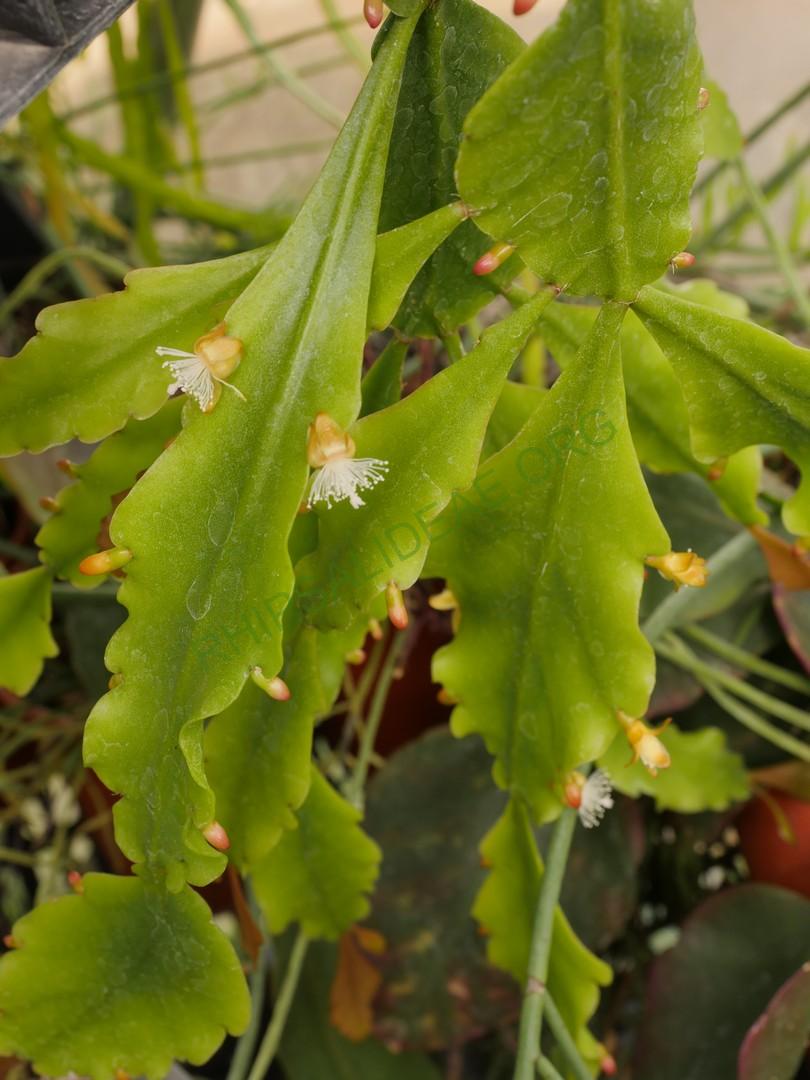

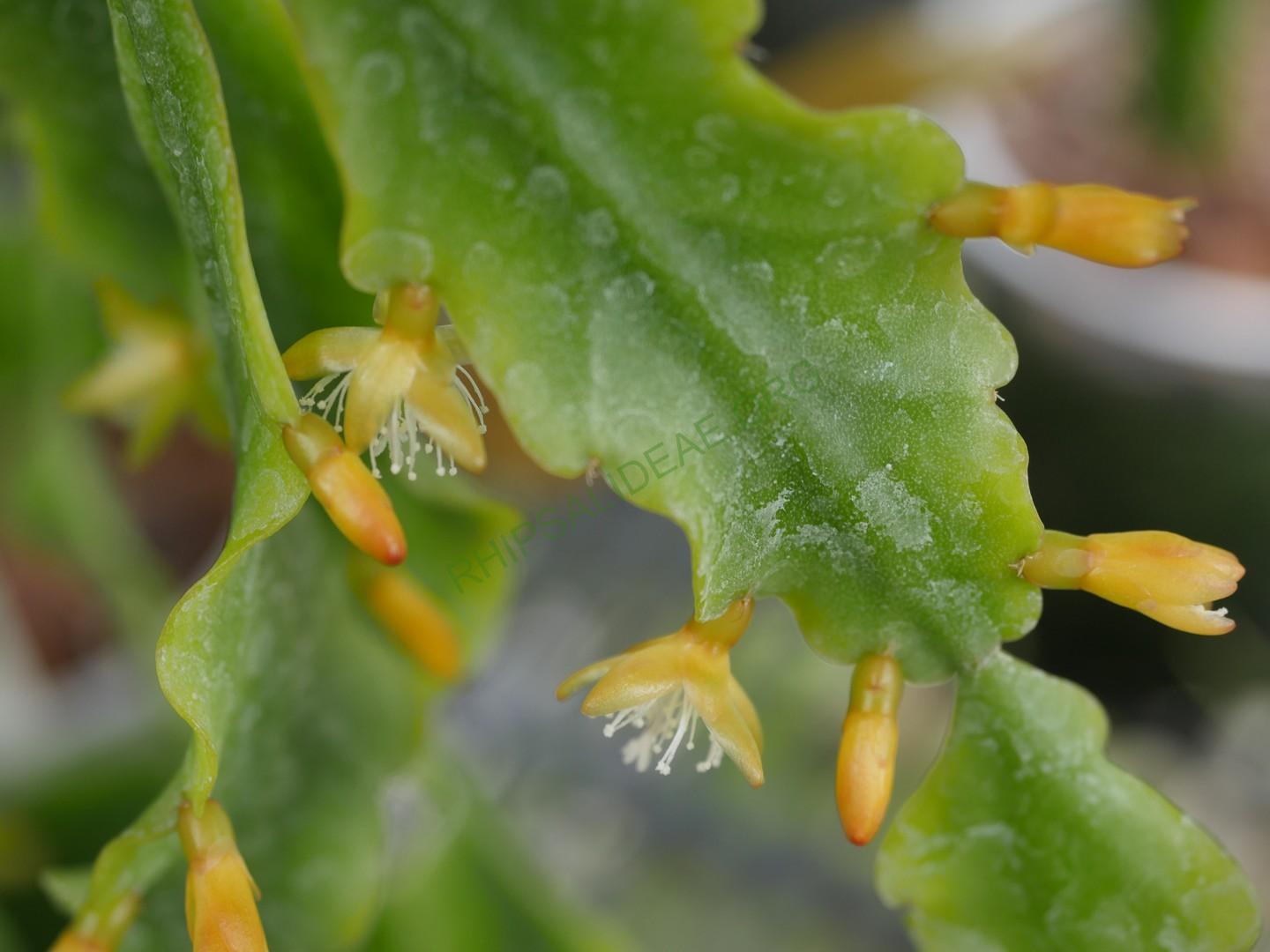
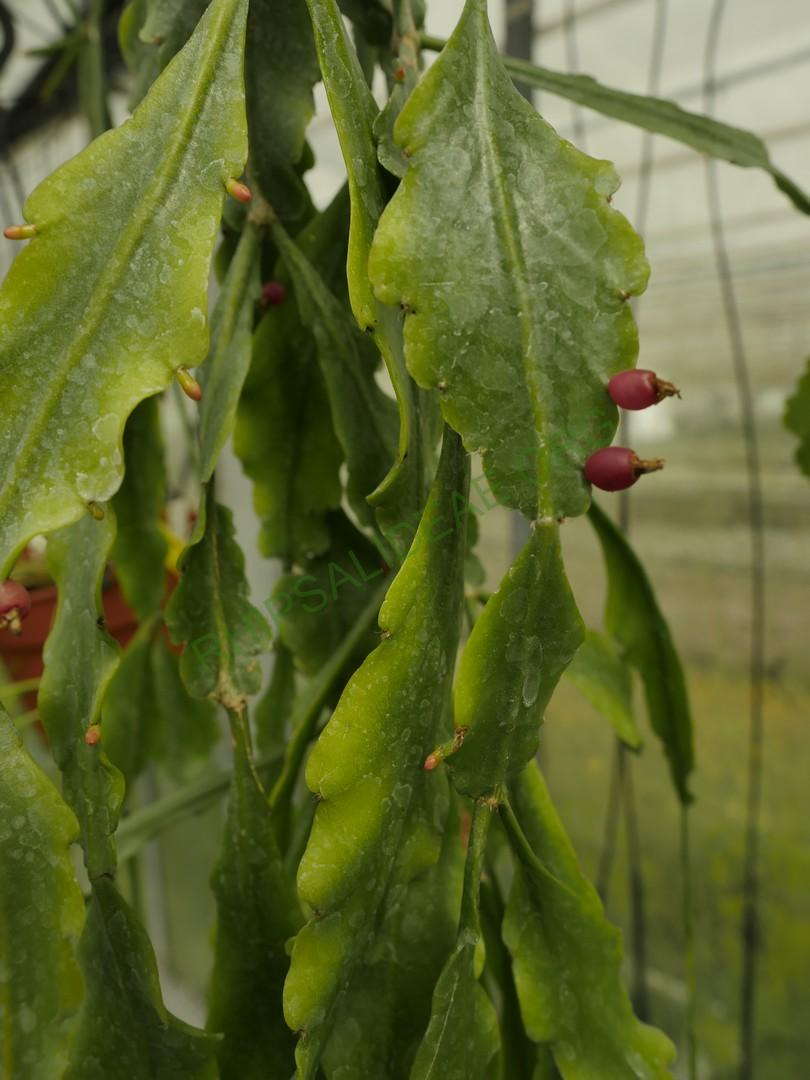
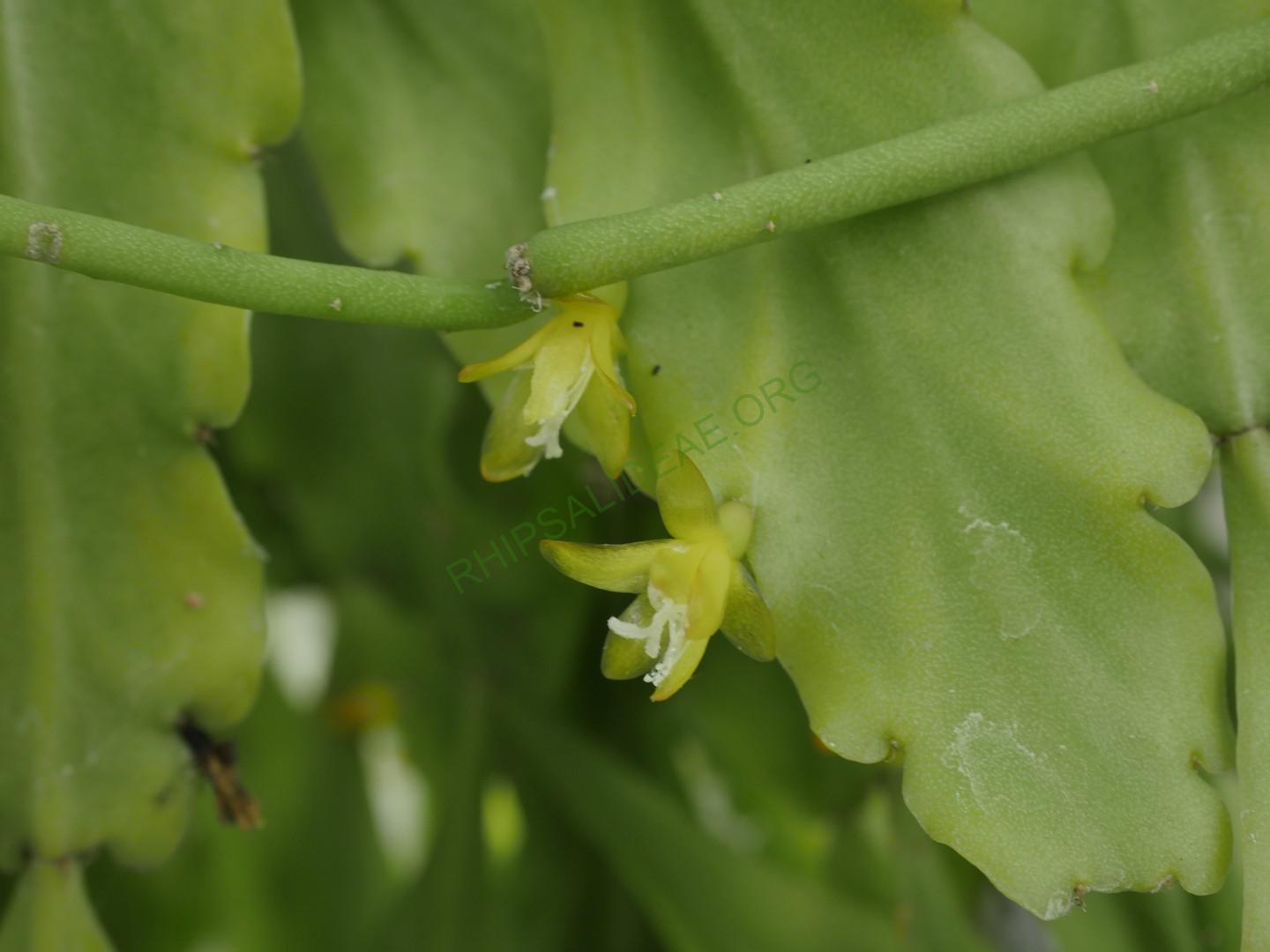
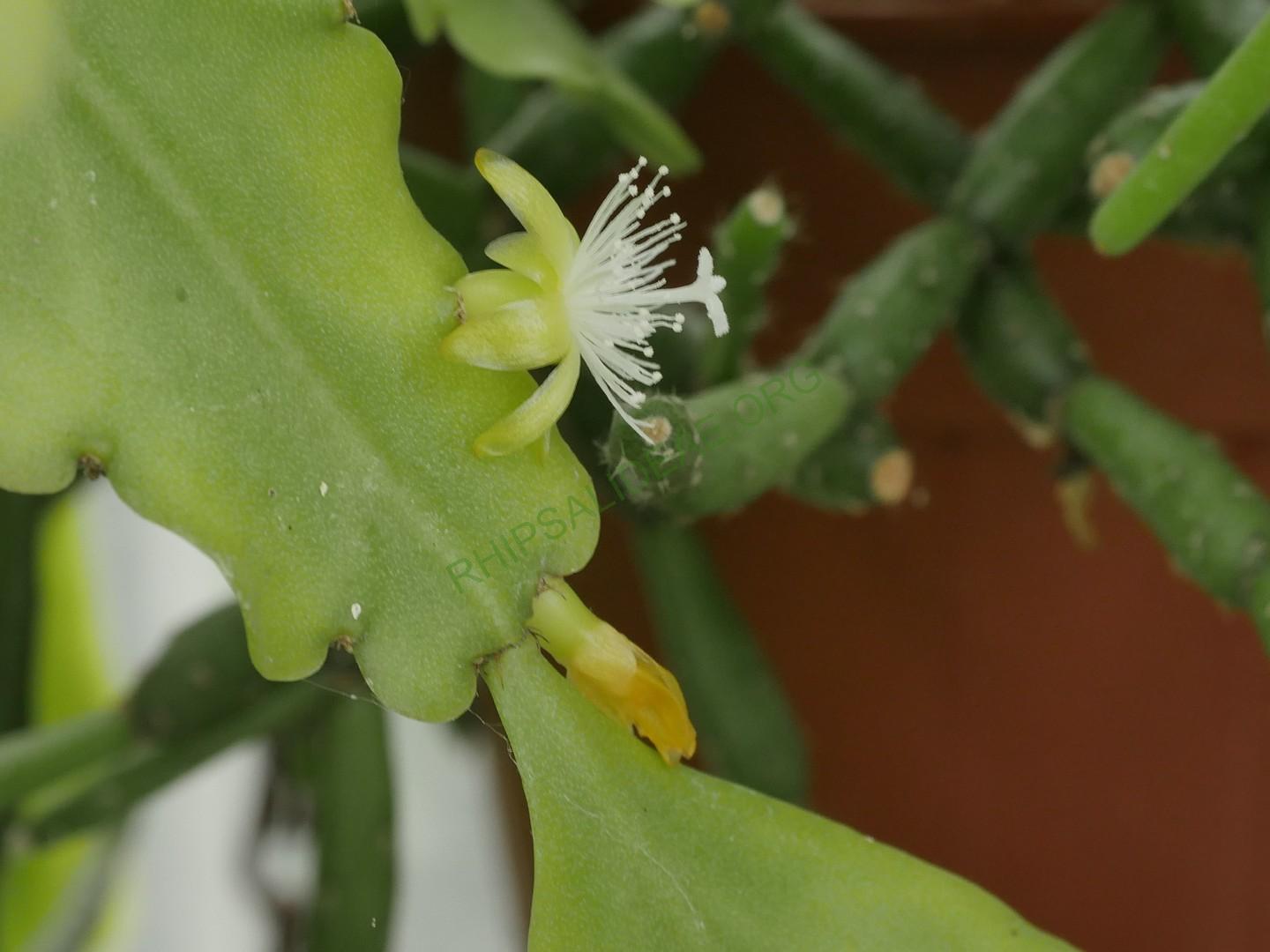
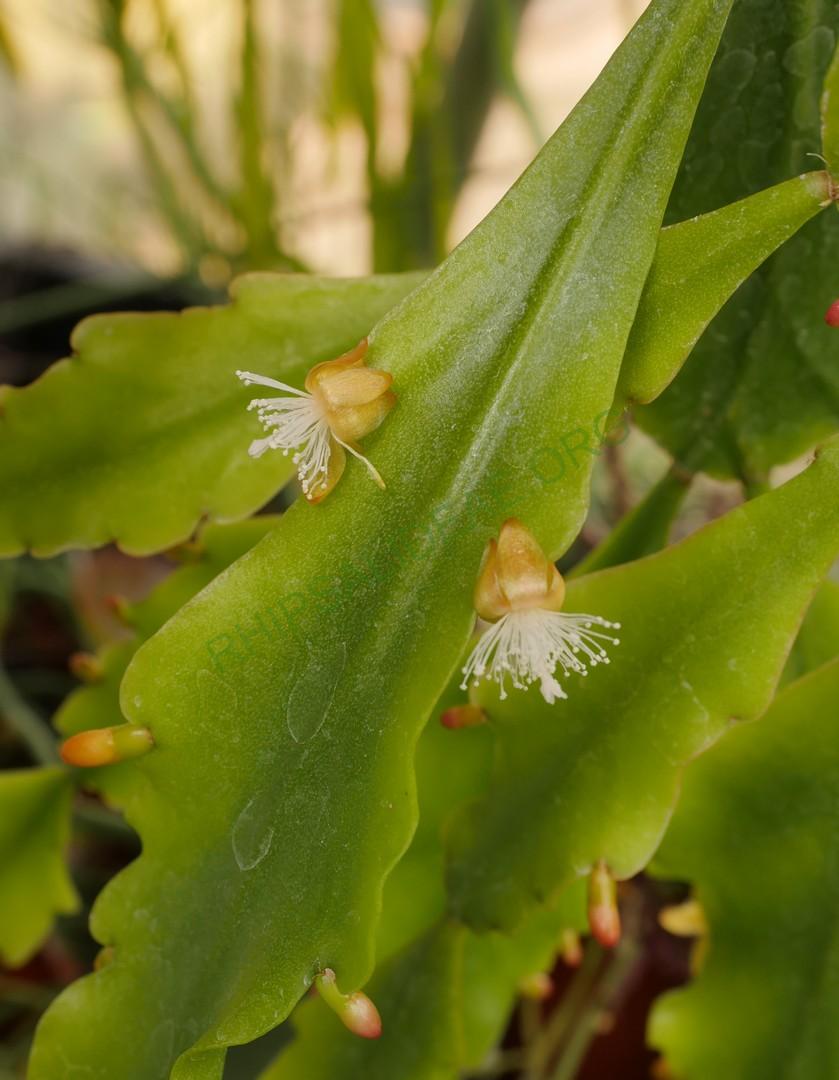
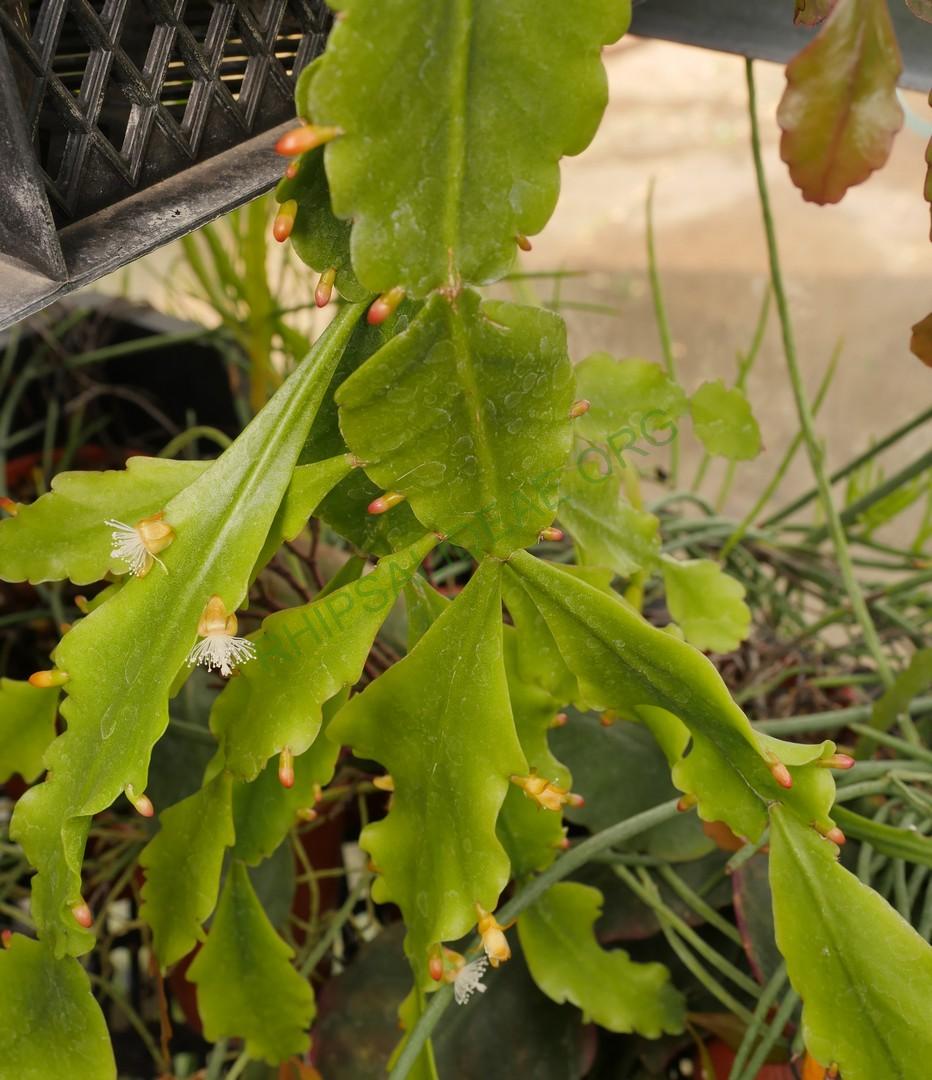
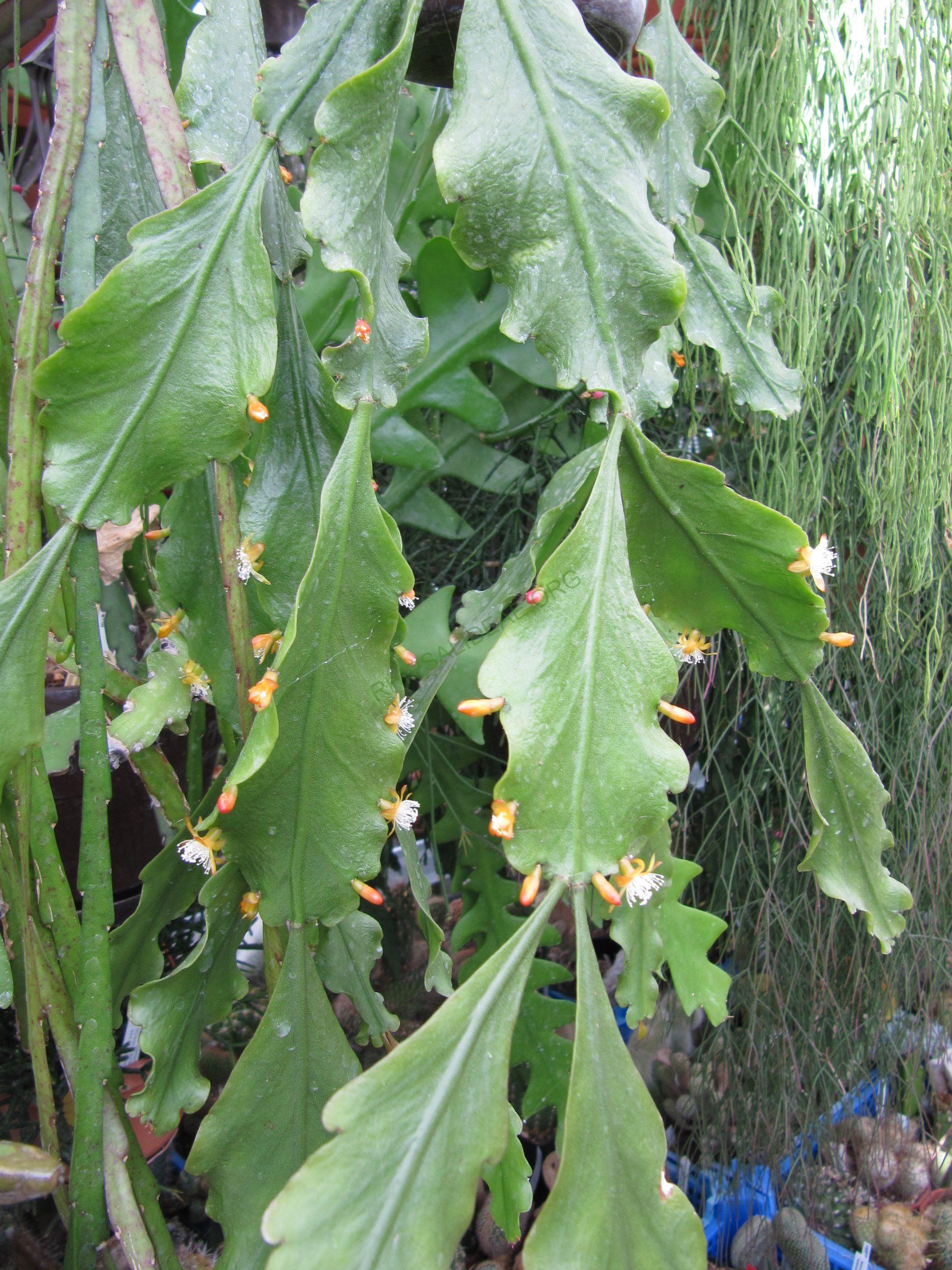
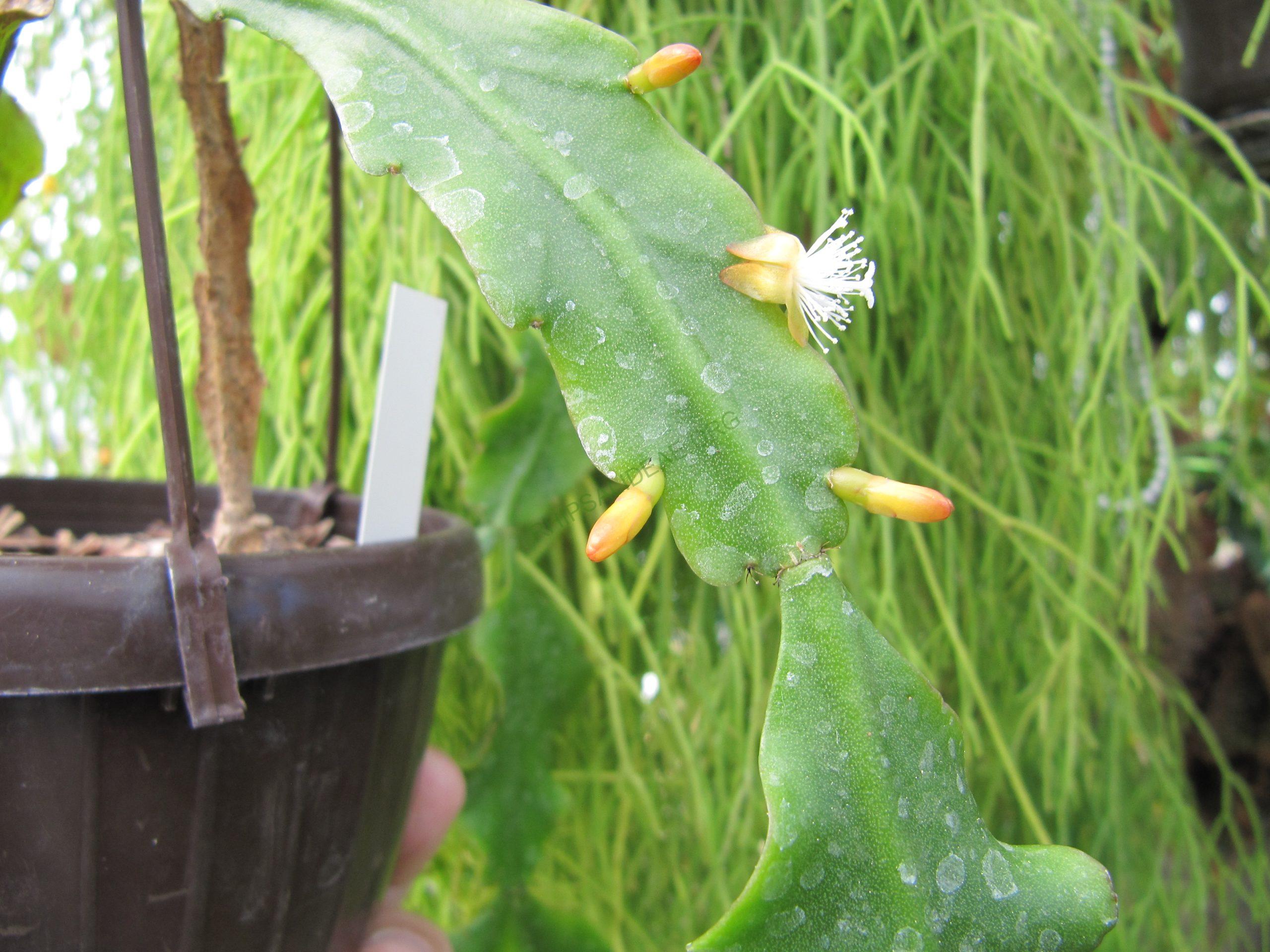
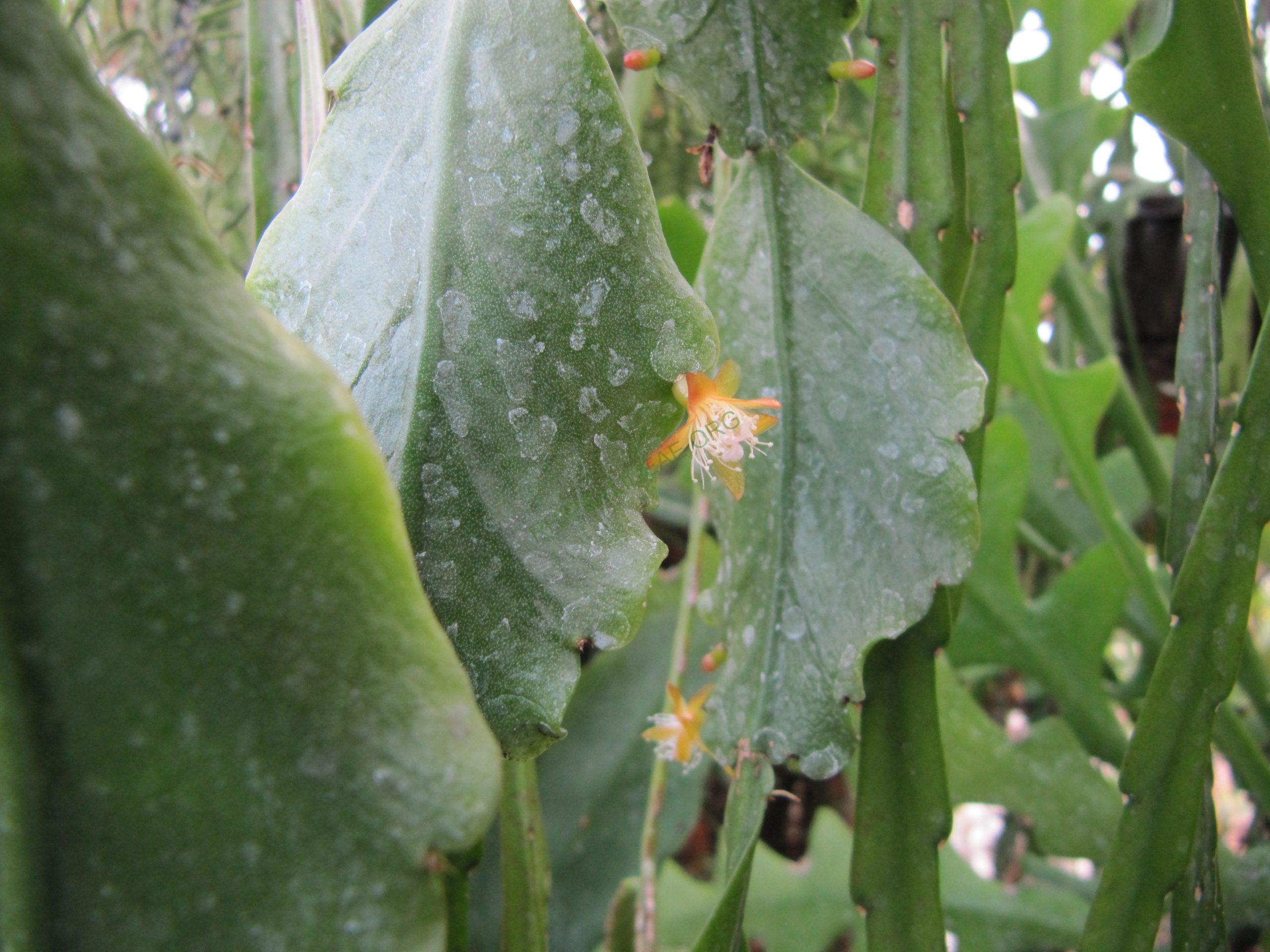
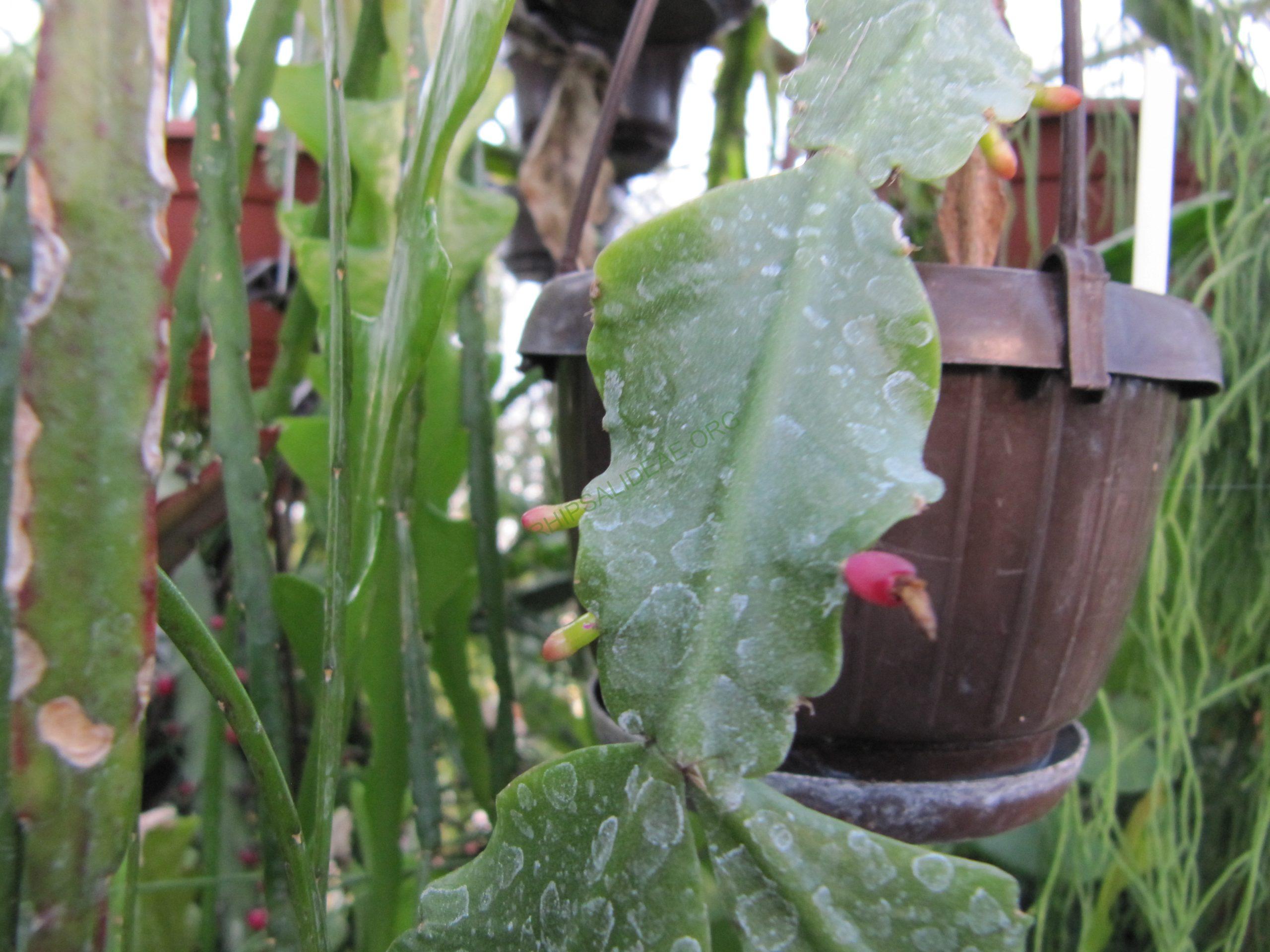
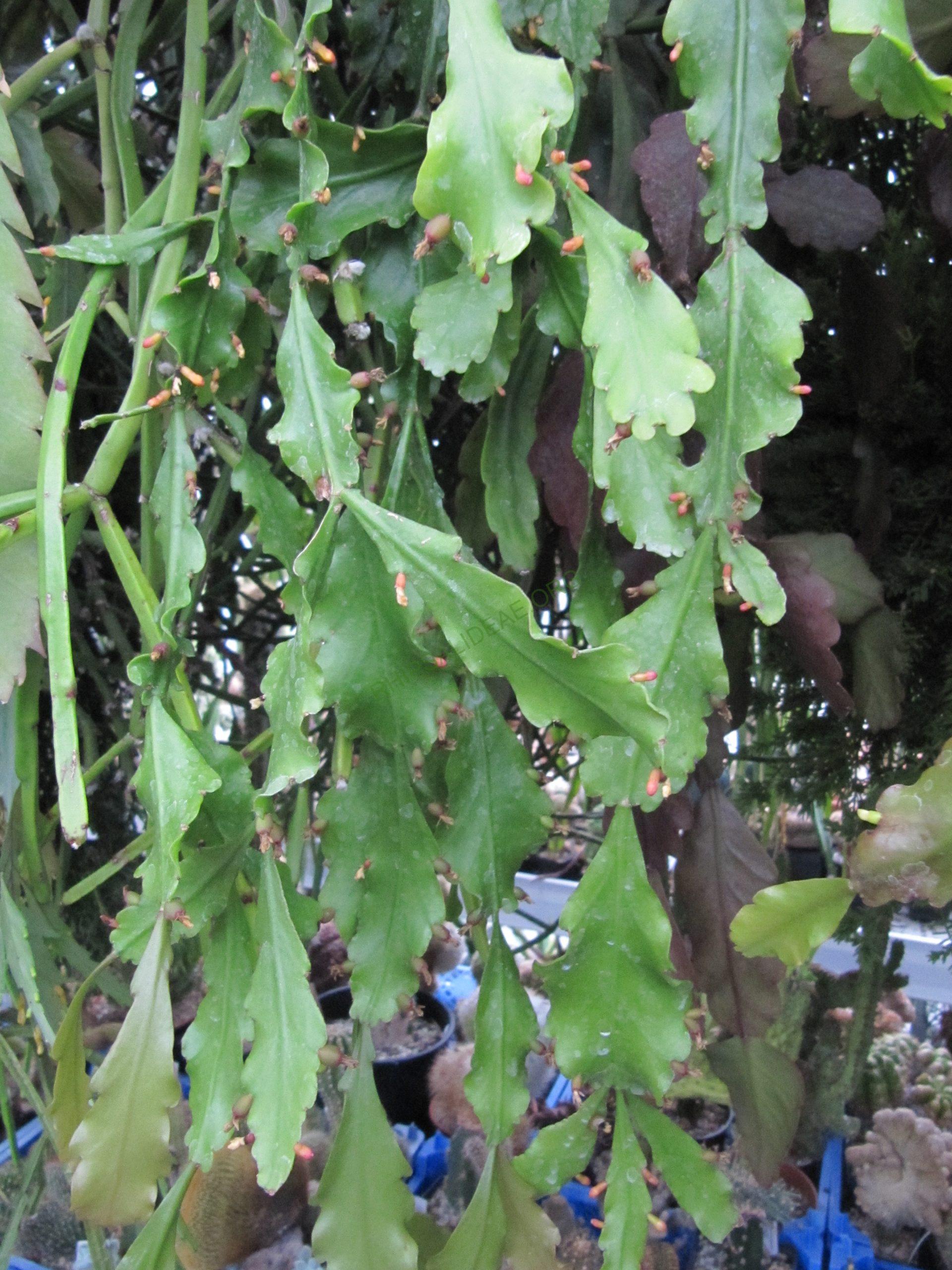
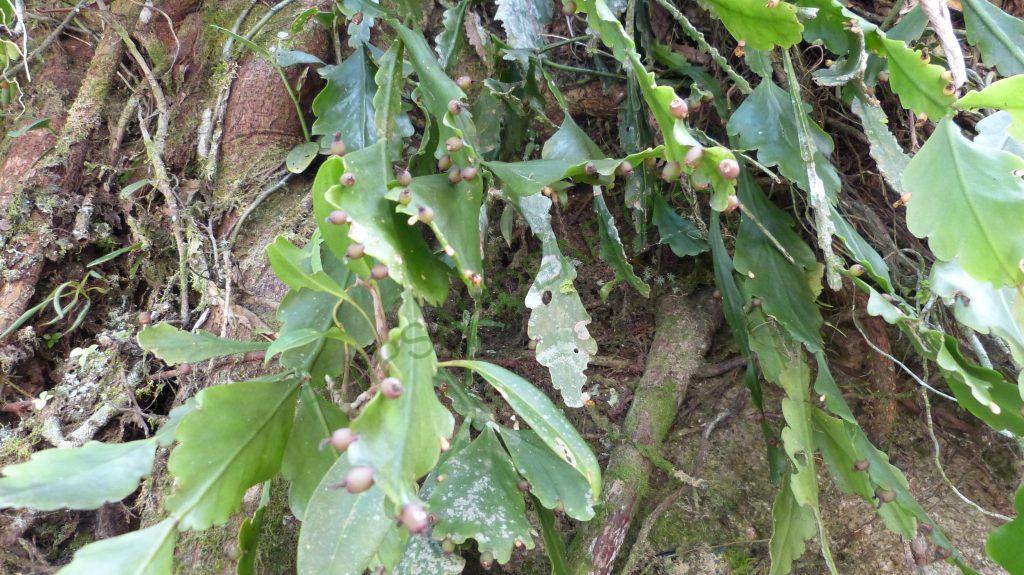
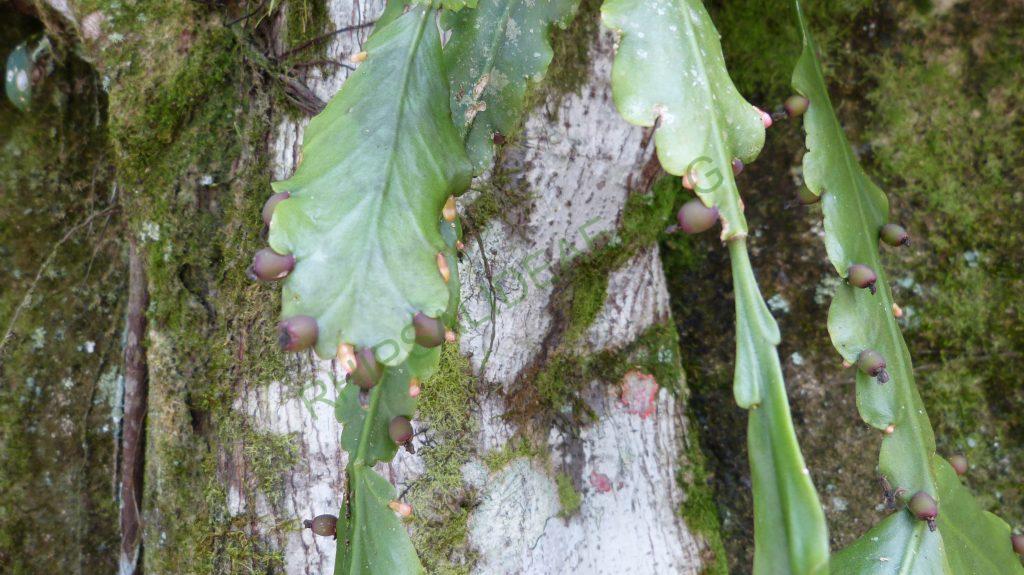
Possibly R. barthlottii, on the road towards Teresópolis, Serra dos Órgãos, Rio de Janeiro, Brazil

Description
| The accepted name Rhipsalis barthlottii Ralf Bauer & N. Korotkova was published in Kakteen And. Sukk. 67(11): 282. 2016. The geographic range is Brazil (Serra dos Orgãos) found at elevations of unreported meters with an endangered status of data deficient. Rhipsalis barthlottii is classified in the subgenus Phyllarthrorhipsalis. Observed growing as an epiphyte. Overall habit is pendant, branches are dimorphic (more than one stem shape) and acrotonic or mesotonic (stems form from the tips to middle of previous stems). Stems are 2 to 3 angled, margins have low to deep crenations, at times undulating or frilled (slightly to deeply scalloped), bristles are absent. Basal stems are indeterminate (seasonal growth is various lengths), 25cm x unreported. Main stems are determinate (seasonal growth is about the same length), 10cm-15cm x 2.5cm-4.5cm. Flowers are rotate: patent or reflexed (wheel shaped: wide open to reflexed), 1.1cm-1.2cm x 1cm-1.7cm. Petals from 5 to 9, sepals from 2 to 3. Inner petals are yellow, outer petals are yellow, pink, brown or red. Stamen are white, from 50 to 85. Stigma lobes from 2 to 4. Flower ovary is cylindrical, 0.25cm-0.35cm x 0.2cm-0.23cm. Flowering position on the stem is lateral and the flower orientation in relation to the stem is perpendicular. Does repeat flowering per areole. A maximum of 3 flowers were reported at a single areole. Areole position in the stems is superficial (flower ovary is visible on the surface of the stems during bud development). Trichomes or wool is absent at the areoles after flowering. Unripe fruit is green, brown or red. Ripe fruit is globose or ovoid; pink, magenta or red, 0.5cm-0.6cm x 0.5cm. Other notable features: Closely related to1 and commonly confused with R. oblonga, R. crispata, R. cuneata, and R. occidentalis. It is distinguishable by the dark pinkish to reddish fruit. The flower color is typically a deeper yellow to gold and the petal tips are often reddened, but environmental factors can affect it making them a lighter yellow. Under some conditions the flowers are indiscernible between R. barthlottii, R. oblonga, and R. crispata. The truest identifiable characteristic is therefore the pink to magenta ripe fruit color and shape. This species can present with undulating or frilly stem margins, but that is not a truly identifiable characteristic as R. occidentalis, R. crispata, R. oblonga, R. cuneata, R. goebeliana, and R. rhombea at least can also present the same characteristic. Comments: Authors Alice Calvente, Maria De Fátima Freitas, and Diego Rafael Gonzaga have synonymized R. barthottii with R. crispimarginata3. The original botanical description for R. crispimarginata given describes a specimen with transparent rose colored fruit4. In The Cactaceae, Britton and Rose (1923) the description given of R. crispimarginata indicates the fruit is white5. Alice Calvente writes, "Furthermore, the illustration for R. crispimarginata presented in Britton and Rose (1923) represents a stouter and apparently stiffer plant that actually resembles R. crispata." 2 Barthlott and Taylor reduced R. crispimarginata as a synonym of R. oblonga6. Writing, "As to type, R. crispimarginata Lofgren (1918) is a synonym of R. oblonga, as has been confirmed by field studies at the type locality they share, but in cultivation this name is commonly misapplied to R. crispata (Haworth) Pfeiffer." 6 The material sampled by Nadja Korotkova1 was cited as Rhipsalis oblonga Loefgr., BG Bonn 4469, Brazil, Rio de Janeiro, Serra dos Órgãos, W. Rauh a specimen collected in 1973. It was later published as the new species R. barthlottii7. Alice Calvente sampled, three R. oblonga: A, B, and C2. R. oblonga B was figured as being what the author attributes to R. crispimarginata and states it was found to be in a sister clade with R. cuneata. Nadja Korotkova's dissertation1 has the placement of the R. barthlottii, sampled as R. oblonga CA024, is in a sister clade with R. crispata. Alice Calvente also sampled R. oblonga C which resolved into a sister clade with R. crispata. It's not clear what materials are R. oblonga A, B, and C. More research is probably needed to determine if the material sampled as R. barthlottii, R. oblonga (B), R. oblonga (C), and if possible any living material from original collections of R. crispimarginata can be sampled and compared. 1Phylogeny and evolution of the epiphytic Rhipsalideae (Cactaceae), Nadja Korotkova, Ph.D. Thesis, 2012 2Molecular phylogeny, evolution and systematics of Rhipsalis (Cactaceae), Alice Calvente, Ph.D. Thesis, 2010 3Flora do Rio de Janeiro: Cactaceae., Rodriguésia 71, 2020. 4Archivos do Jardim Botânico do Rio de Janeiro, Jardim Botânico do Rio de Janeiro, Vol. 2, 1918 5The Cactaceae: descriptions and illustrations of plants of the cactus family, Nathaniel Lord Britton, Mary E. Eaton, J. N. Rose, and Helen Adelaide, Vol. 4, 1923 6Notes towards a Monograph of Rhipsalideae (Cactaceae), W. Barthlott, N. P. Taylor, Bradleya 13, 1995 7Eine neue Rhipsalis aus Brasilien – Rhipsalis barthlottii, Ralf Bauer, Nadja Korotkova, Kakteen und andere Sukkulenten, 67:11, 2016 Taxonomic treatment and description were derived from:
|
Rhipsalis barthlottii referenced publications
| Title | Authors | Type | Journal | Year | Volume | Issue | Pages | Publisher |
|---|---|---|---|---|---|---|---|---|
| Rhipsalis barthlottii - JACQ consortium (2004 ff.) Virtual Herbaria Website at https://www.jacq.org/ consulted on 2025-01-07 | Virtual Herbarium Website | 2025 | ||||||
| Epifytische cactussen, rhipsalis.eu. Accessed on: 15 Jan. 2025 | Aat van Uijen | Website | 2025 | |||||
| Royal Botanic Gardens Kew | Plants of the World Online. Accessed on: 15 Jan. 2025 | Website | 2025 | ||||||
| The Caryophyllales Network 2015+ [continuously updated]: A global synthesis of species diversity in the angiosperm order Caryophyllales. Accessed on: 15 Jan. 2025 | Website | 2025 | ||||||
| WFO The World Flora Online. Accessed on: 15 Jan. 2025 | Website | 2025 | ||||||
| Cactaceae at Caryophyllales.org – a dynamic online species-level taxonomic backbone for the family | Nadja Korotkova, David Aquino, Salvador Arias, Urs Eggli, Alan Franck, Carlos Gómez-Hinostrosa, Pablo C. Guerrero, Héctor M. Hernández, Andreas Kohlbecker, Matias Köhler, Katja Luther, Lucas C. Majure, Andreas Müller, Detlev Metzing, Reto Nyffeler, Daniel Sánchez, Boris Schlumpberger, Walter G. Berendsohn | Journal Article | Willdenowia | 2021 | 51 | 2 | 251 – 270 | Botanic Garden and Botanical Museum Berlin (BGBM) |
| Cactaceae in Flora do Brasil 2020. Jardim Botânico do Rio de Janeiro. Accessed on: 15 Jan. 2025 | Daniela C. Zappi, Nigel P. Taylor | Website | 2020 | |||||
| Flora do Rio de Janeiro: Cactaceae | Maria de Fátima Freitas, Alice Calvente, Diego Rafael Gonzaga | Journal Article | Rodriguésia | 2020 | 71 | |||
| Neotypification of Rhipsalis rhombea (Rhipsalideae, Cactaceae) and Its Taxonomic History | Ralf Bauer, Nadja Korotkova | Journal Article | Haseltonia | 2020 | 27 | 95-101 | Cactus and Succulent Society of America | |
| A Journey Over the Organ Mountains in Brazil | Andreas Hofacker | Journal Article | The Cactus Explorer | 2018 | 23 | 48-62 | ||
| Rhipsalis, cactussen uit het tropische woud 1 | Aat van Uijen | Journal Article | Succulenta | 2017 | 96 | 6 | 270-275 | |
| Eine neue Rhipsalis aus Brasilien – Rhipsalis barthlottii | Ralf Bauer, Nadja Korotkova | Journal Article | Kakteen und andere Sukkulenten | 2016 | 67 | 11 | 281-287 |
Reduced Synonyms
| Name | Reduced by | Published Date | Published In |
|---|